
Jobless Growth and the Islamic Economic Solution
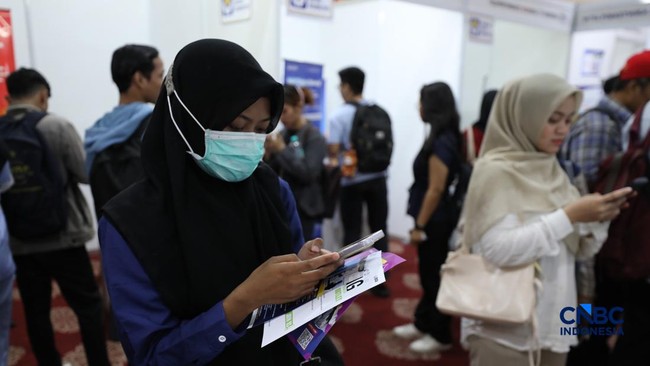
Amidst various optimistic reports about the national economy, Indonesia is actually facing a paradox that cannot be ignored. Economic growth remains around 5 per cent, inflation is relatively under control, investment continues to flow, and various national strategic projects are proceeding. On paper, these macroeconomic indicators give the impression that the economy is on a positive track. However, a deeper look into the condition of society reveals a different picture. Economic growth has not been fully capable of creating quality jobs. Employment opportunities have indeed increased, but most are in the informal sector with low productivity and income levels. This phenomenon is known as jobless growth, where economic growth is not followed by adequate job creation. Data from the Central Statistics Agency (BPS) shows that in February 2026, Indonesia’s labour force reached 154.91 million people. Of that number, around 147.67 million people were employed, while 7.24 million were still unemployed, resulting in an Open Unemployment Rate of 4.68 per cent. At the same time, the average wage for Indonesian workers only reached around Rp3.29 million per month. This figure indicates that the problems in Indonesia’s labour market are no longer just about quantity, but also about the quality of jobs and the level of welfare they produce. This phenomenon is reinforced by the large proportion of informal workers. BPS noted that more than half of Indonesia’s workforce is still employed in the informal sector, which generally has low productivity, uncertain income, limited social protection, and is vulnerable to economic shocks. It is therefore unsurprising that the phenomenon of the working poor has emerged, where people work every day but their income is insufficient to lift them to a more prosperous life. This paradox shows that economic growth has not been fully qualitative. Growth should not only increase the Gross Domestic Product (GDP), but also expand job opportunities, increase labour productivity, and improve income distribution. When the benefits of growth are concentrated only in certain groups or sectors, growth loses its social meaning. The root of the jobless growth problem in Indonesia cannot be separated from changes in the national economic structure. In recent years, investment has flowed more into capital-intensive sectors such as mining, mineral downstreaming, the smelter industry, data centres, and various high-tech sectors. These sectors are indeed capable of increasing economic added value and exports, but their labour absorption capacity is relatively limited because they are highly dependent on technology and automation. On the other hand, the manufacturing sector, which for decades was the engine of job creation, is actually experiencing a slowdown. The contribution of the manufacturing industry to GDP has continued to decline compared to two decades ago. Yet the experience of East Asian countries shows that industrialisation is the main foundation for creating quality jobs, increasing productivity, and lifting a country out of the middle-income trap. Another problem is the skills mismatch. The education system has not been fully able to produce graduates who meet the needs of industry. Many companies struggle to find workers with the required skills, while millions of new graduates find it difficult to enter the job market. This condition is further exacerbated by the development of artificial intelligence and automation, which are beginning to replace various routine jobs in the industrial and service sectors. As a result, economic growth no longer has a high elasticity for job creation. Every one per cent increase in economic growth now generates far fewer additional jobs compared to two or three decades ago. From a conventional economic perspective, this condition is generally responded to through increased investment, labour market deregulation, or the provision of various fiscal incentives. These steps are indeed important, but they often do not address the root of the problem, which is how to ensure that economic growth truly produces benefit for the wider community. This is where Islamic economics offers a different perspective. In Islamic economics, growth is not the ultimate goal of development, but rather a means to realise maqashid sharia, which are the preservation of religion, life, intellect, lineage, and property. Therefore, the success of development is not only measured by high GDP growth figures, but also by the opening of job opportunities, the reduction of poverty, the narrowing of inequality, and the improvement of public welfare. Islam views work as an activity that has both economic and spiritual dimensions. The Prophet Muhammad emphasised that there is no better food than that which comes from the work of one’s own hands. Thus, providing job opportunities is part of the effort to preserve human dignity. The first solution offered by Islamic economics is to strengthen the real sector, especially micro, small, and medium enterprises (MSMEs). Currently, more than 99 per cent of business units in Indonesia are MSMEs, and this sector absorbs around 97 per cent of the national workforce. Therefore, economic policies should be more directed at expanding access to financing, increasing production capacity, strengthening digitalisation, and broadening market access for MSMEs. The growth of MSMEs will have a far greater job creation effect compared to capital-intensive large industries.