
Job Hunting Now Difficult to the Point of Frustration, It Turns Out There's This Phenomenon
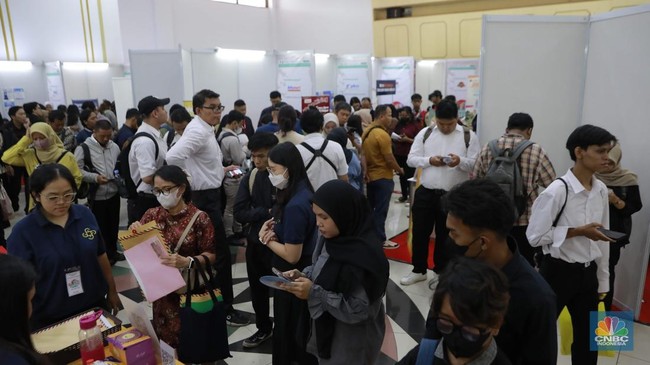
Jakarta, CNBC Indonesia - The business world is facing ongoing pressures in early 2026. Amid production activities that still show expansion, workforce absorption has yet to recover. Business actors are opting to hold back on recruitment and rely on efficiency amid economic uncertainty.
This pressure is reflected in the results of Bank Indonesia’s Business Activity Survey (SKDU). In the first quarter of 2026, the Weighted Net Balance (SBT) for business activities was recorded at 10.11%, down from 10.61% in the fourth quarter of 2025.
On the other hand, manufacturing industry performance remains in the expansion zone. Bank Indonesia’s Manufacturing Purchasing Managers’ Index (PMI) shows an index of 52.03% in the first quarter of 2026, up from 51.86% in the previous quarter. However, this production increase is not accompanied by workforce absorption.
The employment component index in the PMI remains in the contraction zone, at 48.76% in the first quarter of 2026. This contraction trend has been ongoing since the second quarter of 2025.
A similar phenomenon is observed in the SKDU. Processing industry business activities are indicated to have increased with an SBT of 1.46%, higher than 1.18% in the previous quarter. However, from the employment perspective, workforce usage in this sector has worsened with an SBT of -0.47%, lower than -0.34%.
General Chairman of the Indonesian Employers’ Association (Apindo), Shinta Widjaja Kamdani, explained that the current production expansion is more seasonal in nature, thus not immediately followed by the creation of new job opportunities.
“First, it needs to be understood that the SKDU release for the first quarter of 2026 presented by BI is post-factum business performance, which is seasonal because the business performance is influenced by various consumption momenta, from year-end consumption carryover, Chinese New Year momentum, to Ramadan and Eid momentum,” Shinta explained to CNBC Indonesia on Tuesday (21/4/2026).
“Therefore, the SKDU and manufacturing PMI performance are recorded as very expansive, as manufacturing companies generally carry out seasonal production expansion to anticipate the influx of seasonal demand in the market,” she continued.
Shinta assessed that the temporary increase in production needs makes business actors reluctant to add permanent workforce.
“Why doesn’t this expansion boost workforce absorption? Because of the seasonal factors I mentioned earlier. Generally, business actors do not create jobs just because of seasonal production needs that will correct themselves once the momentum ends,” she clarified.
She stated that market conditions over the past year have also not been conducive enough, both domestically and globally. This makes companies more cautious in determining workforce needs.
“It should be noted that market performance over the past year, as reflected in the PMI since the imposition of reciprocal US tariffs, has created considerable pressure on overall market performance, both domestic and foreign markets. So, workforce needs projections in companies are based on those ‘normal’ market conditions, not seasonal ones,” Shinta explained.
She emphasised that economic uncertainty and increasing business burdens make companies tend to hold back on permanent workforce expansion. Additionally, high formal sector labour costs are a consideration.
“Moreover, considering that in Indonesia, the formal sector labour burden is quite high, and the burden when that workforce is no longer needed, such as PHK and severance burdens, is also substantial for business actors. So, with the existing conditions, it is quite reasonable that job creation feels very slow, even tending towards contraction,” she said.
In this situation, companies prefer to optimise existing resources rather than add new workforce.
“Now, business actors tend to focus on business cost efficiency and intensification of business resource usage, including existing workforce, rather than carrying out expansion or large-scale workforce acquisition that economically may not yet be sustainable for the company,” she continued.
In agreement, Vice General Chairman of the Indonesian Chamber of Commerce and Industry (Kadin) Coordinator for Organisational Affairs, Erwin Aksa, said that business pressures have been felt over the last few quarters.
“The business world sees that the first quarter of 2026 is indeed under quite real pressure, reflected in the slowdown of activities for three consecutive quarters. The main pressures most felt at this time come from a combination of external and domestic factors,” Erwin said when contacted separately.
From the external side, global uncertainty and weakening export demand pose challenges. Meanwhile, domestically, business actors face rising production costs and purchasing power pressures.
“From the external side, geopolitical uncertainty and weakening global demand make exports not as strong as before. Meanwhile, domestically, business actors face rising production costs, from energy, logistics, to raw materials, as well as exchange rate fluctuations that increase import costs. At the same time, people’s purchasing power is also starting to be pressured, so domestic demand is not yet strong enough to drive aggressive expansion,” he explained.
According to Erwin, the condition of increasing production but not accompanied by workforce absorption reflects a change in industrial expansion patterns.
“Regarding the condition where production is increasing but workforce absorption is still contracting, this reflects a change in industrial expansion patterns. The business world today tends to increase output through efficiency and capacity optimisation, not workforce expansion,” he said.
He also highlighted business actors’ caution factors and changes in workforce needs.
“In addition, demand uncertainty makes business actors
Source: jawawa.id (https://jawawa.id/newsitem/job-hunting-now-difficult-to-the-point-of-frustration-it-turns-out-theres-this-phenomenon-1776747057)
Originally published by CNBC Indonesia (https://www.cnbcindonesia.com/news/20260421102921-4-728411/cari-kerja-sekarang-susah-sampai-frustrasi-ternyata-ada-fenomena-ini), translated from Indonesian