
JK: Two-State Solution is the Middle Ground for Palestine-Israel Conflict
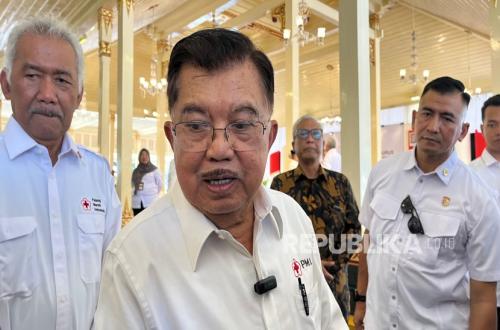
Former Vice President of Indonesia, Jusuf Kalla (JK), stated that the two-state solution is the most acceptable option for various parties to end the Palestine-Israel conflict. According to him, this solution can provide recognition and dignity for both Palestine and Israel.
“The most acceptable solution for many parties is the two-state solution. Therefore, it provides dignity for all,” JK said during a special session of the Global Town Hall 2026 titled “From Aspiration to Reality: Prospects and Challenges for Palestinian Independence and Statehood”, on Saturday (19/9/2026).
JK noted that implementing a two-state solution means that both Palestine and Israel would receive recognition as sovereign states. Consequently, the territorial boundaries of both nations could be established and recognised as part of a peace agreement.
“This means that Palestine is recognised and Israel is also recognised to reach the boundaries that currently exist,” he said.
He assessed that such an agreement could serve as an exit strategy from the long-standing conflict. According to JK, the greatest challenge lies in how both parties are willing to accept a resolution framework that recognises the existence of each state.
In the forum, JK also highlighted the efforts of the Board of Peace (BoP) in promoting Palestine-Israel peace. He mentioned that the BoP, chaired by US President Donald Trump, has been attempting to find a middle ground to resolve the conflict.
JK mentioned that Jared Kushner, Trump’s son-in-law, has also been dispatched to participate in peace efforts. However, he noted that these efforts still face rejection and differing stances from the warring parties.
“The BoP has a concept that certainly seeks a middle ground, but it is not fully accepted by Israel, nor is it fully accepted by the Palestinian side,” said JK.
JK stated that one idea that continues to emerge in these efforts is the two-state solution. However, he noted that this idea still faces objections from Israel.
He assessed that the situation on the ground is also a factor making the peace process difficult. Israel, according to JK, is in a stronger military position after controlling much of Gaza and maintaining military control in the West Bank.
“Because they are generally in a military position that controls Gaza, and also the West Bank, so they are on the stronger side militarily,” he explained.
Therefore, JK predicts that the Palestine-Israel issue will continue for a long time. He mentioned two factors that will determine future developments: the actions of President Trump and the developments in Israeli domestic politics.
JK also touched upon the Israeli general election scheduled for 27 October 2026. He expressed hope that a change in leadership in Israel, if it occurs, could open space for a softer approach to resolving the Palestinian issue.
“Hopefully, a successor to Netanyahu, if he loses, can be softer in resolving this Palestinian problem,” said JK.
In addition to Israeli political issues, JK also addressed Palestinian hardline groups. He argued that within a two-state solution framework, groups such as Hamas need to reduce offensive activities and shift their struggle towards a context of self-defence.
“Indeed, for hardliners like Hamas, it is about how they, let’s say, reduce activities or focus only on self-defence, rather than attacking as was done in October 2023,” he said.
The Global Town Hall 2026 was organised by the Foreign Policy Community of Indonesia (FPCI) on Saturday (19/9/2026). The virtual forum adopted the theme “Calling for a Global U-Turn: Recentering Development, Reclaiming Humanity, Restoring Justice in a Crazier World.”
The special session on Palestine featured Palestinian Minister of Foreign Affairs and Expats Varsen Aghabekian Shahin, Jusuf Kalla, High Representative for Gaza–Board of Peace Nickolay Mladenov, President of the U.S./Middle East Project Daniel Levy, and President of Al Sharq Forum Wadah Khanfar.
Other prominent figures attending the session included Yenny Wahid, Michael Vatikiotis, Tarek Adel, Jismi Johari, Muhammed Hüseyin Mercan, and Qamar Cheema.
Meanwhile, the Israeli national election is scheduled for 27 October 2026. This election is the first since the Hamas attacks on 7 October 2023 and the subsequent war in Gaza and the surrounding region.