
JK at Yale: Advanced Weapons Do Not Guarantee Victory
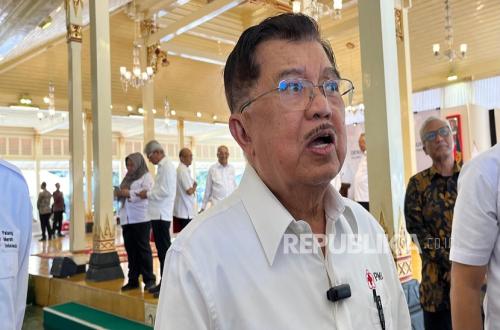
JAKARTA — Jusuf Kalla (JK), Indonesia’s 10th and 12th vice-president, has warned that sophisticated military weapons do not always guarantee victory in war. Amid the Russia-Ukraine conflict, tensions between Iran, the United States and Israel, and threats from the Houthi group in the Middle East, JK said mastery of technology, strategy and human capabilities were increasingly shaping modern conflicts.
He made the remarks during a public lecture at Yale University in New Haven, Connecticut, this week. Speaking to about 100 students and lecturers, he discussed how armed conflicts are changing and the importance of making humanitarian values the basis for resolving global crises.
JK said the development of modern warfare showed that military technological superiority could not be separated from people’s ability to devise strategies, understand situations and operate technology effectively.
“Developments in current conflicts show that superior weaponry alone is not enough. Morale, strategy, and the ability to master and operate technology are also decisive. That is why knowledge and human capabilities are important factors in meeting challenges,” JK said, according to a press statement received in Jakarta on Sunday (25 October 2026).
Russia-Ukraine conflict and Iran in focus
JK cited the Russia-Ukraine war as an example of how armed conflict can drag on despite the involvement of forces with differing military capabilities and weaponry.
He also referred to Iran’s ability to withstand pressure from the United States and Israel, as well as threats posed by the Houthi armed group to countries in the Gulf region.
These examples, JK said, showed that conventional military power was not the only factor determining how conflicts unfold. Strategy, resilience, adaptability and technological mastery also influence the course of warfare.
His view reflects changes in the nature of modern conflict, which increasingly involves drones, digital communications systems, surveillance equipment and precision weapons. The effectiveness of these technologies, however, still depends on people’s ability to operate them and integrate them into military strategy.
In such circumstances, war is not simply a matter of comparing troop numbers or the sophistication of combat equipment. Conflicts also concern a country’s resilience, its ability to maintain support, and the humanitarian consequences they cause.
Humanity must transcend national borders
Alongside his discussion of changing military power, JK stressed that humanitarian values should be the central paradigm for addressing global crises.
He said armed conflicts and natural disasters can cause suffering that transcends national borders, identities and social backgrounds.
“Humanity must be our central paradigm in responding to global crises. Humanity transcends national borders, race, ethnicity, religion and any affiliation. As long as our starting point is a sense of humanity, we can face and overcome global crises together,” JK said.
He said a sense of humanity was an important asset for the international community as it seeks shared solutions amid interconnected problems.
JK explained that the world is now facing crises that do not occur in isolation. Armed conflicts in several regions are unfolding alongside the threat of natural disasters and humanitarian challenges whose effects can spread to other countries.
This situation calls for international co-operation based not solely on each country’s political and security interests. Responses to crises must also address the safety of civilians, the needs of affected communities and efforts to prevent human suffering from spreading.