
JIAT Helps Banjar Farmers Secure Water Supply Amid El Niño Threat
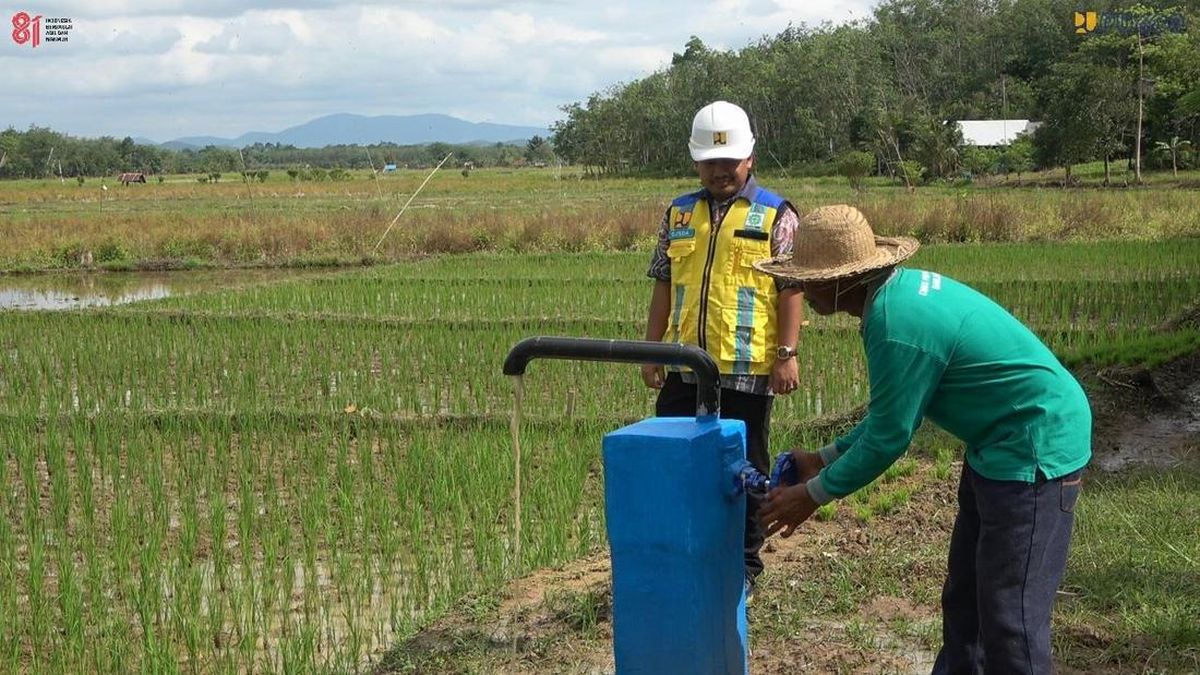
The Ministry of Public Works (PU) has built a Groundwater Irrigation Network (JIAT) in Banjar Regency, South Kalimantan, to support national food self-sufficiency. This infrastructure utilises groundwater so that farmers still have a water source when rainfall decreases due to El Nino.
Minister of Public Works Dody Hanggodo said the construction of JIAT is a strategic step to guarantee water availability, especially during prolonged dry seasons. This more reliable irrigation system is expected to significantly boost agricultural productivity.
“Through this JIAT, we want to ensure water availability so that agricultural productivity increases and food security becomes stronger,” he said in a written statement on Wednesday (12/8).
He also requested that JIAT development not stop at the construction of wells and groundwater pumps. Tertiary channel networks need to be completed so that water can flow more effectively to agricultural land.
For information, JIAT is an irrigation system that utilises groundwater through boreholes or pumps to irrigate agricultural land. This system is mainly used in areas not yet reached by surface irrigation networks.
One JIAT construction is located in Bawahan Seberang Village, Mataraman District, Banjar Regency. The 1-kilometre network is capable of irrigating 10.71 hectares of agricultural land.
The infrastructure was built by the Kalimantan III Banjarmasin River Basin Agency (BWS). The well, with a depth of 100 metres, is capable of producing a water discharge of around 3 litres per second.
BWS Kalimantan III Banjarmasin also built a JIAT in Bawahan Selan Village with a length of 760 metres. This network irrigates 13.30 hectares of agricultural land with a well 126 metres deep that produces a water discharge of around 3 litres per second.
The construction was enthusiastically welcomed by the head of the local Farmers Group Association (Gapoktan), Waluyo. He expressed gratitude for the borehole assistance built in his village.
“Thank you to BWS Kalimantan III Banjarmasin for helping with the construction of the borehole in our village. Hopefully, with this assistance from the Ministry of Public Works, the living standards of farmers in Bawahan Selan Village can improve, from planting rice once a year to twice, and hopefully even three times,” he said.
In its operation, the JIAT system uses electricity as its main power source. A generator set is prepared as a backup power source so that services continue to run when the main electricity supply is disrupted.
The water produced by JIAT is mainly used as raw irrigation water to support food self-sufficiency. This infrastructure also provides additional benefits for the community in the form of raw water supply for daily needs.
With JIAT, farmers no longer rely solely on daily rainfall. The farming process can also run more optimally and regularly throughout the year.
This step is in line with the PU608 Vision, which prioritises infrastructure development oriented towards tangible benefits for the community. JIAT construction is expected to help boost agricultural productivity while creating economic growth in the region.
Source: jawawa.id (https://jawawa.id/newsitem/jiat-helps-banjar-farmers-secure-water-supply-amid-el-nino-threat-1786521257)
Originally published by CNN Indonesia (https://www.cnnindonesia.com/nasional/20260812130410-25-1391419/jiat-bantu-petani-banjar-amankan-pasokan-air-di-tengah-ancaman-el-nino), translated from Indonesian