
JHT Tax: Tax Office Chief Awaits Purbaya's Directive
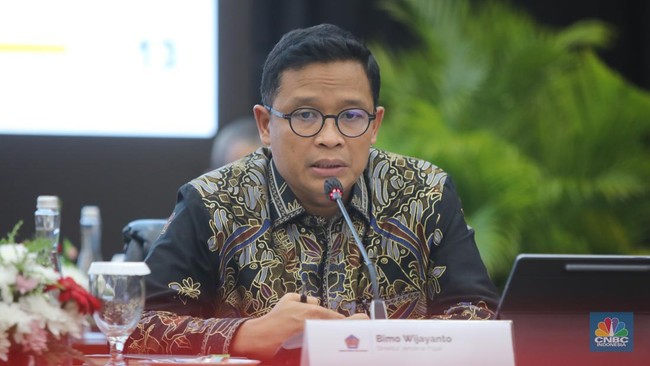
Director General of Taxes Bimo Wijayanto has spoken again regarding the plan to review the tax rules for the Old Age Security (JHT) programme. According to Bimo, the evaluation is the authority of the Directorate General of Fiscal Strategy, so the Directorate General of Taxes cannot make a decision independently. “Frankly, we are still waiting for direction, because this is actually the domain of the Directorate General of Fiscal Strategy,” Bimo said at the Directorate General of Taxes Head Office in Jakarta. Nevertheless, Bimo acknowledged that input from workers has been received and is being reviewed. Bimo added that, based on Directorate General of Taxes data, 95% of current JHT beneficiaries are not taxed because their JHT disbursement value is below the Rp 50 million threshold. “The data has also been conveyed by the Minister, that 95% of JHT recipients have 0% tax, because it is below Rp 50 million,” he explained. Whatever the decision later, even if the taxable threshold is raised to Rp 100 million, Bimo hopes the public, including workers and relevant ministries and agencies, can understand. “If they want to raise it, for example from Rp 50 million to Rp 100 million for the JHT tax-free amount, it is as ordered. The important thing is that the impact of its implementation is understood by all. The people understand, labour unions understand, the relevant ministries understand, BPJS also understands,” Bimo stressed. In addition, he added that the Directorate General of Taxes and BPJS Ketenagakerjaan are working very closely together to ensure that corporate tax deductions are also proportional to the mandatory amounts entering the labour social security protection. Through Minister of Finance Regulation Number 16 of 2010, the Ministry of Finance has actually provided a Final Income Tax rate facility of 0% for the disbursement of JHT benefits at retirement with a nominal value of up to Rp 50 million. “Based on BPJS Ketenagakerjaan data, for JHT claim payments from January to May 2026, out of 1,723,910 claims paid, 1,645,469 claims (95.45%) had a balance below Rp 50 million and were given a 0% tax incentive,” said Head of the Communication and Information Services Bureau of the Ministry of Finance Deni Surjanto. Meanwhile, for participants with a JHT balance above Rp 50 million, the excess is subject to a very light Final Income Tax rate of 5%, provided the entire disbursement process is completed within a maximum of two calendar years from the date of the first disbursement at retirement. For JHT withdrawals by workers while still actively employed, the taxation mechanism is implemented in accordance with the applicable General Individual Income Tax Rate provisions. He also emphasised that this is intended to encourage JHT participants not to withdraw early so that participants receive the maximum benefit from the JHT programme. It should be understood that the JHT contributions paid every month while actively working are a component that has never been subject to Income Tax. However, workers and labourers through the Indonesian Trade Union Confederation (KSPI) have requested that the tax be abolished. President of the Indonesian Trade Union Confederation and Special Advisor to the President on Employment and Labour Welfare Said Iqbal met with Minister of Finance Purbaya Yudhi Sadewa at the Ministry of Finance last week. There were several points conveyed by KSPI to Purbaya. “Firstly, we conveyed that we request a 0% JHT tax. The reason being, JHT is a social savings scheme, and tax should be imposed on the returns, not on the savings. But the Minister of Finance will study it again and will make changes,” said Said Iqbal. Secondly, Said Iqbal also requested an evaluation regarding the potential for progressive tax on JHT if a worker is laid off and returns to work several times. “Then we also conveyed regarding the potential for progressive tax, which should be taxed once, but this could be multiple times. In our view, the Minister of Finance will first discuss this internally at the Ministry of Finance, but the Minister said the tax should only be imposed once,” continued Said Iqbal. Next, regarding the tax threshold, Said Iqbal argued that the Rp 50 million limit, based on Government Regulation Number 68 of 2009, is outdated. “The taxable limit, based on PP Number 68 of 2009, is that JHT from Rp 0 to 50 million is not taxed, or 0%. Meanwhile, above Rp 50 million, the tax is 5%. We said that was 2009, 17 years ago. The Minister of Finance will review it again, but has already mentioned considering inflation, so there is a possibility the limit could be raised, no longer Rp 50 million,” Said Iqbal explained. The Minister of Finance appreciated KSPI’s efforts to convey concerns regarding the JHT tax complained about by Indonesian workers, especially those affected by layoffs. According to Purbaya, the Ministry of Finance will review this regulation. “I think I will see what regulations can accommodate Mr Said’s request or not. We will look at the existing regulations and what the impact is on my revenue and the economic impact on the people we exempt from tax,” Purbaya explained.