
JFX supports government plan for strategic mineral and commodity exchange
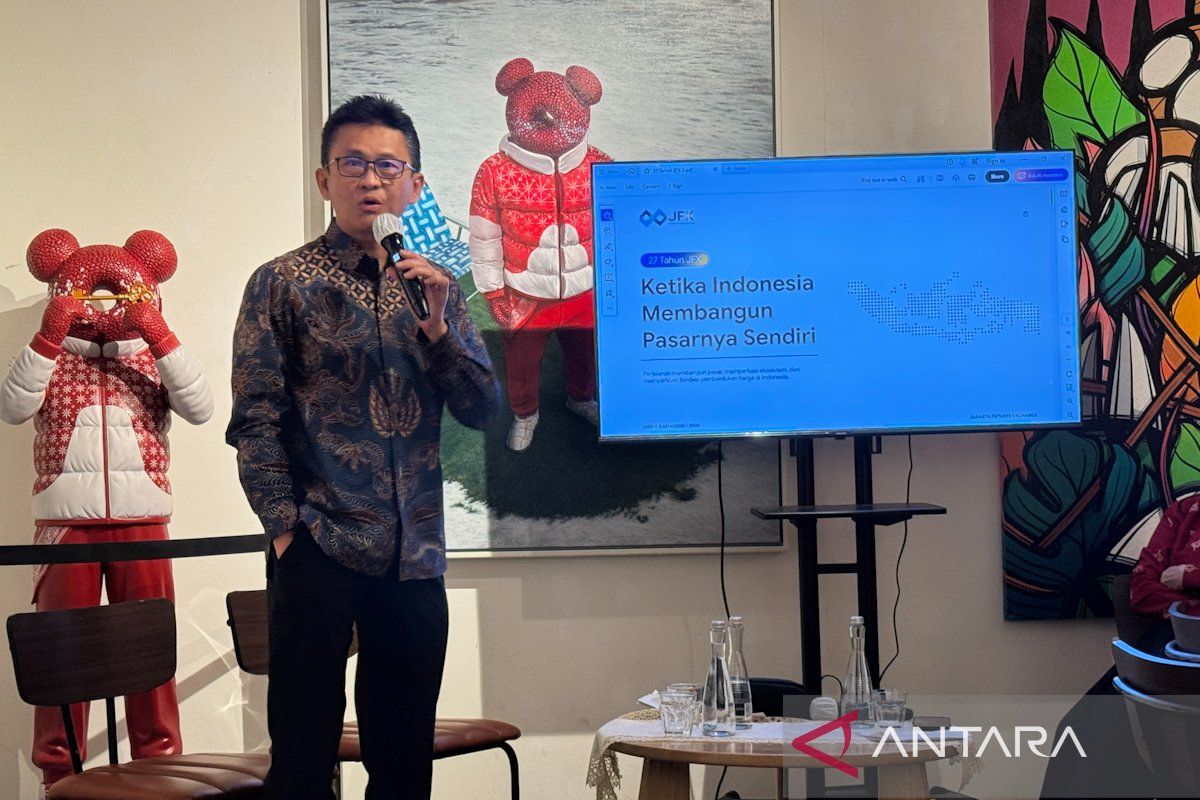
Jakarta (ANTARA) - The Jakarta Futures Exchange (JFX) has stated it is ready to support the establishment of the Strategic Mineral and Commodity Exchange (BMKS) as an important step to strengthen Indonesia’s position in setting prices for strategic commodities.
“Drawing on 27 years of experience, JFX is ready to support this agenda through the systems, infrastructure and market ecosystem that the company has built,” said JFX President Director Yazid Kanca Surya at the JFX Media Gathering 2026 in Jakarta on Wednesday.
The government is targeting BMKS to begin operations on 1 January 2027. For Kanca, this is a momentum for Indonesia to become a price setter.
Kanca said the company welcomes the plan because Indonesia holds an important position as a producer of various strategic commodities worldwide. Its position as a major producer, he said, should serve as capital to strengthen Indonesia’s influence over the prices of the commodities it produces.
“Indonesia has a very strong position as a producer of various world commodities,” said Kanca.
Moreover, Indonesia is not starting this agenda from scratch. Trading systems, mechanisms, market participants, and experience in organising commodity trading through an exchange are already available and can serve as a foundation to support the development of BMKS.
Since its establishment in 1999 and the start of trading in 2000, JFX has grown in line with the needs of the Indonesian market.
Starting with olein and robusta coffee futures contracts, JFX later developed an alternative trading system, a physical tin market and digital gold, as well as access for Indonesian customers to overseas exchanges through the PALN scheme.
This journey has helped shape the trading system, clearing and settlement mechanisms, transaction supervision, exchange member network, and relationships with domestic and international industry players.
However, according to Kanca, 27 years of experience has also taught that the success of an exchange is not determined solely by the existence of systems and infrastructure. He stressed that a successful exchange is not built overnight, but through a process.
“The most important thing is how the mechanism built can provide comfort for sellers without disrupting their trading process, while providing certainty for buyers who place their funds,” said Kanca.
This certainty is also part of the function of the exchange and clearing institution. In physical trading, JFX ensures that the commodities delivered meet the specifications set out in the contract and ensures that goods do not leave the storage facility before payment is completed by the buyer.
This mechanism operates alongside risk management and transaction supervision to provide certainty for both parties.
Physical tin trading is one of JFX’s concrete experiences. From 2019 to August 2025, tin trading volume through JFX reached more than 300,000 tonnes with a value of more than 8 billion US dollars and involved more than 60 active business players.
“In 2024, more than 95 percent of national tin transactions were recorded through JFX,” he said.
For Kanca, one important indicator of the market’s development is the involvement of international buyers. Buyers from China, Japan, Singapore and Europe choose to conduct tin transactions through JFX even though the government does not require them to buy through the Indonesian exchange.
“Buyers have a choice. They are not required to buy through JFX, but they still come and transact here. If our market were not efficient or not trusted, they could certainly buy elsewhere,” he explained.
“This shows that the market built by Indonesia has gained the trust of international players,” Kanca added.
This trust has also made JFX tin prices a reference for international buyers when conducting transactions. Market players who want to buy Indonesian tin now look not only at the London Metal Exchange (LME) price, but also at the price formed on JFX.
“In principle, we have become one of the price references. Its weight may not yet be as large as other global exchanges, but the JFX price has become one of the factors considered when people transact tin. This shows that price formation from Indonesia has actually begun to take place,” he said.
He further said the experience is not limited to tin. Over 27 years, the company has developed trading in various commodities, from olein, coffee, cocoa and gold to tin.
“Each commodity has different characteristics. A mechanism that succeeds for one commodity may not necessarily be applied in the same way to other commodities,” he explained.
For JFX, this cross-commodity experience is capital to support the implementation of BMKS. The systems, mechanisms and ecosystem already in operation can be utilised and developed in line with the government’s direction and the needs of each strategic commodity.
“If the government wants BMKS to operate in 2027, we are very ready to help make it happen. In terms of systems, mechanisms and ecosystem, the foundation is already in place,” he said.
“It is just a matter of how the experience we already have is strengthened and adapted to the needs of each commodity,” Kanca added.