
JF-17 China-Pakistan Enters the Caucasus, Who Is Most Threatened?
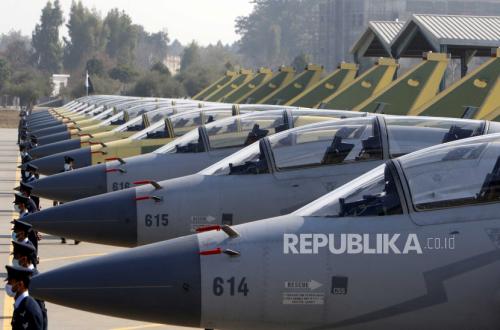
The appearance of the JF-17C Thunder Block III in an Azerbaijani Air Force exercise is not merely a display of a new fighter jet. Its presence marks a significant change in the balance of air power in the South Caucasus, a region that for decades has been an arena of rivalry between Azerbaijan and Armenia, as well as a space for contesting influence among Russia, Iran, Turkey, and Western nations.
The Azerbaijani Ministry of Defence, in an official statement on Monday, 6 July 2026, announced the conduct of training flights using the JF-17C Block III alongside Su-25ML attack aircraft, Su-25s, and L-39 trainer aircraft. The pilots carried out individual and group flights, simulated combat missions, tactical manoeuvres, and exercises to detect and destroy targets. The statement was the clearest confirmation that the JF-17 is no longer just on display but has entered the operational use phase.
The sales contract for the JF-17 to Azerbaijan was first announced publicly by the Pakistani military in September 2024. As reported by Reuters on Thursday, 26 September 2024, the Pakistani military stated the aircraft was “capable of carrying out a variety of combat missions and provides a modern air power employment option”. However, at that time, Pakistan did not disclose the number of aircraft or the contract value.
Several Pakistani government and defence industry reports in 2025 subsequently mentioned the package was enlarged to 40 aircraft with a value of around 4.6 billion US dollars. That figure would make it Pakistan’s largest defence export contract. Regardless of the debate over the numbers and value, the entry of the JF-17 demonstrates one major change: Azerbaijan is beginning to abandon its dependence on the Russian fighter jet ecosystem. For years, Baku’s air power relied on the MiG-29 and Su-25. With the JF-17, Azerbaijan gains access to radar, missiles, data links, and avionics systems originating from the Chinese and Pakistani defence industrial networks, with the potential to be integrated with Turkish-made devices.
What Aircraft Is It Equivalent To?
The JF-17 Block III is often introduced as a 4.5-generation fighter jet. This designation refers to the use of several technologies also found in newer generation aircraft, such as an Active Electronically Scanned Array (AESA) radar, a digital cockpit, a digital fly-by-wire control system, a helmet-mounted display, electronic warfare capabilities, and the ability to fire beyond-visual-range missiles.
However, the “4.5 generation” classification is not a universal technical standard. Two aircraft both called 4.5 generation can have vastly different radar capabilities, payload, range, engines, electronic warfare, and network integration.
According to official data from the Pakistan Aeronautical Complex, the JF-17 has a maximum take-off weight of 13,500 kilogrammes, a maximum speed of Mach 1.6, eight weapon hardpoints, and an external payload capacity of approximately 3,400 kilogrammes. The Block III variant is equipped with an AESA radar, a digital fly-by-wire system, jamming devices, a tactical data link, multi-target tracking capability, infrared-guided short-range missiles, and long-range air-to-air missiles.
Source: jawawa.id (https://jawawa.id/newsitem/jf-17-china-pakistan-enters-the-caucasus-who-is-most-threatened-1783723838)
Originally published by Republika (https://news.republika.co.id/berita/thzc3d451/jf17-chinapakistan-masuk-kaukasus-siapa-yang-paling-terancam), translated from Indonesian