
JETP Has Yet to Maximally Drive the Energy Transition — Here's Why
Jakarta, CNBC Indonesia — CERAH’s Program and Policy Manager, Wicaksono Gitawan, believes the Just Energy Transition Partnership (JETP) scheme has so far been ineffective in supporting the energy transition. According to Wicaksono, JETP was launched at the G20 Summit four years ago.
“Moreover, the investment target is quite large. If you recall, the US$20 billion figure rose to US$21.6 billion. Over time, we have also seen that JETP targeted the early retirement of two coal-fired power plants, namely Cirebon 1 and Pelabuhan Ratu, which should have become pilot projects, but were cancelled. That actually demonstrates the complexity of electricity system planning in Indonesia,” Wicaksono told CNBC Indonesia on Tuesday (15/9/2026).
Nevertheless, Wicaksono said JETP has now entered its implementation phase as JETP 2.0, running under the JETP Delivery Unit (JDU). According to him, there are several things that could be improved or focused on in this second phase.
In that phase, JETP is expected to once again prioritise the early retirement of coal-fired power plants. This is evident from the various projects approved by the Government to support the development of 100 GW of solar power.
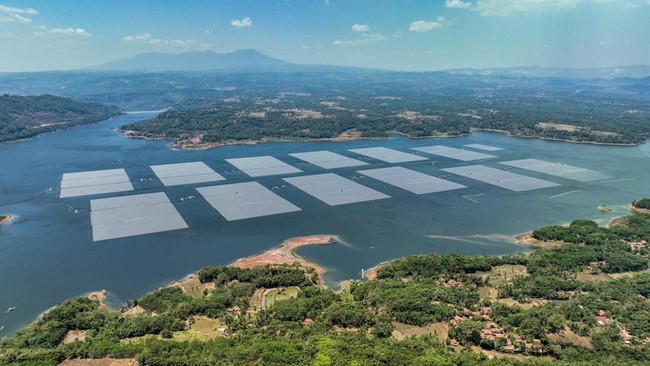
“This can also be seen in the development of 100 GW of solar. Of the 14 projects launched by the President on 25 August, several are actually listed in JETP planning documents. In the 2023 Comprehensive Investment and Policy Plan, there are projects like the Saguling and Gajah Mungkur solar plants. So although JETP was initially focused more on the early retirement of coal plants, it also covers fast renewables,” Wicaksono asserted.
Previously, Wicaksono assessed that the 100 GW solar power development target remains quite realistic, especially given Indonesia’s renewable energy potential of 3,300 GW. According to him, this target can be achieved if it is accompanied by a reduction in coal-based power generation.
He said that in the RPJMN, of the total renewable energy potential, the largest share comes from solar energy via solar plants.
“But the question is whether Indonesia is ready to plan things properly so that this 100 GW can be executed correctly within three or even two years?” he said.
To that end, he stressed that if Indonesia wants 100 GW to enter the renewable energy system, it must begin planning the phase-out of coal and other fossil fuels.