
Jetour T-Series put to the test on urban roads
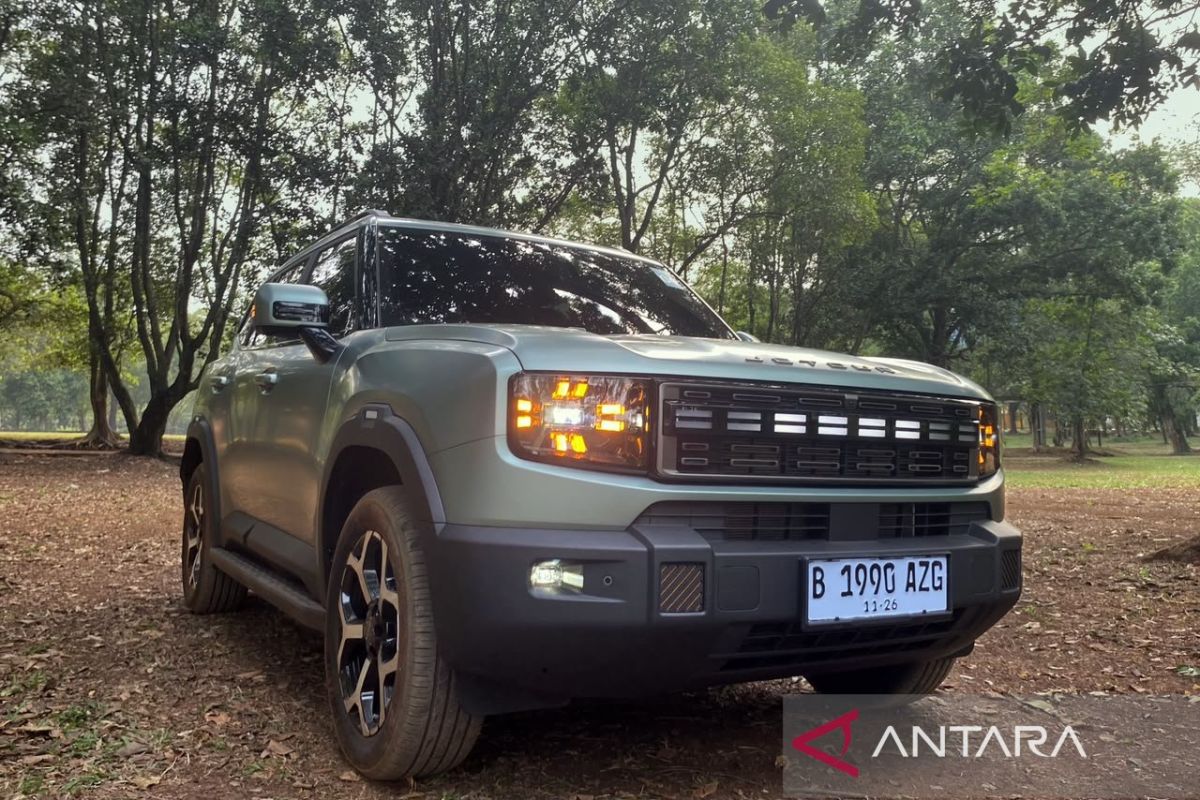
Jakarta (ANTARA) – Jetour Indonesia gave several members of the media the opportunity to experience driving its two flagship Sport Utility Vehicles (SUVs), the T1 and T2.
The test, held on roads in central Jakarta, was intended to provide experience of driving large vehicles through narrow lanes and heavy traffic.
Jetour Sales Indonesia PT brand manager Arief Sutrisno said in remarks in Jakarta on Monday (9 November) that the Jetour T-Series aimed to offer a vehicle option suited to consumers with different travel needs.
ANTARA had the opportunity to drive the vehicles on the streets of the capital. The first destination on the route was Pasar Baru in Central Jakarta. The initial challenge focused on the limited parking space often found around office buildings, food districts and commercial areas.
The T2’s N-Gear Easy Moving feature allows the vehicle to be moved while the engine is off by selecting neutral (N). It is designed to help drivers reposition the vehicle, particularly when parallel parking or dealing with limited parking space.
Manoeuvring is also supported by 540° Surround Vision technology, which provides a comprehensive view of the area around the vehicle.
The technology helps drivers identify objects and obstacles when moving in confined spaces. Jetour has also fitted a 24-Hour Parking AC feature, which allows the cabin air conditioning to continue operating while the vehicle is parked.
The next challenge combined a Hill Climb Challenge and a Narrow Road Challenge to test the vehicles’ ability to handle steep gradients and relatively narrow local roads. Participants drove up the Pasar Senen and Kuningan 13 inclines, testing the vehicles’ power response as road elevation changed.
The event included three checkpoints in areas of Jakarta and its surroundings to demonstrate how the vehicles handled everyday driving challenges. Participants drove through narrow roads, uphill and downhill sections, and areas with more challenging surfaces.
On descents, the vehicles use Hill Descent Control (HDC), which helps automatically regulate speed at up to 20 kilometres per hour. The feature is intended to help drivers maintain control when travelling downhill.
The vehicle structure is designed to support stability and control on different types of roads. These characteristics were also tested in the Narrow Road Challenge, which required drivers to manoeuvre through routes with limited room.
The third challenge took place at the Fun Experience area in Buperta Cibubur, giving participants the chance to experience the vehicles on more demanding surfaces.
The Jetour T2 ICE is equipped with Crawl Control Mode, with Rock and Sand settings. The feature allows the vehicle to move at a controlled, crawling speed over certain terrain, including rocky and sandy surfaces.
The Jetour T2 also has 210 millimetres of ground clearance, providing space between the underside of the vehicle and the road. This specification supports its ability to travel over uneven ground.
Alongside internal combustion engine (ICE) options, the Jetour T-Series is also available with Intelligent Dual Mode (i-DM) technology, which combines a petrol engine with an electric motor.
The hybrid technology allows the vehicle to use electric power for short trips and combine the petrol engine and electric motor when greater flexibility is needed for longer journeys.
The Jetour T1 i-DM uses an ACTECO 1.5 TGDI Dedicated Hybrid Engine producing 136 PS and 220 Nm of torque. It is paired with an electric motor producing 204 PS and 310 Nm of torque.
The system uses a 1-Speed Dedicated Hybrid Transmission (1DHT) and an 18.4 kWh lithium iron phosphate (LFP) battery. Under the WLTC testing standard, the vehicle offers an electric range of up to 100 kilometres and a combined range of up to 1,200 kilometres.
The combined powertrain produces up to 360 PS and 610 Nm of torque. The T2 i-DM also uses an 18.4 kWh CATL LFP battery, with an electric range of up to 90 kilometres and a combined range of more than 1,200 kilometres.
Both hybrid models offer three operating modes for managing energy use: EV Mode, HEV Mode and Smart Power Saving.
EV Mode prioritises electric power for short trips, while HEV Mode combines the petrol engine and electric motor.
Smart Power Saving manages energy according to the vehicle’s needs in order to maintain battery charge.
In addition to their powertrain technology, all Jetour T-Series models are equipped with several driving-assistance systems, including Integrated Cruise Assist (ICA), Traffic Jam Assist (TJA) and Front Departure Alert.
ICA helps maintain a distance from the vehicle ahead on motorways, while TJA helps regulate the vehicle’s speed and position in its lane in heavy traffic.
Front Departure Alert notifies the driver when the vehicle ahead begins moving after stopping in a queue.
The Jetour T-Series comprises the T1, an SUV designed for urban mobility, and the T2, which offers greater capability for a wider range of driving conditions. Both are available with petrol engines and i-DM hybrid technology.
The test demonstrated how the two models cater to different driving needs, from manoeuvring in urban areas to handling more challenging road surfaces.
Source: jawawa.id (https://jawawa.id/newsitem/jetour-t-series-put-to-the-test-on-urban-roads-1794293499)
Originally published by Antara (Indonesian) (https://otomotif.antaranews.com/berita/5843635/uji-coba-jetour-t-series-di-jalur-perkotaan), translated from Indonesian