
JELI and BACH Shares Dumped by Investors, RANS Attracts Tycoons
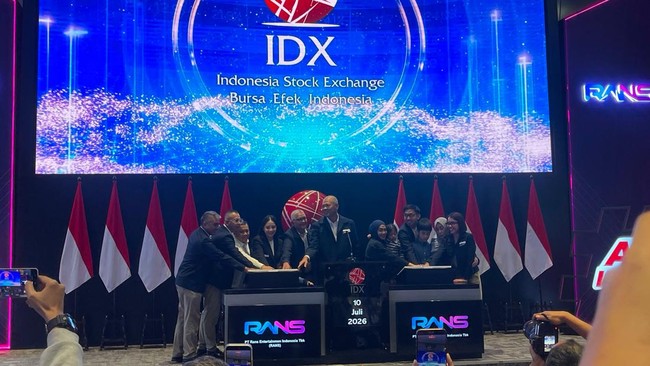
Two companies from the early July IPO wave, PT Niramas Utama Tbk (JELI) and PT Bach Multi Global Tbk (BACH), were hit by a sell-off on Friday (10/7/2026). Meanwhile, PT Rans Entertainment Indonesia Tbk (RANS) soared.
JELI, the producer of the INACO branded food, was the most pressured last Friday. The issuer plunged 14.81% to Rp1,495 per share, hitting the lower auto-rejection limit (ARB). Meanwhile, BACH, a genset and telecommunications infrastructure company affiliated with the Djarum Group, slumped nearly 10% to Rp500 per share.
The first issue for JELI is a valuation that has soared far beyond its earnings performance. Throughout 2025, JELI only recorded a net profit of Rp39.0 billion. While this figure jumped 235.5% compared to the previous year’s profit of just Rp11.6 billion, the large percentage increase came from a very small base. With such meagre earnings, JELI’s IPO price alone reflected a price-to-earnings (PER) ratio in the range of 31-39 times—far above the average for similar issuers in the food and beverage sector, which sits in the 12-18 times range. At the current market price, let alone at yesterday’s peak, this valuation becomes increasingly difficult to justify by real performance.
What makes this premium even more precarious is the direction of its core business. Instead of growing, JELI’s revenue has actually contracted for three consecutive years, from Rp838.94 billion in 2023 to Rp753.05 billion in 2025. This means the profit surge that was the main attraction for this issuer did not come from increased sales volume, but from efficiency and margin improvements—a source of growth that has limits and cannot be repeated endlessly every year. When the room for efficiency runs out, the question returns to whether sales can genuinely grow.
The most striking signal came from its cash flow. According to the prospectus, JELI’s cash flow from operating activities collapsed by around 83% in 2025. The cause was a spike in trade receivables from Rp104.21 billion to Rp174.13 billion due to credit sales near the year’s end. This condition is a classic red flag regarding earnings quality: profits recorded on paper have not necessarily turned into cash actually entering the company’s coffers, while also raising the risk of default from distributors.
Today’s weakening of BACH shares is not without reason, as warning signals have emerged. Broker summary data since listing shows one broker recorded as a net seller of approximately Rp117.4 billion in BACH, the largest figure among this IPO batch, with indicators pointing to a Big Distribution phase. Such footprints often precede price pressure on newly listed stocks.
From a fundamental perspective, the first concern is liquidity. Based on the prospectus, BACH’s cash ratio in 2025 was recorded at only 0.02 times, or about 2%, plummeting from 0.09 times the previous year. Such a thin figure indicates very narrow room for manoeuvre for the company to meet its short-term obligations, a condition that needs continuous monitoring, especially since part of the IPO funds is allocated for working capital to purchase gensets.
The second issue concerns dependence on affiliated parties. Most of the clients in BACH’s telecommunications line are entities within the Djarum Group ecosystem, such as TOWR, Protelindo, and SUPR. This structure does provide short-term revenue stability, but it also makes the company’s performance highly dependent on internal group business decisions rather than pure market dynamics.
Operationally, BACH faces supply chain risks. The company is heavily reliant on foreign genset principals like Himoinsa and Guangdong Westinpower for its main components, making it vulnerable to rupiah exchange rate fluctuations against the US dollar and global supply disruptions. Additionally, an increase in its debt ratio binds the company to strict negative covenants from banks, which could limit its corporate actions without creditor approval.
Equally important is the overhang on the ownership structure. The prospectus reveals an option agreement between shareholders, where PT Global Telekomunikasi Prima (GTP), a Djarum entity, will exercise a share purchase option to increase its ownership in BACH to 51%, scheduled to occur no later than five business days after the stock listing. This rapid change in controlling structure is a variable that medium-term investors need to watch closely.
Finally, with a public float of only 15.06%, the limited number of shares circulating in the market makes BACH’s price susceptible to wild swings from relatively small trading volumes, amplifying market volatility.
This condition was the opposite of the performance of another new issuer, PT RANS Entertainment Indonesia Tbk (RANS), owned by Raffi Ahmad, which surged to its upper auto-rejection limit on its first day, leading the top gainers list. At the market opening, RANS shares were priced at Rp228, marking a 34.12% increase.
The RANS IPO ceremony at the end of last week was attended directly by a number of tycoons. One of them was Andi Syamsuddin Arsad, known as Haji Isam. Based on CNBC Indonesia’s observation, Haji Isam pressed the opening bell together with Raffi Ahmad, Nagita Slavina, and the RANS board of directors. Besides Haji Isam, other prominent figures were also present, including third-generation Salim Group owner Axton Salim, Adaro owner Garibaldi ‘Boy’ Thohir, Kadin Chairman Anindya Bakrie, and SCTV CEO Sutanto Hartono. RANS founder Raffi Ahmad stated that Haji Isam is a 1% shareholder in RANS, adding, ‘He is also one of my mentors.’