
JEBS Holds FGD on East Java’s 2026 Economic Outlook, Highlighting Investment and Industry
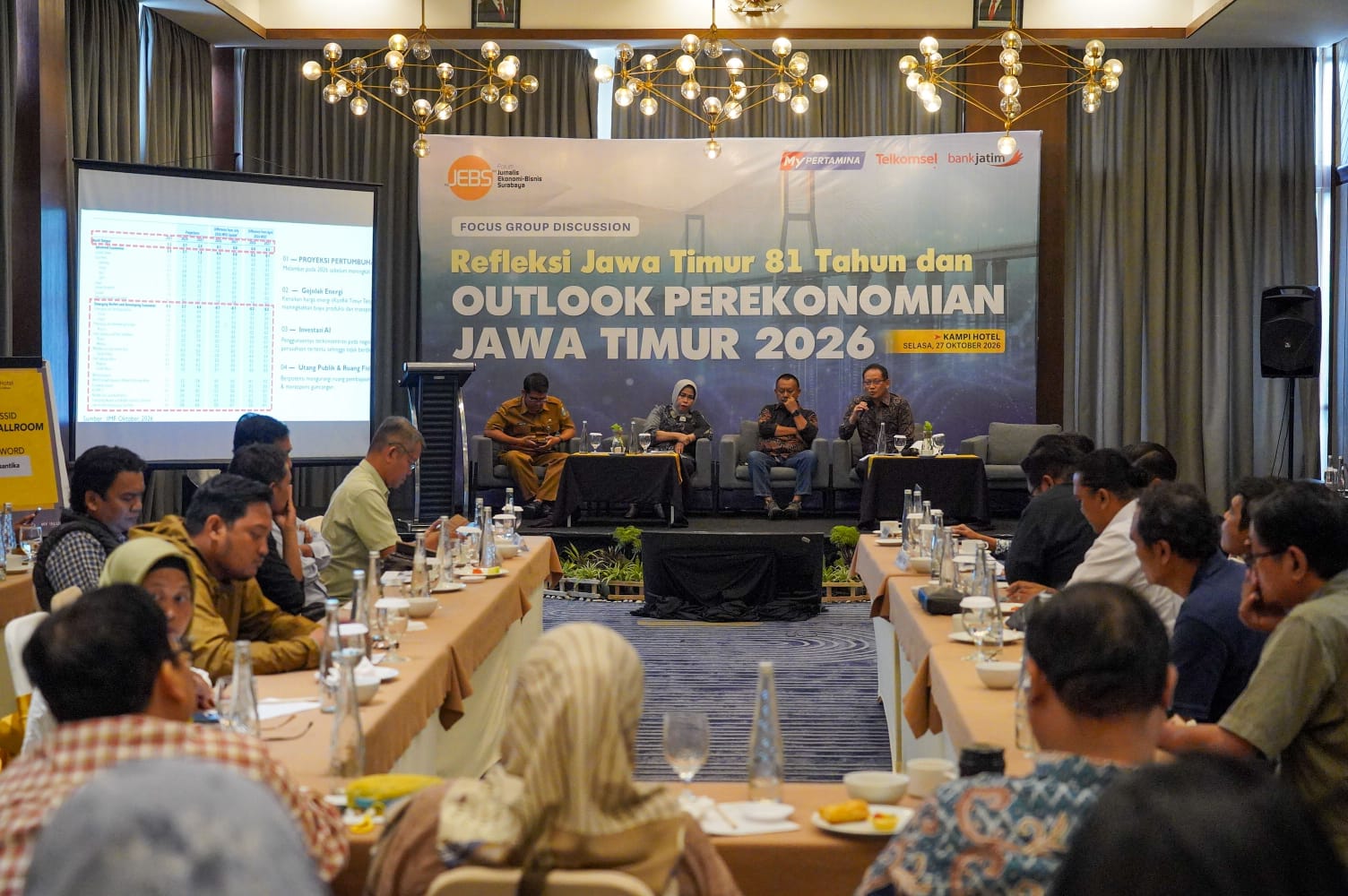
The Surabaya Economic-Business Journalists (JEBS) held a focus group discussion (FGD) entitled “81 Years of Reflection on East Java and the 2026 Economic Outlook” at Hotel Kampi in Surabaya on Tuesday, 27 October 2026.
The event brought together representatives of the East Java Chamber of Commerce and Industry (Kadin), the Surabaya Cigarette Entrepreneurs Association (Gapero), the Indonesian Young Entrepreneurs Association (HIPMI) in East Java, the East Java chapter of the Indonesian Truck Owners Association (Aptrindo), the East Java chapter of the Indonesian Journalists Association (PWI), the Indonesian Cyber Media Network (JMSI), as well as academics and government representatives. They discussed challenges and prospects for the regional economy.
East Java Kadin chairman Adik Dwi Putranto opened the discussion with three fundamental questions about the province’s economic future: whether growth had generated added value, whether trade was becoming more competitive, and whether energy supplies were reliable enough to support industry.
East Java’s economy grew by 5.33 per cent in 2025, Adik said. Growth continued at 5.96 per cent year on year in the first quarter of 2026 and 5.72 per cent in the second quarter. However, this expansion needs to be accompanied by better-quality jobs and improved public welfare.
He highlighted a poverty rate of 9.06 per cent in March 2026 and an open unemployment rate of 3.42 per cent in May 2026. In his view, the figures show that relatively strong economic growth has yet to fully address employment and the equitable distribution of prosperity.
Graduate unemployment is also a concern. Adik said university and vocational-school graduates needed skills that matched industry requirements. Collaboration between businesses, universities and the government should therefore be strengthened, making it easier for graduates to enter the labour market while also boosting East Java’s appeal to investors.
Turning campus research into commercial applications is another issue that needs to be addressed, he said. The use of university innovations by industry remains limited. Kadin is working to bridge the needs of businesses and university research so that innovations can be developed into economically valuable products and technologies.
Rudi Purnowono, a professor of monetary economics at Airlangga University, stressed the importance of strengthening manufacturing investment, including by making better use of Special Economic Zones (SEZs). Zones that have been operating for more than a decade should be assessed for their contribution to economic growth, job creation and industrial value-added.
Rudi said an SEZ’s success should not be measured only by the volume of investment it attracts, but also by its ability to build links with surrounding industries. Large companies are expected to involve medium-sized businesses, small firms and micro, small and medium enterprises (MSMEs) in their supply chains so that investment benefits are more widely shared.
“When large industries grow, they are expected to lift medium-sized industries. When those medium-sized industries advance, they can also support small industries. These linkages will improve the performance of industry as a whole,” he said.
He also noted that East Java’s share of national investment from both foreign direct investment (FDI) and domestic investment had been declining. To make the province more attractive for manufacturing investment, East Java needs to improve its competitiveness, provide investors with adequate information and ensure that energy is available at competitive prices.
Electricity supplies in the Java-Madura-Bali interconnected system are said to exceed demand. However, energy prices remain a challenge for industry because they affect production costs. Reliable and affordable energy is crucial to maintaining manufacturing competitiveness and attracting new investment.
The tobacco products industry, which plays an important role in East Java’s economy, was another focus. Gapero Surabaya chairwoman Sulami Bahar said the sector was under pressure from falling production, weaker purchasing power and the widespread circulation of illicit cigarettes.
According to figures presented by Sulami, tobacco excise revenue in 2025 reached Rp221.7 trillion, or 90.8 per cent of the state budget target, down 2.1 per cent from 2024. National cigarette production also fell from about 317 billion sticks in 2024 to 307 billion in 2025.
Sulami cited a Gadjah Mada University survey, which she presented, showing that illicit cigarettes’ market share rose from 6.9 per cent in 2023 to 13.97 per cent in 2025. She said this added to pressure on legal cigarette producers, particularly as consumers switched to cheaper products or those on which excise had not been paid.
Sulami said excise increases, combined with widening price gaps between cigarette categories, could accelerate consumers’ shift to cheaper products. She urged the government to take account of industry conditions and household purchasing power when setting its 2026 excise policy, including by not raising rates.
Reliable energy supplies are also essential to sustaining East Java’s economic activity. Ahad Rahedi, area manager for communications, relations and CSR at PT Pertamina Patra Niaga’s Jatimbalinus Regional Office, said industry, trade, agriculture, fisheries, logistics and tourism all needed dependable energy to develop.
Pertamina Patra Niaga’s Jatimbalinus regional operations are supported by distribution infrastructure reaching all 38 regencies and cities in East Java. The network includes 1,117 petrol stations and 699 Pertashop outlets, as well as aviation-fuel facilities supporting operations at several airports.
“Energy support is provided not only through fuel at petrol stations, but also across various transport hubs and economic activities. We continue to maintain the reliability of our facilities and distribution so that energy needs are met for their intended purposes,” Ahad said.
The discussion underscored that East Java’s economic challenge is not merely to sustain growth, but to ensure that growth creates jobs, strengthens industrial competitiveness and investment, and generates greater value for local businesses.
Source: jawawa.id (https://jawawa.id/newsitem/jebs-holds-fgd-on-east-javas-2026-economic-outlook-highlighting-investment-and-industry-1793152239)
Originally published by kilasjatim.com (https://kilasjatim.com/2026/10/28/jebs-gelar-fgd-outlook-ekonomi-jatim-2026-soroti-investasi-hingga-industri/), translated from Indonesian