
JCI Weakens Following Asian Markets as Investors Monitor Escalation of US-Iran Conflict
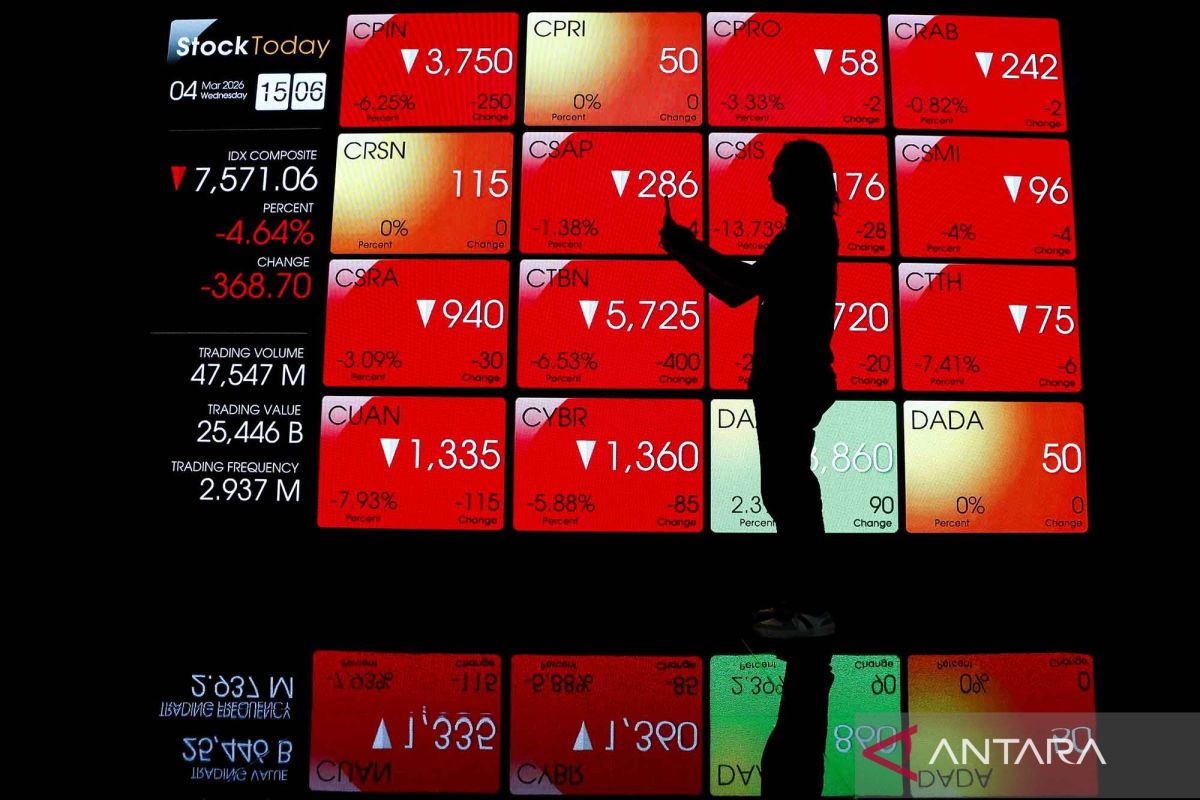
Jakarta (ANTARA) - The Composite Stock Price Index (JCI) of the Indonesia Stock Exchange (IDX) closed down on Monday afternoon, following the weakness in Asian stock markets, as market participants monitored the escalation of the conflict between the United States (US) and Iran.
The JCI closed weaker by 5.39 points or 0.08 percent to 7,091.67. Meanwhile, the LQ45 index of 45 leading stocks fell 1.47 points or 0.20 percent to 717.49.
“Asian stock indices closed weaker on Monday afternoon, in line with the increasing conflict in the Middle East entering its fifth week despite efforts to find a diplomatic solution,” stated the Research Team of Phillip Sekuritas Indonesia in its analysis in Jakarta on Monday.
From abroad, the Houthi group in Yemen stated that they had fired missiles at Israel, marking their first direct involvement in the US and Israel war against Iran.
In a post on X, Houthi spokesperson Yahya Saree said the Houthi group launched a barrage of ballistic missiles at locations they described as sensitive Israeli military sites, in support of Iran and Hezbollah forces in Lebanon.
The attack marks further escalation in the conflict that began with US and Israeli airstrikes against Iran on 28 February 2026.
Domestically, the government is designing budget efficiency schemes, including work-from-home (WFH), as mitigation steps to minimise the impact of rising crude oil prices on the state budget (APBN) and the domestic economy.
The government has identified three vulnerable sectors: energy stability, global supply chains, and overall economic growth.
Several measures to curb oil and gas imports include energy savings and strengthening the B50 biodiesel mandate.
This government policy plan is an effort to avoid raising subsidised fuel prices, which would broadly impact inflation, and to prevent widening the APBN deficit.
However, non-subsidised fuel is expected to potentially experience an increase during the monthly fuel price adjustment announcement on 1 April 2026.
Opening weaker, the JCI remained in negative territory until the close of the first trading session. In the second session, the JCI still lingered in the red zone until the close of trading.
Based on the IDX-IC Sectoral Index, seven sectors strengthened, led by the energy sector which rose 2.31 percent, followed by the transportation & logistics sector and the non-primary consumer goods sector, each up 1.45 percent and 1.23 percent.
Meanwhile, four sectors weakened, with the financial sector falling the most at 1.28 percent, followed by the basic materials sector and the property sector, each down 0.56 percent and 0.48 percent.
The stocks with the largest gains were GSMF, NZIA, RGAS, AGII, and YPAS. Meanwhile, the stocks with the largest declines were PTSN, FMII, FITT, BBLD, and ASSA.
Stock trading frequency was recorded at 1,669,544 transactions with 25.12 billion shares traded worth Rp14.94 trillion. 272 stocks rose, 403 stocks fell, and 149 remained unchanged.
Regional Asian stock markets this afternoon included the Nikkei Index weakening by 2,558.57 points or 2.92 percent to 51,814.50, the Shanghai Index strengthening by 9.56 points or 0.24 percent to 3,923.29, the Hang Seng Index weakening by 201.09 points or 0.81 percent to 24,750.79, and the Straits Times Index weakening by 0.92 points or 0.02 percent to 4,897.26.