
JCI Weakens as Markets Assess the Direction of Global Monetary Policy
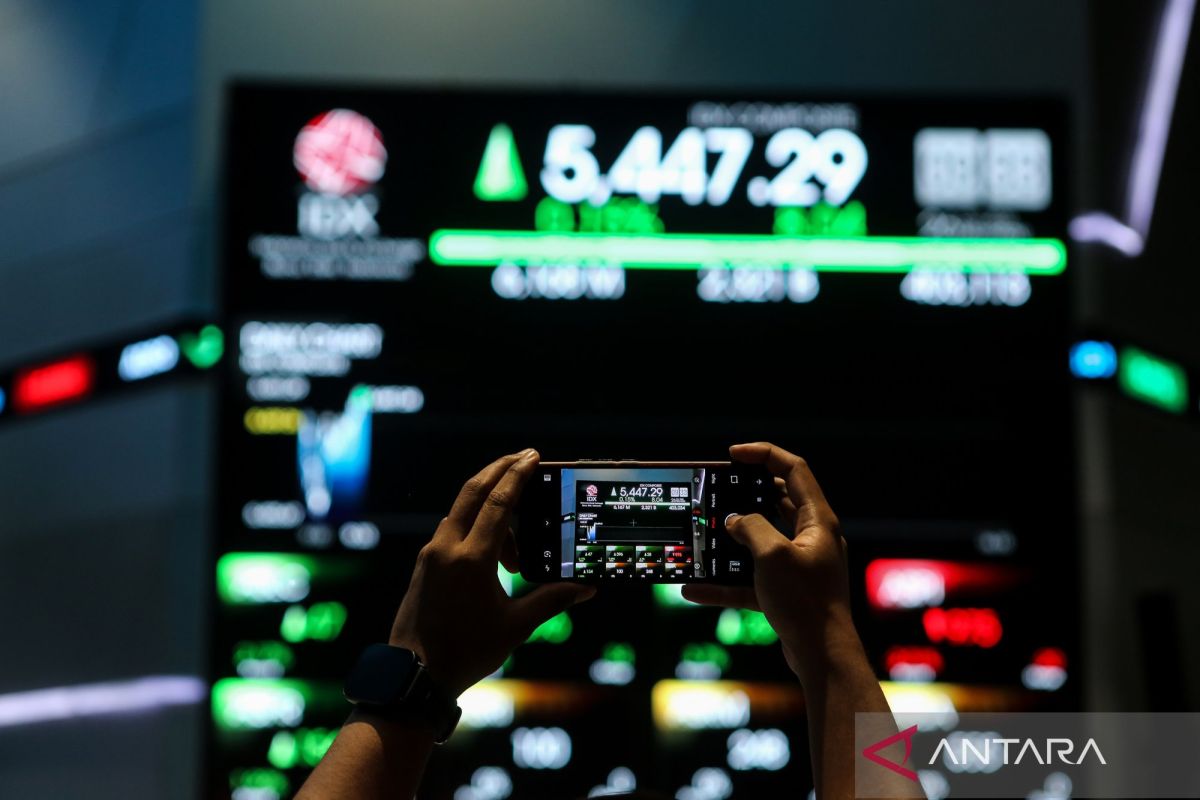
Jakarta (ANTARA) – The Indonesia Stock Exchange’s (IDX) Composite Stock Price Index (JCI) weakened in early trading on Wednesday as market participants assessed the direction of global monetary policy.
The JCI opened down 17.06 points, or 0.32 per cent, at 5,249.07. The LQ45 index, which tracks 45 leading shares, fell 2.30 points, or 0.43 per cent, to 530.72.
“The JCI is vulnerable to a further test of its nearest support at 5,185. If it breaks below that level, it could head towards support at 5,012 or 4,980. If the index rebounds, its nearest resistance is 5,317; a break above that could take it back towards resistance at 5,349 or 5,418,” said Liza Camelia Suryanata, head of research at Kiwoom Sekuritas Indonesia, in a report issued in Jakarta on Wednesday.
Internationally, market participants expect the US Federal Reserve to keep its benchmark interest rate unchanged at its meeting this week. The European Central Bank (ECB) is also expected to leave its policy rate unchanged.
Liza said the decisions by both central banks would be a key focus for investors assessing the future direction of global monetary policy.
“Investors are also awaiting the release of several US economic data points this week to gain a clearer picture of the economy and the scope for monetary easing ahead,” Liza said.
Meanwhile, diplomatic efforts to ease the Middle East conflict have shown signs of progress after Iran’s Supreme Leader, Mojtaba Khamenei, called for an end to what he described as a state of “neither war nor peace”.
Officials from Saudi Arabia, Pakistan and Turkey held talks in Tehran and agreed to continue diplomatic discussions. Russian President Vladimir Putin is also scheduled to meet Iranian President Masoud Pezeshkian and the Emir of Qatar in Moscow.
“While this offers the possibility of de-escalation, Houthi attacks on Saudi energy infrastructure and Iranian attacks on tankers in the Strait of Hormuz show that regional security risks have not yet subsided,” Liza said.
Domestically, Bank Indonesia (BI) decided to keep its benchmark BI Rate at 5.75 per cent at its Board of Governors’ Meeting on 20–21 October 2026.
Over the past two weeks, the Financial Services Authority (OJK) and the IDX have announced several policy initiatives to boost investor confidence, amid an evaluation by global index provider MSCI.
The government is also considering reinstating electricity-bill discounts, increasing supplies of subsidised fuel and offering discounted air fares ahead of the 2026 Christmas and New Year holiday period, in an effort to contain inflation and sustain household purchasing power.
“However, the stimulus must take account of limited fiscal space and the additional burden of energy subsidies,” Liza said.
She advised the government to prioritise assistance for poor and vulnerable households, strengthen food security, improve distribution and make the most of market operations to achieve more sustainable inflation control.
The Finance Ministry, meanwhile, is confident that the 2026 state budget deficit will remain under control at 2.85 per cent of gross domestic product (GDP), despite the rupiah weakening to Rp18,156 per US dollar and Brent crude reaching US$115.81 a barrel.
CORE Indonesia estimates that only around Rp39 trillion remains in fiscal space before the deficit reaches the 3 per cent-of-GDP limit. Higher oil prices and a weaker rupiah could increase the need for subsidies and energy compensation by Rp30 trillion–Rp50 trillion above the government’s outlook in the fourth quarter of 2026.
Taking into account growth in state revenue and the possibility that some spending will not be fully disbursed, the deficit is projected to reach 2.85–2.95 per cent of GDP by the end of the year.
“The government should also be alert to the risk of delaying compensation payments to Pertamina and PLN, as this would merely shift the fiscal burden to the following year,” Liza said.
Most European markets rose on Tuesday (27 October). The Euro Stoxx 50 gained 0.79 per cent, while the UK’s FTSE 100 fell 0.75 per cent. Germany’s DAX rose 0.71 per cent and France’s CAC 40 gained 0.51 per cent.
US markets all closed higher on Tuesday (27 October): the S&P 500 rose 0.60 per cent, the Nasdaq Composite gained 1.18 per cent and the Dow Jones Industrial Average added 0.03 per cent.
Asian markets were mixed in morning trading. Japan’s Nikkei rose 1.20 per cent to 64,030.00, the Shanghai Composite gained 0.28 per cent to 3,658.96, Hong Kong’s Hang Seng fell 0.03 per cent to 23,035.95, South Korea’s Kospi surged 5.94 per cent to 5,972.17, and Singapore’s Straits Times Index edged down 0.07 per cent to 5,400.83.
Source: jawawa.id (https://jawawa.id/newsitem/jci-weakens-as-markets-assess-the-direction-of-global-monetary-policy-1793163385)
Originally published by Antara (Indonesian) (https://www.antaranews.com/berita/5816359/ihsg-melemah-di-tengah-pasar-cermati-arah-kebijakan-moneter-global), translated from Indonesian