
JCI weakens amid foreign fund rebalancing in Southeast Asia
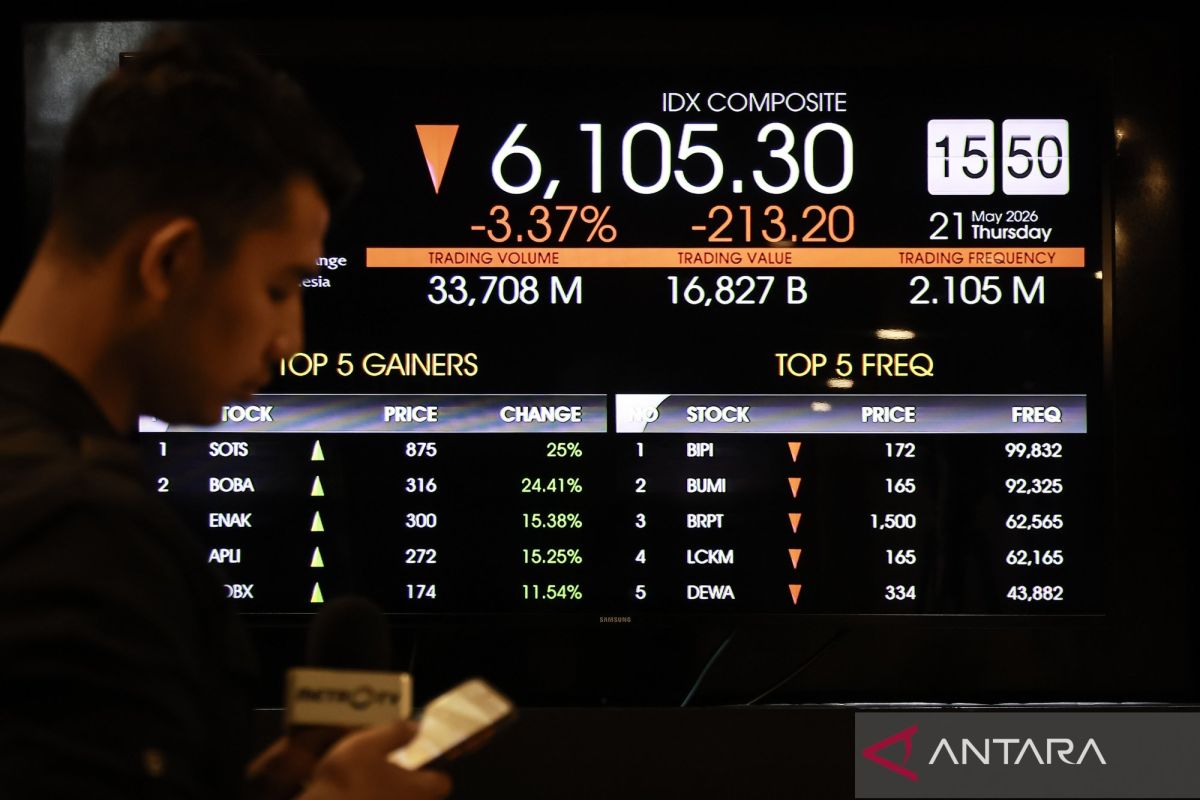
The Indonesia Composite Index (JCI) on the Indonesia Stock Exchange (IDX) closed weaker on Tuesday afternoon, amid the potential for a rebalancing of foreign fund flows within the Southeast Asian region.
The JCI fell by 107.69 points, or 1.69 per cent, to 6,277.04. Meanwhile, the LQ45 index, comprising 45 blue-chip stocks, declined by 8.68 points, or 1.37 per cent, to 625.61.
“The upgrade of Vietnam’s status to an FTSE emerging market has directly triggered the potential rebalancing of foreign capital flows in Southeast Asia,” said Maximilianus Nico Demus, Associate Director of Research and Investment at Pilarmas Investindo Sekuritas, in his analysis in Jakarta on Tuesday.
Regarding international factors, Nico stated that global market participants are responding to FTSE’s decision to change Vietnam’s status from a frontier market to an emerging market, a move expected to attract significant foreign investor inflows into the Vietnamese stock exchange.
Furthermore, he noted that the strengthening of regional Asian markets was supported by the sentiment of declining crude oil prices, following increased diplomatic efforts to resolve the Middle East conflict and signs of sustained energy flows from the region.
“Lower oil prices help alleviate inflationary pressures,” said Nico.
Satellite data indicates that Saudi oil loadings in the Persian Gulf have surged, suggesting exports are shifting back to the Strait of Hormuz as the closure of the East-West pipeline continues, although reports suggest the route may partially resume operations within a few days.
“This certainly represents hope for diplomatic progress in ending the conflict in the Middle East,” added Nico.
On the other hand, market participants are closely watching US President Donald Trump, who is scheduled to speak at the UN General Assembly in New York, and the possibility of a meeting with Iranian President Pezeshkian on the sidelines of the event.
Domestically, Nico noted that market participants are maintaining a ‘wait and see’ approach regarding the direction of Bank Indonesia’s (BI) monetary policy during the Board of Governors Meeting scheduled for 22-23 September 2026.
“The consensus expects the benchmark interest rate to remain unchanged, which could potentially narrow the margin for intervention or support to strengthen the rupiah against foreign currencies,” said Nico.
After opening stronger, the JCI moved into negative territory and remained there until the close of the first trading session. In the second session, the JCI remained in the red until the market close.
Based on the IDX-IC Sectoral Index, only one sector strengthened, with the non-primary consumer goods sector rising by 0.23 per cent.
Conversely, ten sectors weakened, led by the energy sector, which dropped by 2.52 per cent, followed by the property and industrial sectors, which fell by 1.90 per cent and 1.85 per cent, respectively.
The stocks that saw the largest price increases were FORU, BPTR, SAPX, AGAR, and DFAM, while the largest decliners were BBSS, RISE, TRIN, GDST, and TRUE.
Trading frequency was recorded at 2.15 million transactions, with a total of 32.23 billion shares traded valued at Rp14.43 trillion. A total of 148 stocks rose, 556 declined, and 259 remained unchanged.
Regional Asian stock indices this afternoon included the Shanghai Index, which rose 0.06 per cent to 3,952.13; the Hang Seng Index, up 0.18 per cent to 25,087.75; the Kospi, up 0.15 per cent to 7,017.91; the Kuala Lumpur Index, up 0.99 per cent to 1,683.50; and the Straits Times Index, up 0.86 per cent to 5,723.76.
Meanwhile, the Nikkei (Japan) was closed for a Citizen’s Holiday.