
JCI Surges 5.65% as Foreign Investors Sell IDR 2.2 Trillion in Shares
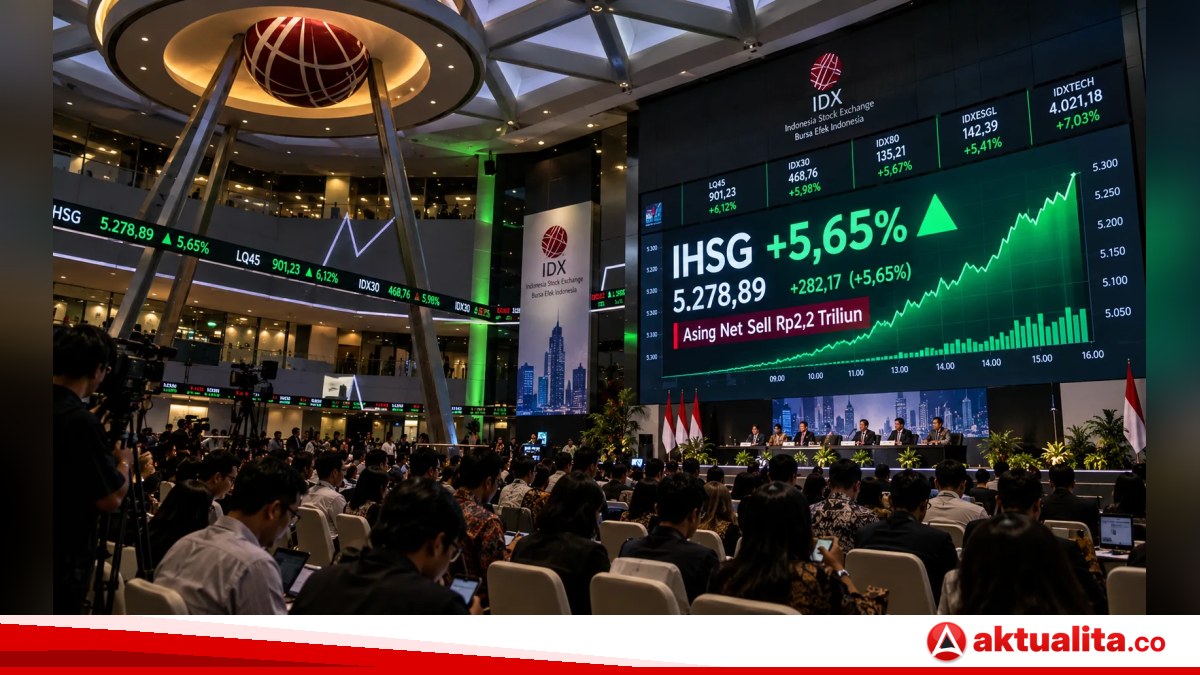
Jakarta, Aktualita.co - The Jakarta Composite Index (JCI) finally rebounded after experiencing intense pressure over the previous two trading days. On Tuesday (October 20, 2026), the JCI closed up 282.28 points or 5.65 percent to the level of 5,278.89.
However, behind this surge, a condition has emerged that has caught the market’s attention. While the majority of stocks moved higher, foreign investors still recorded a net sell of approximately IDR 2.2 trillion.
This situation raises the question: why could the JCI strengthen sharply when foreign investors are still withdrawing funds from the Indonesian stock market?
This movement reveals a difference in response between domestic market participants and global investors, especially after concerns arose regarding a possible change in the classification of the Indonesian capital market by Morgan Stanley Capital International (MSCI).
The strengthening of the index also does not automatically signal that market pressure has ended. A number of issues related to transparency, foreign capital flows, and international investor confidence remain a concern.
JCI Rebounds, Majority of Stocks End Higher
Based on Indonesia Stock Exchange (IDX) trading data, 670 stocks ended higher in Tuesday’s trading. Meanwhile, 99 stocks weakened and 30 stocks saw no price change.
The total trading transaction value reached approximately IDR 26.54 trillion with a frequency of 2.5 million transactions. Market capitalization also increased again to approximately IDR 9,307 trillion.
The strengthening did not only occur in the JCI. The LQ45 index, which reflects the movement of a number of blue-chip stocks, jumped 8.58 percent to the 530.35 level.
Large-cap banking stocks were one of the main pillars of the market recovery.
Shares of PT Bank Central Asia Tbk (BBCA) rose 7.88 percent to IDR 5,200. PT Bank Rakyat Indonesia (Persero) Tbk (BBRI) strengthened 9.84 percent to IDR 2,790, while PT Bank Mandiri (Persero) Tbk (BMRI) increased 9.82 percent to IDR 3,690.
Gains also occurred in PT Telkom Indonesia (Persero) Tbk (TLKM), which soared 16.38 percent to a price of IDR 2,060 per share.
The recovery of these large-cap stocks made a significant contribution to the JCI’s rise because their weight is quite significant in the index calculation.
Why Are Foreign Investors Still Selling Shares?
Although the JCI closed higher, transaction data shows that foreign investors still recorded a net sell of approximately IDR 2.2 trillion across the entire market.
A number of banking stocks were the main targets of foreign selling.
BBCA recorded a foreign net sell of approximately IDR 966.11 billion, followed by BBRI at IDR 355.39 billion and BMRI at approximately IDR 269.82 billion.
Interestingly, these three stocks actually experienced quite high price increases at the end of trading.
This phenomenon shows that foreign investor selling does not always cause stock prices to fall. When there is sufficiently strong buying demand from other market participants, stock prices still have the opportunity to rise.
Domestic investors were able to absorb the shares released by foreign investors, especially after the prices of a number of blue-chip issuers corrected sharply in several trading sessions.
In addition, the JCI is an index calculated based on stock price movements with certain weights, not based on the volume of foreign funds entering or leaving.
Therefore, the rise of the JCI and foreign investor net selling can occur simultaneously without contradicting each other.
MSCI Shadow Still Weighs on the Market
One of the main factors affecting Indonesian stock market sentiment is the MSCI announcement on October 15, 2026.
The global index provider opened a consultation regarding a proposed change in Indonesia’s classification from an Emerging Market to a Standalone Market.
MSCI highlighted a number of issues, including the transparency of share ownership structures, high ownership concentration, and alleged coordinated trading practices.
These concerns previously triggered heavy selling pressure in the Indonesian stock market.
On Friday (October 16, 2026), the JCI experienced a sharp fall. The weakness continued on Monday (October 19, 2026), before the index finally reversed to strengthen in Tuesday’s trading.
This classification change has the potential to affect the investment decisions of international fund managers who use the MSCI index as a benchmark.
If Indonesia actually loses its emerging market status, some index-based investment funds are at risk of undergoing portfolio adjustments.
However, the MSCI proposal is not yet a final decision. Consultations are still ongoing until April 30, 2027, while the final decision is scheduled to be announced no later than June 30, 2027.
This means there is still an opportunity for Indonesian authorities to demonstrate progress in capital market reform.
IDX Steps and Buying Action Drive Recovery
The JCI recovery also occurred as capital market authorities took a number of steps to ease investor concerns.
The IDX announced plans to exclude stocks with high ownership concentration, or High Shareholding Concentration (HSC), from the JCI calculation.
This group of stocks was previously said to have a weight of about 18 percent on the index.
This step is intended to improve the quality of the index while providing a more representative picture of the condition of the Indonesian stock market.
On the other hand, a number of issuers are also preparing share buyback actions, which can help support demand when the market experiences high volatility.
BRI Danareksa Sekuritas analyst Helmy Kristanto considers the implementation of reform to be an important factor in restoring market participant confidence.
“The implementation of this policy is a focus for restoring investor confidence,” said Helmy in his study, Tuesday (October 20, 2026).
The Financial Services Authority (OJK) also emphasized its commitment to strengthening supervision, transparency, and law enforcement in the capital market sector.
However, the effectiveness of these steps will still be tested through their consistent implementation.
Will the JCI Rise Continue?
The JCI’s 5.65 percent surge provides room for recovery after the market experienced a very sharp decline.
However, a one-day rise is not enough to ensure that the market’s downward trend has completely ended.
Capital market observer Elandry Pratama believes the strengthening of the index more reflects a technical recovery, as investors began buying stocks whose prices had fallen quite deeply.
“However, this does not mean that market risks have completely subsided,” said Elandry, Tuesday (October 20, 2026).
Market participants still need to monitor developments in foreign capital flows, the stability of the rupiah exchange rate, Bank Indonesia’s policies, and the follow-up to capital market reforms.
In addition, the consistency of the strengthening of large-cap stocks will be one of the indicators to see if the recovery can last longer.
Investors also need to distinguish between price increases due to buying action after a sharp correction and a recovery that is truly supported by improvements in company fundamentals.
For now, Tuesday’s trading provides a picture that buying interest in the domestic market is still able to support the index even though foreign investors continue to sell.
The JCI has indeed managed to rebound, but the biggest challenge for the Indonesian stock market right now is not just maintaining the index’s rise. The more fundamental challenge is restoring investor confidence so that foreign funds flow back in a sustainable manner.
Source: jawawa.id (https://jawawa.id/newsitem/jci-surges-5-65-as-foreign-investors-sell-idr-2-2-trillion-in-shares-1792536617)
Originally published by aktualita.co (https://aktualita.co/en/economy/jci-surges-565-percent-yet-foreign-investors-still-sell-idr-22-trillion-in-shares-whats-happening)