
JCI strengthens as BI policy provides certainty for domestic monetary direction
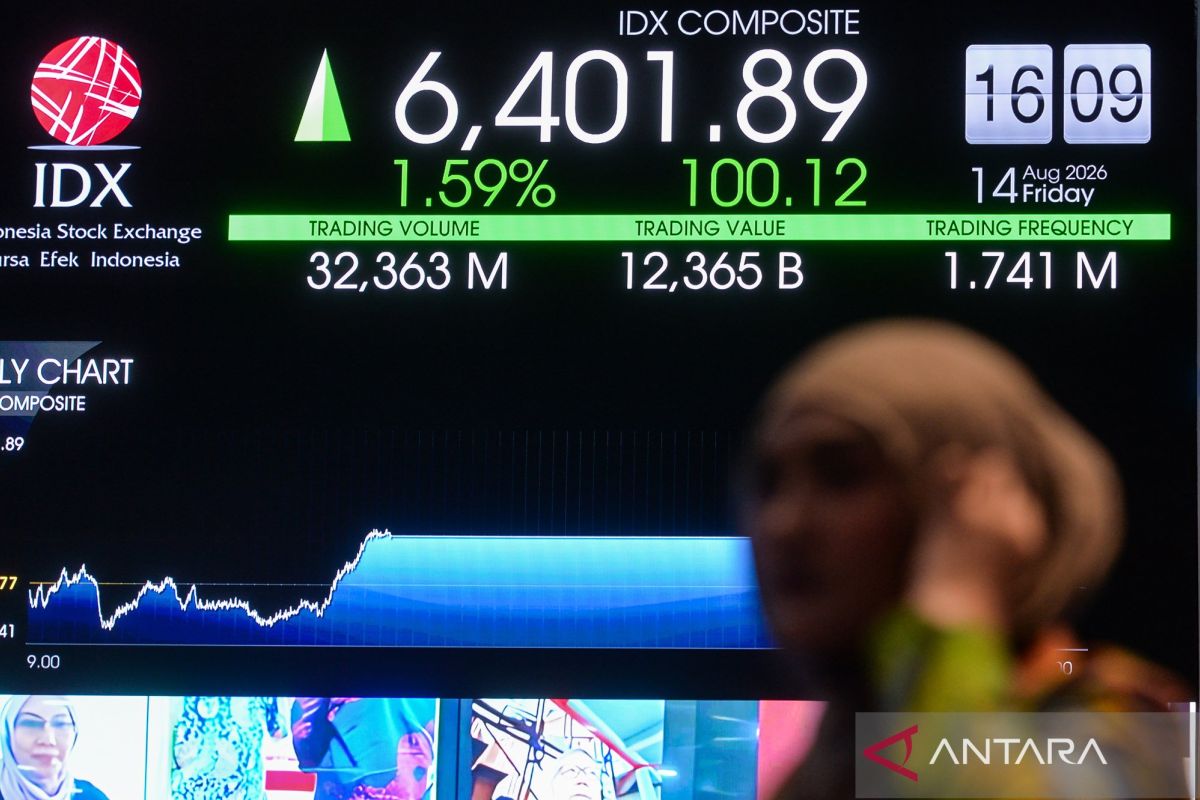
The Indonesia Composite Index (JCI) on the Indonesia Stock Exchange (IDX) closed stronger on Wednesday afternoon, as Bank Indonesia’s (BI) policy was deemed to provide certainty regarding the domestic monetary direction.
The JCI closed up 97.87 points, or 1.56 per cent, to a position of 6,374.91. Meanwhile, the blue-chip group of 45 stocks, known as the LQ45 index, rose 7.57 points, or 1.21 per cent, to 633.18.
“In my view, the significant strengthening of the JCI in the second session was primarily driven by the results of the Bank Indonesia Board of Governors Meeting (RDG), which maintained the BI Rate at 5.75 per cent,” said M Nafan Aji Gusta, Senior Technical Analyst at Mirae Asset Sekuritas Indonesia, when contacted in Jakarta on Wednesday.
According to Nafan, the decision provides certainty for market participants and alleviates concerns regarding the direction of domestic monetary policy, particularly amidst pressure on the Rupiah exchange rate and rising global yields.
“Following the announcement of BI’s decision, large banking stocks responded immediately and positively, becoming one of the main catalysts for the JCI’s strength,” Nafan added.
Furthermore, Nafan noted that positive sentiment from global markets and a rebound in commodity-based stocks helped bolster investor risk appetite after the JCI had corrected significantly by 1.69 per cent in the previous day’s trading.
“From a sectoral perspective, the JCI’s strength was supported by a combination of the financial, basic materials, energy, and consumer cyclicals sectors,” said Nafan.
Prior to the BI decision, Nafan mentioned that the basic materials sector had already been a driver of strength, with commodity stocks also recording significant gains.
However, after the BI Rate was maintained, market attention shifted more strongly towards the banking sector, as interest rate stability can provide better visibility regarding funding costs, asset quality, and net interest margin prospects for banks.
“With their large market capitalisation weights, the strength of these big banks contributed significantly to the JCI’s rise,” said Nafan.
For the remainder of the period, Nafan sees the JCI still having the opportunity to continue a technical rebound, though volatility should still be monitored.
Nevertheless, he noted that today’s gains still need to be confirmed by the index’s ability to remain above the support area and test the nearest resistance.
Fundamentally, he assessed that the BI decision to maintain the BI Rate at 5.75 per cent could serve as a short-term positive catalyst, though the market still faces several external risks such as US Treasury yield movements, the direction of the Fed’s policy, Rupiah fluctuations, oil prices, and foreign fund flows.
“Therefore, for the remainder of this month, the JCI has the potential to move in a volatile sideways pattern with a tendency to rebound, as long as foreign selling pressure does not increase significantly and technical support levels can be maintained,” he said.
According to the IDX-IC Sectoral Index, ten sectors strengthened, with the basic materials sector rising by 3.44 per cent, followed by the energy and non-primary consumer goods sectors, which rose by 2.63 per cent and 2.56 per cent, respectively.
Meanwhile, one sector weakened, with the healthcare sector falling by 0.54 per cent.
Trading frequency was recorded at 1.90 million transactions, with a total of 34.65 billion shares traded worth Rp12.87 trillion. A total of 464 stocks increased, 200 stocks decreased, and 299 remained unchanged.
Source: jawawa.id (https://jawawa.id/newsitem/jci-strengthens-as-bi-policy-provides-certainty-for-domestic-monetary-direction-1790161351)
Originally published by Antara (Indonesian) (https://www.antaranews.com/berita/5754836/ihsg-menguat-seiring-kebijakan-bi-beri-kepastian-arah-moneter-domestik), translated from Indonesian