
JCI Rebounds as Investors Welcome BI’s Decision to Hold Its Policy Rate
Jakarta (ANTARA) – M Nafan Aji Gusta, Senior Technical Analyst at Mirae Asset Sekuritas Indonesia, said the Jakarta Composite Index (JCI) had rebounded partly because market participants welcomed Bank Indonesia’s (BI) decision to keep its policy rate, known as the BI-Rate, at 5.75 per cent.
He said BI had also remained consistent in its strategy to stabilise the rupiah amid strong external pressures, supporting its inflation target of 2.5 per cent, plus or minus 1 percentage point, in 2026 and 2027, while promoting sustainable economic growth.
“Even so, the JCI’s recovery needs to be watched carefully, as sentiment surrounding MSCI’s review of Indonesia’s classification has not fully subsided. The current rebound is therefore better viewed as an early recovery phase that still needs confirmation from sustained buying, rupiah stability and effective capital-market reforms,” Nafan told ANTARA in Jakarta on Wednesday.
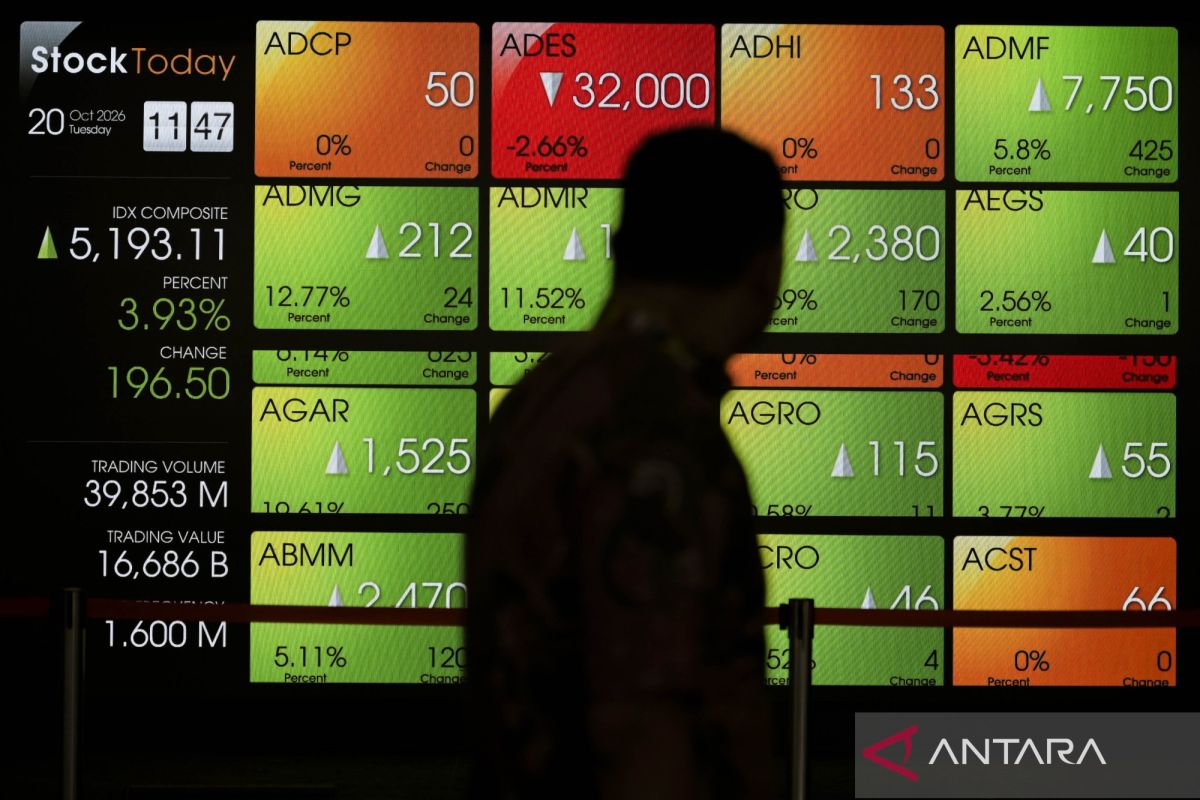
Nafan said the JCI’s rebound in Wednesday’s trading reflected a combination of technical recovery after significant selling pressure on Tuesday (20 October).
At 2.45 pm local time on Wednesday (21 October), the JCI had risen 18.54 points, or 0.35 per cent, to 5,297.43, after closing the first trading session down 44.53 points, or 0.84 per cent, at 5,234.36.
“Bargain-hunting in shares that had fallen sharply, as well as a positive response to capital-market improvements undertaken by the Financial Services Authority (OJK) and the Indonesia Stock Exchange (IDX),” Nafan said.
By sector, he said the rebound was supported by large-cap shares, particularly in banking, energy and mining, as well as basic materials and consumer goods.
Banking shares had driven the recovery because of their significant weighting in the index and relatively high liquidity, he said. Changes in buying interest in leading shares can therefore have a substantial effect on the JCI.
Meanwhile, energy and mining could receive support from movements in global commodity prices, while consumer shares may attract investors seeking companies with relatively stable demand.
“Nevertheless, sectoral gains need to be confirmed by transaction data and actual price movements, since a rebound in the index does not necessarily mean that shares have risen across the board,” Nafan said.
Global investors remain cautious about Indonesian equities, Nafan said, particularly because of concerns over share-ownership transparency, disclosure of free float and the risk of Indonesia’s classification being changed by MSCI.
This has led foreign investors to be more selective about their exposure to domestic assets as they wait for concrete evidence that capital-market reforms can improve the market’s credibility and accessibility, he added.
Domestic investors, meanwhile, may take advantage of sharp corrections to selectively accumulate shares in companies with strong fundamentals and attractive valuations.
“However, bargain-hunting does not necessarily indicate a broad-based recovery in confidence. Key indicators to watch are sustained foreign fund flows, improved transaction quality and the JCI’s ability to maintain its gains after the rebound,” Nafan said.
In the short term, he forecast that the JCI could extend its technical recovery, although volatility was expected to remain high as investors monitored developments concerning MSCI, rupiah stability and the implementation of capital-market reforms.
A rise accompanied by higher trading volume and improved foreign fund flows would indicate that the rebound had a stronger foundation, he said.
Conversely, if gains were driven only by speculative buying and were not accompanied by an improvement in investor confidence, the JCI could come under renewed selling pressure.
Over the medium term, the index’s outlook would depend largely on the OJK and IDX’s success in improving ownership transparency, strengthening the credibility of price formation and enhancing investor protection, Nafan said.
“If these reforms are implemented consistently, the prospects for restoring market confidence will improve. The recommended investment strategy is to accumulate gradually in fundamentally solid, sufficiently liquid shares with attractive valuations, while maintaining disciplined risk management,” he said.
Source: jawawa.id (https://jawawa.id/newsitem/jci-rebounds-as-investors-welcome-bis-decision-to-hold-its-policy-rate-1792572861)
Originally published by Antara (Indonesian) (https://www.antaranews.com/berita/5801697/ihsg-rebound-analis-sebut-pelaku-pasar-apresiasi-bi-rate-ditahan), translated from Indonesian