
JCI Plunges Over 1% Following S&P Warning
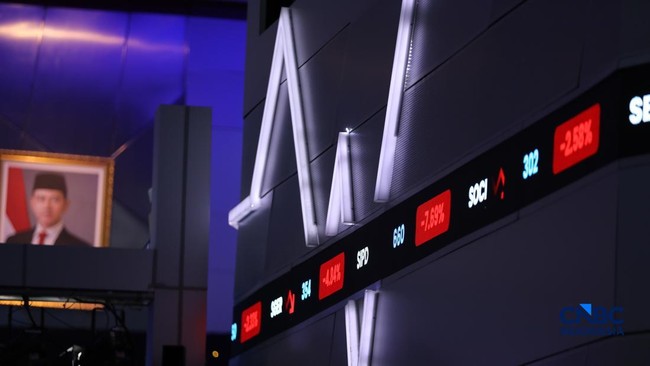
The Indonesia Composite Index (IHSG) plummeted by more than 1% in early trading on Tuesday (7/7/2026), halting the gains seen in the previous session despite market optimism regarding domestic stock market prospects.
Based on Indonesia Stock Exchange (IDX) data via IDX Mobile as of 09:36 WIB, the IHSG stood at 5,907.70, down 79 points or 1.32% from the previous close of 5,986.50.
Transaction value was recorded at Rp 2.59 trillion, with trading volume reaching 6.02 billion shares across 568,000 transactions. A total of 134 stocks were in the green zone, while 4lar 479 stocks weakened and 114 stocks remained stagnant.
All trading sectors weakened, with the deepest corrections recorded in the basic materials, property, and consumer sectors. The primary contributors to the IHSG’s decline today included BBRI, AMMN, SMRI, BBCA, and MORA.
The Indonesian financial market is expected to face pressure today due to significant negative sentiment from abroad, particularly the warning from S&P Global Indices.
Global index provider S&P Dow Jones Indices (S&P DJI) has maintained the Indonesia Stock Exchange (IDX) classification as an Emerging Market. However, in its latest announcement, the institution also issued a serious threat should several issues in the domestic capital market remain unresolved.
In the Country Classification - 2026/2027 Watchlist released on 7 July 2026, S&P DJI placed Indonesia on the 2027 Watchlist. This means Indonesia is now under monitoring by the index provider for a potential change in classification during the 2027 annual review. Indonesia, currently classified as Emerging, faces the potential reclassification to Special Measures/Frontier.
The core issue causing S&P DJI to place Indonesia under monitoring is the issue of share ownership transparency and its impact on liquidity and the reliability of price formation in the market.
Global institutional investors frequently question the lack of openness regarding share ownership structures in the Indonesian exchange, alongside concerns regarding alleged coordinated trading patterns. Both factors make it difficult for foreign investors to measure true free float and cast doubt on whether market prices truly reflect fair mechanisms.
On a positive note, S&P DJI noted that Indonesian authorities—ranging from the OJK to the IDX—have taken several regulatory steps to address these issues. However, S&P issued a firm note: if these problems are not resolved, Indonesia could be subject to Special Measures or even reclassified as a Frontier Market during the 2027 review.
Conversely, if market transparency and liquidity improve, positive sentiment will flow, and Indonesia’s Emerging Market status could be maintained.
This warning from S&P DJI comes amidst similar pressure from another global index provider, MSCI, which had previously highlighted issues within the Indonesian exchange.
In the MSCI 2026 Market Classification Review released in late June 2026, MSCI maintained Indonesia as an Emerging Market. However, MSCI downgraded Indonesia’s ‘Information Flow’ criteria from a ‘no issue’ category to a category requiring improvement.
MSCI highlighted three structural issues almost identical to the concerns raised by S&P: opacity in share ownership structures, indications of coordinated trading patterns disrupting price formation, and the lack of English-language information availability for foreign investors.
The agency warned that if adequate progress is not visible by the November 2026 Index Review, MSCI will consider further steps, including the possibility of reclassifying Indonesia from an Emerging Market to a Frontier Market.
This pressure carries real consequences. Foreign capital continues to exit the Indonesian stock market, with net foreign selling on the Indonesia Stock Exchange reaching approximately US$3.6 billion year-to-date. A downgrade by either MSCI or S&P risks triggering even larger capital outflows, as global passive funds track indices tied to specific market tiers.