
JCI Plunges Over 1% Dragged Down by Major Bank and Conglomerate Stocks
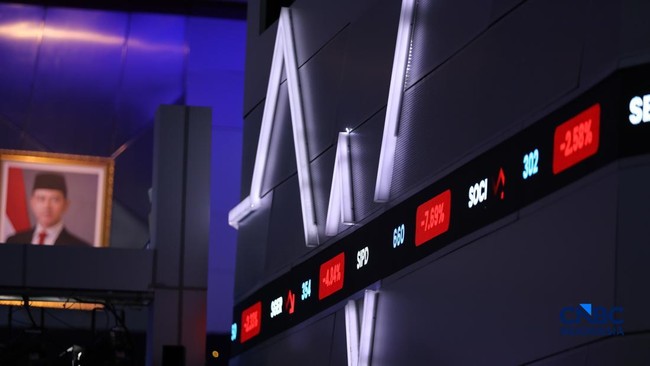
The Jakarta Composite Index (JCI) plummeted sharply after opening higher at 6,383.81 during trading on Monday (10/8/2026). According to data from the Indonesia Stock Exchange (BEI), by 09:14 WIB the JCI had suddenly slumped to 6,292.28, or weakened by 1.15% from the previous close. The transaction value reached Rp 3.85 trillion with a trading volume of 9.94 billion shares across 502,193 transactions. A total of 133 stocks advanced, 451 stocks declined, and 139 stocks remained unchanged. The decline in the JCI today was triggered by the falling prices of conglomerate stocks, led by deep drops recorded by BBCA and DSSA. Citing Refinitiv data, all trading sectors weakened today. Specifically, BBCA shares were the biggest drag on the JCI’s performance today, followed by DSSA, VKTR, BREN, IMPC, and BRPT. The JCI’s movement today remains overshadowed by a number of sentiments coming from both domestic and global sources. US President Donald Trump on Monday responded to Iran’s demands for a peace deal with new demands that Tehran pay compensation for casualties resulting from wars, attacks, and demonstrations. Trump said Iran must pay for the damage caused over the last 50 years, including compensation for US civilians and troops killed in the region. This new demand has the potential to further complicate efforts to reopen the Strait of Hormuz. Previously, Iran had demanded compensation, an end to sanctions, and a halt to US military threats as conditions for reopening the strategic waterway. Oil prices surged around 5% on Monday due to doubts that the US and Iran would reach an agreement to reopen ship traffic in the Strait of Hormuz. WTI closed at US$82.13 per barrel, while Brent was at US$87.72 per barrel. Domestically, after a very prolonged period of net selling, foreign investors have begun to enter the Indonesian stock market, albeit in a limited manner. In Monday’s trading, foreigners were observed booking a net foreign inflow of Rp 829.69 billion in the all market, but recorded a net foreign sell of Rp 875.51 billion in the regular market. Out of 141 trading days since 2 January, foreigners have recorded net sells on 93 days and net buys on 48 days. Thus, one session of significant buying has not erased the year-long distribution trend. Consequently, year-to-date data shows the stock market has experienced a net foreign outflow of Rp 70.46 trillion in the all market and Rp 95.37 trillion in the regular market. The Indonesian stock market had previously recorded a very large net buy on Friday the previous week, amounting to Rp 1.24 trillion in the overall market, while the regular market experienced a net inflow of Rp 917.23 billion. This entry of foreign funds is good news after foreigners fled en masse during the May-July 2026 period. However, this foreign push remains very limited.