
JCI Plunges Due to Global Sentiment, Oil Prices, and Rupiah Weakness
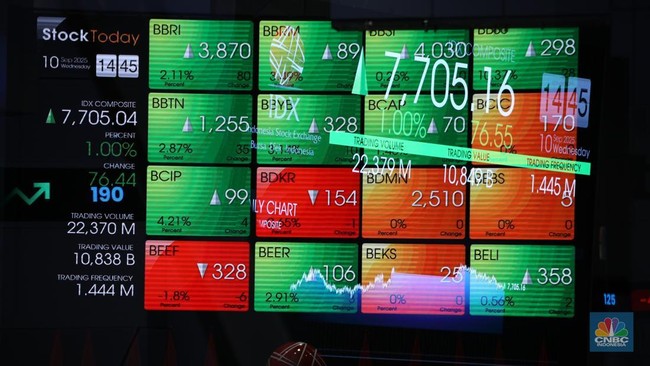
The Jakarta Composite Index (JCI) came under significant pressure during the second trading session today, Thursday (30/4/2026), with a decline of more than 2%. At the end of the second session, the JCI was recorded at 6,956.80, down 144 points (-2.03%) and marking the lowest JCI level throughout 2026. In fact, since the beginning of the year, the JCI has corrected by nearly 20%.
The significant weakening of the JCI occurred alongside the rupiah’s depreciation due to global economic uncertainty stemming from tensions in the Middle East, which ultimately led to a rise in global crude oil prices.
Only 133 stocks rose, 576 fell, and 105 were stagnant. Transaction value reached Rp 21.88 trillion with a trading volume of around 48.20 billion shares in more than 2.66 million transactions.
All trading sectors weakened, with the deepest corrections recorded in infrastructure, basic materials, and energy.
Rupiah Exchange Rate Weakness Due to Global Oil Price Surge
Currencies exposed to oil prices have fallen 2.2% in April, marking the largest monthly decline since October 2024. High oil prices add to the list of concerns challenging these currencies, including fiscal health.
Oil prices surged to a four-year high after Axios reported that the US is considering potential military action against Iran, heightening concerns about supply disruptions.
“The Middle East shock has tightened the constraints facing Indonesia. Higher oil bills worsen fiscal considerations, and higher risk premiums make the IDR more sensitive,” said Krystal Tan, Asia economist at ANZ.
Tan also raised her forecast for Indonesia’s 2026 inflation to 3.5% from 3.0%, and expects Indonesia’s central bank to raise interest rates twice, by 25 basis points each, to 5.25% by year-end.
Most emerging market stocks in Asia declined, led by the JCI’s more than 2% drop to its lowest level since 16 March.
In East Asia, South Korea’s KOSPI fell 1.4%, while Taiwan’s benchmark index lost 1%, as higher oil prices and supply disruption fears overshadowed Samsung Electronics’ 50-fold profit surge and largely positive earnings from US tech giants.
Rising Middle East tensions threaten to slow the tech-driven rally momentum in Seoul and Taipei, which helped both benchmark indices post their best trading months in decades.
Taiwan stocks recorded their best monthly performance since December 2001, while the KOSPI rose 30.6% in April, its best month since January 1998. Confidence in tech stocks grew as chipmakers continued to post strong revenues driven by AI demand. Samsung has risen 88.5% this year, while SK Hynix’s market cap has nearly doubled to $625.75 billion.
In Southeast Asia, the Philippine stock exchange fell up to 0.9%, while Thai stocks dropped 0.4%.
Contrary to the overall trend, Singapore’s stock exchange rose 0.6%, ending a six-session decline. The gain was mainly led by major banks in the city-state, after DBS Group posted better-than-expected first-quarter revenue.
Other Asian currencies also fell. The Philippine peso weakened slightly, touching an all-time low of 61.693 per dollar in early trading. The Malaysian ringgit fell 0.5%.
Analysts at Doo Financial Futures said the sentiment hitting the JCI remains centred on ongoing global geopolitical uncertainty.
“Overall, the global mood is still risk-off due to Middle East peace uncertainty, rising oil prices in response to Trump’s latest military threats, and last night’s hawkish FOMC,” they said when contacted by CNBC Indonesia on Thursday (30/4/2026).
Moreover, there are no domestic drivers that can serve as a fresh wind for the Indonesian stock market. The rupiah’s value continues to hit new lows, compounded by budget deficit concerns. Not to mention the MSCI rebalancing issues that still loom.
“There are no sentiments that can lift it, although valuations of some blue-chip stocks are already quite attractive, but geopolitical downside and AI bubble risks still threaten,” they added.
MNC Sekuritas analyst Herditya echoed this, saying that JCI strengthening will likely be limited and there is still potential for further weakening ahead.
“From a sentiment perspective, the rupiah’s exchange rate still weakening against the USD at 17,390 remains a capital market sentiment,” he said.
Additionally, Asian regional market movements are tending towards correction, plus banking and energy issuers weighing on JCI movements.
“In our technical report, there is potential for the JCI to breach the 6,917 area and head towards 6,727-6,800. For sentiment itself, up to now, nothing supports strengthening,” he concluded.