
JCI Plunges as Investors Weigh Indonesia's Security Stability Risks
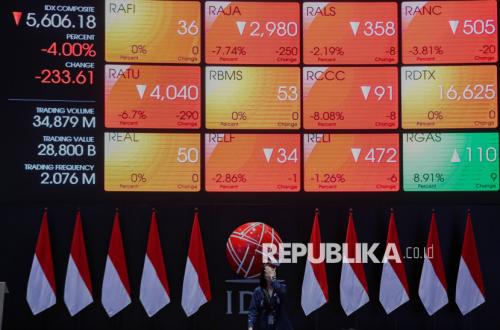
The Jakarta Composite Index (JCI) of the Indonesia Stock Exchange (IDX) closed lower on Wednesday (26/8/2026) as investors remained cautious about domestic security stability risks. The JCI closed down 95.98 points, or 1.48 per cent, at 6,405.69. Meanwhile, the LQ45 index of 45 leading stocks fell 9.40 points, or 1.46 per cent, to 632.55.
“Market attention is focused on national security stability as well as macroeconomic fundamentals. Market players hope that demonstrations proceed peacefully so that domestic security stability is maintained,” said Maximilianus Nico Demus, Associate Director of Research and Investment at Pilarmas Investindo Sekuritas, in his analysis in Jakarta on Wednesday (26/8/2026).
Domestically, market players are focusing on the planned demonstration in front of the DPR/MPR RI building on Thursday (27/8), with one of the demands being the ratification of the Asset Forfeiture Bill.
On the other hand, market players responded to Fitch Ratings’ assessment that the economic growth assumption of 6.0 per cent in 2027 in the 2027 State Budget Draft (RAPBN) is more realistic. However, Fitch noted that geopolitical uncertainty, rising oil prices, and undisciplined fiscal policy could potentially affect Indonesia’s economic growth target.
Market players are also watching the fit and proper test agenda for the Bank Indonesia (BI) governor candidate, with Destry Damayanti as the sole candidate proposed by the government. “Market players are waiting for the views of the new BI governor regarding monetary policy direction, inflation control, rupiah exchange rate stability, and strategies for maintaining foreign capital flows,” said Nico.
From abroad, Asian regional markets strengthened amid signs of progress in Middle East talks, easing concerns about potential global energy supply shortages. Pakistan said it had made significant progress in talks with Iran aimed at ending the war. At the same time, the foreign ministers of Iran and Oman said they discussed plans for a temporary transit corridor through the Strait of Hormuz, along with a project to clear mines from the waterway.
“Thus, the decline in oil prices and reduced concerns about disruption in the Strait of Hormuz also reduces pressure on inflation,” said Nico.
On the other hand, market players are watching the developments of the China National People’s Congress Standing Committee meeting taking place on 25–28 August 2026. The meeting is being closely monitored for policy support following weak economic data and repeated promises from policymakers to boost growth.
Opening higher, the JCI moved into negative territory until the close of the first trading session. In the second session, the JCI remained in the red until the close of stock trading.
Based on the IDX-IC Sectoral Index, all 11 sectors weakened. The transportation and logistics sector fell the deepest by 4.04 per cent, followed by the energy and property sectors, which fell by 2.40 per cent and 2.35 per cent respectively.
The stocks that experienced the largest price gains were TMPO, NICE, SAFE, BIKE, and JAST. Meanwhile, the stocks that experienced the largest price declines were PADA, PSKT, TAMA, FUTR, and PIA.
Stock trading frequency was recorded at 2,489,000 transactions with 40.15 billion shares traded worth Rp 18.06 trillion. A total of 136 stocks rose, 599 stocks fell, and 228 stocks were unchanged.
Asian regional stock markets this afternoon included the Nikkei index strengthening 0.61 per cent to 66,258.00, the Shanghai index strengthening 0.59 per cent to 3,912.52, the Hang Seng index strengthening 0.56 per cent to 25,652.97, the Kospi index strengthening 0.97 per cent to 6,808.21, and the Straits Times index weakening 0.24 per cent to 5,721.88.