
JCI Plummets as Indonesia Faces Potential MSCI Downgrade
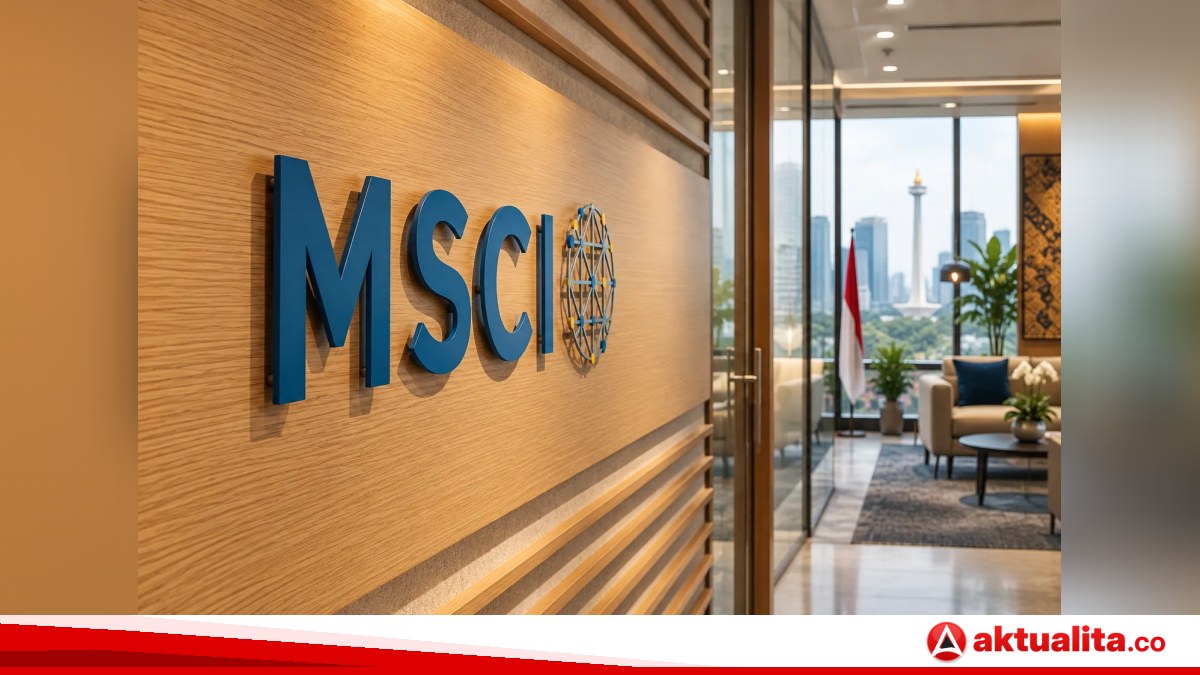
Jakarta, Aktualita.co — The Indonesian stock market is facing immense pressure after global index provider MSCI raised the possibility of downgrading Indonesia’s capital market classification from Emerging Market to Standalone Market. This threat is not merely a matter of status change but has the potential to trigger a massive exodus of foreign funds from the Indonesia Stock Exchange (IDX).
These concerns were immediately reflected in trading on Friday (10/16/2026). The Jakarta Composite Index (JCI) plummeted by as much as 11.4 percent, marking its deepest intraday decline since January 1998. The selling pressure also led to a 30-minute trading halt.
Several large-cap stocks were hit hard. Banking stocks such as PT Bank Central Asia Tbk (BBCA), PT Bank Rakyat Indonesia Tbk (BBRI), and PT Bank Mandiri Tbk (BMRI) saw declines approaching 15 percent.
However, Indonesia has not officially lost its emerging market status. The MSCI announcement dated October 15, 2026, remains a reclassification proposal that will be discussed with international market participants.
Why Does MSCI Want to Downgrade Indonesia?
In its official statement, MSCI highlighted issues regarding share ownership transparency, high ownership concentration, and alleged coordinated trading activities in the Indonesian capital market.
These issues are considered to reduce the level of investability, especially for global institutional investors who require accurate ownership information, adequate liquidity, and transparent trading mechanisms.
In reality, Indonesian regulators have announced several reform measures. These include increasing the disclosure of shareholders with ownership above 1 percent, refining investor classifications, reporting share ownership concentration, and plans to increase the minimum public float to 15 percent.
However, MSCI believes these developments have not yet shown consistent and convincing results across the entire market.
MSCI even views a downgrade to the Frontier Market category as insufficient to reflect the depth of the issues concerning global investors.
Therefore, the option currently being consulted is a direct shift to a Standalone Market, a market category outside the main MSCI Emerging Markets and Frontier Markets index groups.
What Does It Mean If Indonesia Becomes a Standalone Market?
MSCI classification plays a crucial role as it is used by international investment managers to determine fund allocations across various countries.
Currently, Indonesia is still classified as an Emerging Market, so stocks that meet the criteria can be included in the emerging market index, which serves as a benchmark for global mutual funds and institutional investors.
If the status changes to Standalone Market, Indonesian stocks risk being removed from the MSCI Emerging Markets index and several related global indices.
The consequences are significant. Passive fund managers who track index composition must adjust their portfolios, including selling Indonesian stocks that are no longer constituents of the index.
Meanwhile, active fund managers may reconsider their exposure to Indonesia because the classification change affects their benchmarks and investment mandates.
However, an MSCI status change does not mean all foreign investors are prohibited from buying Indonesian stocks. These stocks can still be traded and owned as long as they comply with applicable capital market regulations.
Potential for Billions of Dollars in Foreign Capital Outflow
The biggest risk of an MSCI classification change is the increased pressure of capital outflows.
UBS calculations estimate that reclassifying Indonesia as a Standalone Market could trigger the sale of approximately 4 billion USD by passive investors. The potential outflow from active investors is estimated to reach 15 billion USD.
These figures are estimates based on a scenario where the reclassification is fully implemented, not funds that have already been confirmed to leave.
Market pressure has actually been occurring throughout 2026. As of the latest update on October 16, foreign investors were recorded as having net sold approximately 4.7 billion USD worth of Indonesian stocks.
This risk has also spread to the foreign exchange market. The Rupiah weakened to around 18,070 IDR per USD as concerns over the outlook for the Indonesian capital market increased.
If capital outflows continue to grow, pressure on the exchange rate and the need for financial market stabilization could increase.
Are Large Bank Stocks and the JCI Most Vulnerable?
Large-cap stocks have the potential to face the most tangible pressure because they are generally the primary choice for institutional investors and carry significant weight in the stock market index.
BBCA, BBRI, and BMRI are among the stocks that need to be watched as foreign fund managers adjust their investment allocations.
Large-scale selling can increase volatility, even when the company’s operational conditions have not changed in proportion to the decline in stock prices.
Furthermore, the exit of institutional investors can reduce market liquidity. In the long term, this condition has the potential to increase the cost of capital raising for companies that need funding through the exchange.
Nevertheless, price movements are not determined solely by MSCI. Earnings performance, credit growth, economic conditions, interest rate policies, and company valuations remain important factors in determining a stock’s prospects.
IDX and OJK Speak Out
IDX President Director Jeffrey Hendrik stated that his party would request further clarification from MSCI regarding the basis of the assessment used in the proposed classification change.
“The IDX respects MSCI’s independence in conducting assessments and determining market classifications based on its methodology,” said Jeffrey in Jakarta, Friday (10/16/2026).
The IDX emphasized that several reforms have been carried out to strengthen the transparency, integrity, and quality of Indonesian stock trading.
Meanwhile, Chairman of the Board of Commissioners of the Financial Services Authority (OJK) Friderica Widyasari Dewi believes the domestic capital market still has good prospects.
“We believe the domestic capital market remains prospective and attractive,” said Friderica in her official statement, Friday (10/16/2026).
The OJK stated it would continue to make improvements, including strengthening law enforcement and following up on various inputs regarding market integrity.
What Should Investors Do?
For retail investors, the threat of an MSCI status downgrade should be watched, but it is not automatically a reason to sell all stock holdings.
Investors need to distinguish between price declines due to market sentiment and the deterioration of a company’s fundamental conditions. Stocks that have fallen sharply are not necessarily cheap if liquidity risks and market uncertainty remain high.
Conversely, the decision to buy just because the price has fallen also carries risks. Further selling pressure is still possible if foreign investors continue to reduce their holdings.
Reviewing portfolio composition, liquidity needs, risk profiles, and the financial condition of each issuer becomes important while the market is unstable.
Investors also need to pay attention to the progress of Indonesia’s capital market reforms and official communication between regulators and MSCI.
When Will MSCI Announce the Final Decision?
MSCI has set a consultation period with market participants until April 30, 2027, while the final decision regarding Indonesia’s classification change will be announced no later than June 30, 2027.
During this process, temporary restrictions on certain index composition changes for Indonesian stocks will be maintained.
This means the government and capital market authorities still have the opportunity to demonstrate real improvements, especially in ownership transparency, trading supervision, and rule enforcement.
If these improvements are considered convincing enough, MSCI may still reconsider the reclassification proposal.
Conversely, if global investor concerns are not addressed, Indonesia faces the risk of losing its position in one of the most widely used international investment benchmark index groups.
For the Indonesian capital market, this issue is no longer just about maintaining the Emerging Market predicate. The greater challenge is rebuilding investor confidence in the quality, transparency, and credibility of the exchange in the long term.