
JCI Plummets 11.57% and Triggers Trading Halt: What Comes Next?
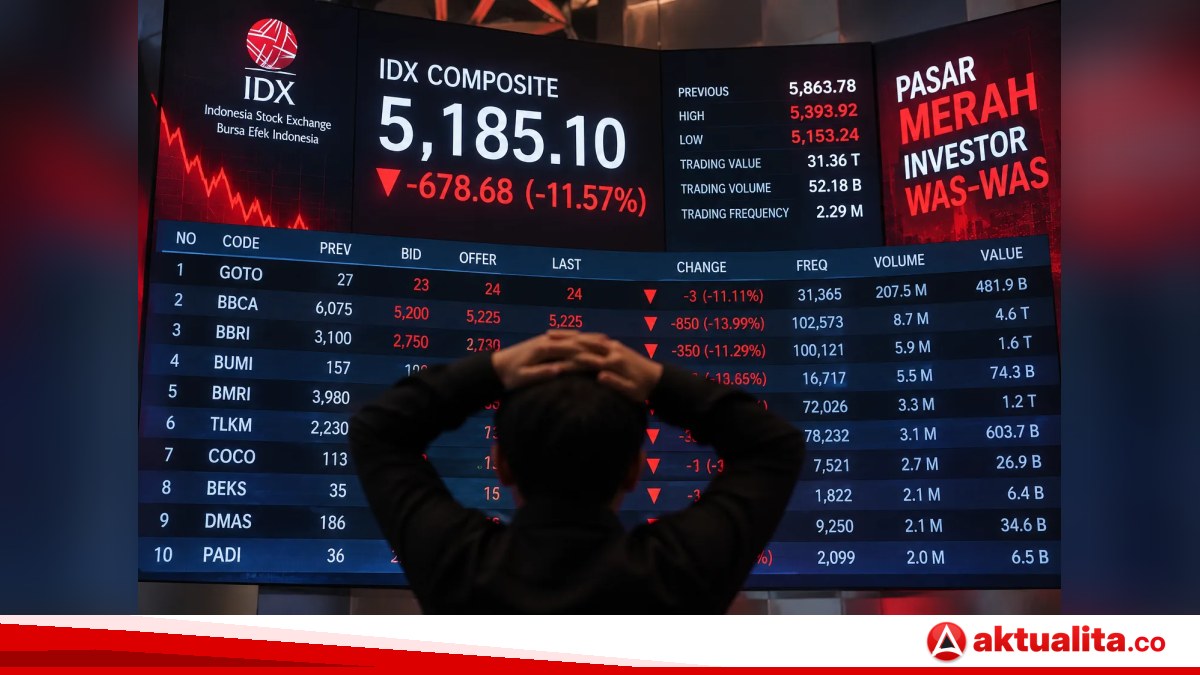
Jakarta, Aktualita.co — The Indonesian stock market experienced a massive shock toward the end of the week. The Composite Stock Price Index (JCI) plummeted during Friday’s trading (10/16/2026), even forcing the Indonesia Stock Exchange (IDX) to temporarily halt trading activities through a trading halt mechanism.
The JCI ultimately closed down by 11.57 percent or 678.68 points to the level of 5,185.10, compared to the previous closing position of 5,863.78.
This fall marks one of the sharpest daily declines in the history of the Indonesian capital market and the deepest since the 1998 Asian financial crisis.
It was not just small-cap stocks that were pressured. A number of blue-chip stocks, including banking issuers and other large companies, also experienced massive sell-offs.
This situation raises questions among investors: why did the JCI fall so deeply, will the selling pressure continue, and what is the fate of the Indonesian stock market when trading reopens on Monday, October 19, 2026?
Chronology of the JCI Plunge and Trading Halt
Pressure on the stock market was already visible from the opening of Friday morning’s trading.
The JCI immediately weakened by 469.86 points or 8.01 percent to the position of 5,393.92. The rapid decline prompted the IDX to activate the temporary trading halt mechanism.
Based on the official IDX announcement, the trading halt was implemented at 08:58 WIB and trading resumed at 09:28 WIB.
“The IDX is taking this step to ensure that stock trading remains orderly, fair, and efficient,” the IDX wrote in its official announcement on Friday (10/16/2026).
However, the 30-minute halt did not immediately stop the selling pressure.
After trading resumed, the JCI continued to move in the red zone until it finally closed at the 5,185.10 level.
On a weekly basis, the index has lost approximately 14.91 percent from the previous Friday’s closing position.
MSCI Is the Main Trigger for the Indonesian Stock Crash
One of the strongest factors influencing market panic is the latest announcement from the global index provider, Morgan Stanley Capital International (MSCI).
On October 15, 2026, MSCI announced a consultation regarding the potential downgrade of the Indonesian stock market classification from Emerging Market to Standalone Market.
This status is important because the MSCI index serves as a benchmark for many international investment fund managers in determining portfolio allocation.
MSCI highlighted issues regarding the transparency of share ownership structures, ownership concentration, and alleged coordinated trading activities.
The institution also assessed that various reforms announced by Indonesian authorities still require proof through consistent implementation and enforcement of rules.
However, the downgrade of Indonesia’s status is not yet a final decision.
MSCI has opened an opportunity for feedback until April 30, 2027, and will announce the decision no later than June 30, 2027.
This means Indonesia still has the opportunity to improve capital market governance to avoid such a classification change.
Banking Stocks and Large Issuers Also Under Pressure
Concerns over the MSCI decision caused the sell-off to spread across various sectors.
At the start of Friday’s trading, shares of PT Bank Rakyat Indonesia (Persero) Tbk (BBRI) were recorded to have fallen by approximately 14.84 percent, while PT Bank Mandiri (Persero) Tbk (BMRI) weakened by approximately 14.82 percent.
Shares of PT Telkom Indonesia (Persero) Tbk (TLKM) also experienced sharp pressure, with a decline of approximately 14.80 percent in the early session.
Some stocks even hit the auto rejection bawah (ARB) limit, which is the maximum limit for a stock price decline in a single trading day.
This condition shows that the pressure did not only occur on speculative stocks but also reached stocks that have been the focus of institutional investors.
In addition to the change in stock prices, foreign investors were recorded as having made net sales of approximately Rp3.35 trillion in the Indonesian stock market on Friday.
This capital outflow adds to concerns regarding the domestic market’s ability to withstand further pressure.
OJK Announces Rp2.1 Trillion in Sanctions
Amid market turmoil, the Financial Services Authority (OJK) announced administrative sanctions with total fines reaching Rp2.1 trillion related to violations in trading and public offerings of shares.
The investigation is related to share transactions of PT Dian Swastatika Sentosa Tbk (DSSA), as well as the public offering processes of PT Barito Renewables Energy Tbk (BREN) and PT Petrindo Jaya Kreasi Tbk (CUAN).
The OJK, through the Chief Executive of Capital Market Supervision Hasan Fawzi, emphasized that the fines were imposed on the parties involved in the violations, not on the three listed companies themselves.
This law enforcement step is part of the regulator’s efforts to improve the integrity and transparency of the capital market.
However, investor attention is now focused on the effectiveness of these reforms in restoring international market confidence.
Could a Trading Halt Happen Again on Monday?
The trading halt mechanism is an official procedure used by the IDX when the JCI experiences an extreme decline.
Based on applicable regulations, trading can be halted for 30 minutes if the JCI falls by more than 8 percent in a single trading day.
Subsequent temporary halts can be carried out if the decline continues past 15 percent.
Meanwhile, if the decline exceeds 20 percent, the IDX can implement a trading suspension in accordance with applicable regulations.
Thus, the possibility of a trading halt occurring again on Monday remains open if selling pressure reaches those thresholds.
However, there is no basis to confirm that a trading halt will occur again.
JCI Prediction for Monday, October 19, 2026: Further Decline or Rebound?
Monday’s trading is expected to be an important test for investor confidence after the sharp fall on Friday.
There are two main possibilities to consider.
First, selling pressure may continue if foreign investors continue to reduce their Indonesian stock holdings and the market has not received certainty regarding the regulator’s follow-up steps.
Second, the JCI has the opportunity to experience a technical rebound, which is a temporary rise after an extreme decline, especially if the sell-off begins to subside and buying emerges in stocks that have experienced large corrections.
However, stocks that have fallen sharply are not necessarily cheap if the company’s risks and business prospects also change.
Investors also need to pay close attention to the movement of the rupiah exchange rate, foreign fund flows, global market developments, and official statements from the government, OJK, and IDX.
What Is the Fate of Investors Whose Stocks Are Already at a Loss?
For investors whose portfolios have experienced sharp declines, the decision to sell or hold stocks should not be based solely on the JCI’s movement in a single day.
The issuer’s fundamental conditions, debt levels, ability to generate profit, trading liquidity, and the individual needs of each investor remain important considerations.
Investors with margin financing also need to pay attention to the risk of margin calls when portfolio values fall.
The JCI’s fall on Friday shows how quickly global sentiment can affect the Indonesian stock market.
Now, attention is focused on the opening of trading on Monday, October 19, 2026. Will the market begin to find balance, or will the selling pressure continue?
The answer is not yet certain. However, one thing is becoming clearer: restoring investor confidence requires real improvements in transparency, supervision, and the integrity of the Indonesian capital market.
Source: jawawa.id (https://jawawa.id/newsitem/jci-plummets-11-57-and-triggers-trading-halt-what-comes-next-1792309811)
Originally published by aktualita.co (https://aktualita.co/en/economy/jci-plummets-1157-triggering-trading-halt-what-happened-to-ri)