
JCI Plummets 11.57% After MSCI Warning as OJK Moves to Reassure Investors
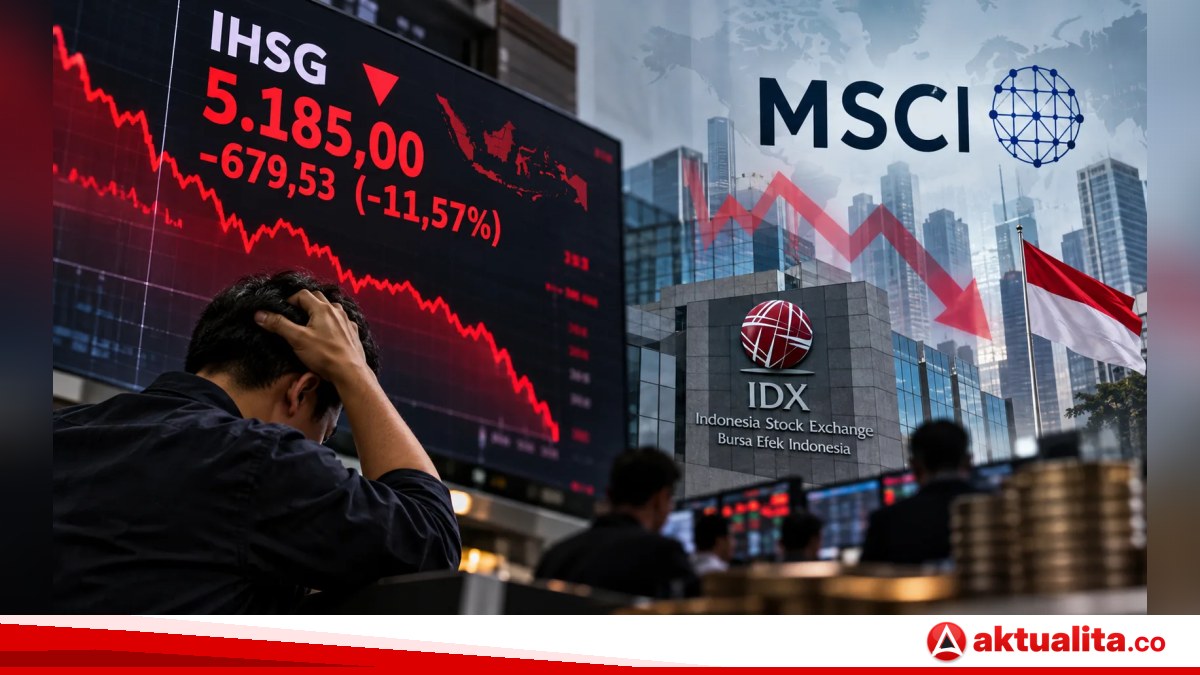
Jakarta, Aktualita.co — The Indonesian stock market is under intense pressure after global index provider MSCI opened the possibility of downgrading Indonesia’s capital market classification from an emerging market to a standalone market.
The news immediately shook investor confidence. During trading on Friday, October 16, 2026, the Jakarta Composite Index (JCI) closed down 11.57 percent to a level of approximately 5,185, marking its deepest daily decline since the 1998 Asian financial crisis.
Selling pressure was evident from the opening bell. The JCI plunged more than 8 percent, triggering a temporary trading halt on the Indonesia Stock Exchange (IDX).
Investor concerns are not only about falling stock prices but also the threat of massive foreign capital outflows if MSCI proceeds with changing Indonesia’s market status.
Amid this turmoil, the Financial Services Authority (OJK) stated it would strengthen capital market reforms and follow up on various notes regarding transparency and stock trading integrity.
Why Can MSCI Shake the JCI?
MSCI is a global index provider that serves as a benchmark for various investment management firms, including pension funds, mutual funds, and international institutional investors.
A change in a country’s classification can influence investment decisions because some fund managers must adjust their portfolios based on the indices they track.
In an announcement dated October 15, 2026, US time, MSCI stated it would consult on a proposal to reclassify Indonesia from an emerging market to a standalone market.
This move relates to concerns regarding the transparency of share ownership structures, ownership concentration, alleged coordinated trading practices, and the effectiveness of market supervision.
MSCI assesses that various reforms announced by Indonesian authorities have not yet shown consistent and adequate impact on improving market governance.
However, the status change is not yet a final decision.
MSCI has opened a consultation period until April 30, 2027, and will announce its final decision no later than June 30, 2027.
This means there is still an opportunity for Indonesia to demonstrate real progress in addressing the issues of concern to global investors.
JCI Plummets, Rupiah Also Under Pressure
The MSCI announcement was immediately met with a negative response from market participants.
A number of large-cap stocks, particularly in the banking, mining, energy, and telecommunications sectors, experienced sharp selling pressure.
Some stocks even approached the daily price decline limits set by the exchange.
The 11.57 percent decline in the JCI on Friday became one of the most serious events for the Indonesian capital market in nearly three decades.
The pressure also spilled over into the foreign exchange market. The rupiah exchange rate weakened to around Rp18,070 per US dollar before trimming some of its losses.
This condition shows how concerns over stock market governance can impact investment sentiment more broadly.
However, the index decline does not automatically indicate that all listed companies are experiencing a decline in fundamental performance.
Market movements are also influenced by sentiment, liquidity needs, and investor decisions to reduce exposure to assets deemed risky.
Threat of Up to 19 Billion USD in Foreign Capital Outflow
One of the biggest risks of an MSCI classification change is the potential for foreign investment outflows.
If Indonesian stocks are removed from the emerging market index, investment managers tracking that index may have to adjust their portfolios.
Passive funds generally follow the composition of their benchmark index. Meanwhile, active fund managers have greater flexibility, although they still consider changes in market status.
Based on UBS estimates reported on October 16, 2026, Indonesia’s reclassification could trigger an outflow of approximately 4 billion USD from passive investments.
Active investors are also estimated to potentially reduce their holdings by around 15 billion USD.
If both scenarios occur, the total potential outflow could reach 19 billion USD.
Although the value is significant, the figure is still an estimate of risk, not funds that have already left Indonesia.
The actual amount of capital outflow will depend on MSCI’s decision, market conditions, and the response of international investors.
OJK Moves, Capital Market Reforms Strengthened
Chair of the OJK Board of Commissioners, Friderica Widyasari Dewi, stated that her party respects MSCI’s independence and is closely examining various issues that still need improvement.
The OJK also emphasized that the Indonesian capital market still has prospects supported by the national economic fundamentals.
“We believe the domestic capital market remains prospective and attractive,” said Friderica Widyasari Dewi in an official OJK statement, Friday (10/16/2026).
According to the OJK, the growth of the investor base, competitive stock valuations, and the fundamental performance of issuers are several factors that still support Indonesia’s investment appeal.
However, this optimism must be accompanied by concrete steps to address investor concerns.
Some reforms of concern include increasing the disclosure of share ownership above 1 percent, detailing investor classifications, reporting share ownership concentration, and a roadmap to increase the minimum free float requirement to 15 percent.
These policies are directed at increasing transparency, strengthening governance, and providing more adequate information to market participants.
Law Enforcement Becomes a Test
Chief Executive of Capital Market, Derivative Finance, and Carbon Exchange Supervision at OJK, Hasan Fawzi, emphasized that strengthening capital market integrity remains a priority.
“OJK is committed to continuing to strengthen law enforcement,” said Hasan Fawzi.
Law enforcement is a critical concern because global investors do not only consider economic growth and company profits.
They also look at the quality of supervision, information disclosure, investor protection, and the certainty of trading rules.
Therefore, improving the capital market is not enough through the announcement of new regulations alone.
Market participants need proof that rules are applied consistently, alleged violations are followed up, and trading transparency is truly increasing.
The success of these reforms will be one of the important factors in restoring investor confidence before the final MSCI decision is announced.
What is the Impact on Retail Investors?
The JCI turmoil is also a concern for retail investors who hold stock portfolios on the Indonesia Stock Exchange.
Widespread price declines can erode investment value, especially in stocks experiencing heavy selling pressure.
However, the decision to buy or sell stocks should not be driven solely by panic.
Investors need to re-examine issuer financial reports, debt levels, profitability, business prospects, and the investment risks of each company.
It is also important to distinguish between stocks falling due to market sentiment pressure and stocks experiencing fundamental problems.
Portfolio diversification can help reduce dependence on a single issuer or sector, although it does not eliminate all risk of loss.
For long-term investors, the development of capital market reforms and the MSCI decision are factors that need to be considered in determining investment strategies.
The Fate of the Indonesian Stock Market Now Awaits MSCI’s Decision
The pressure hitting the JCI shows how great the influence of investor confidence is on financial market stability.
An MSCI classification change is not just a matter of status, but has the potential to affect the access of Indonesian companies to international capital.
The government, OJK, and exchange authorities now face the challenge of showing that capital market reforms can produce real change.
Indonesia still has time until the end of the MSCI consultation in April 2027 to strengthen governance, increase transparency, and prove the effectiveness of law enforcement.
For the time being, uncertainty regarding Indonesia’s market status still has the potential to overshadow JCI movements.
Although the threat of reclassification is not yet a final decision, the market turmoil on October 16, 2026, serves as a warning that investor confidence must be built through policies that are consistent, measurable, and proven in their results.
Source: jawawa.id (https://jawawa.id/newsitem/jci-plummets-11-57-after-msci-warning-as-ojk-moves-to-reassure-investors-1792288209)
Originally published by aktualita.co (https://aktualita.co/en/economy/jci-plummets-1157-after-msci-warning-ojk-acts-as-investors-fear)