
JCI falls on Monday as MSCI’s Indonesia market classification review continues to weigh
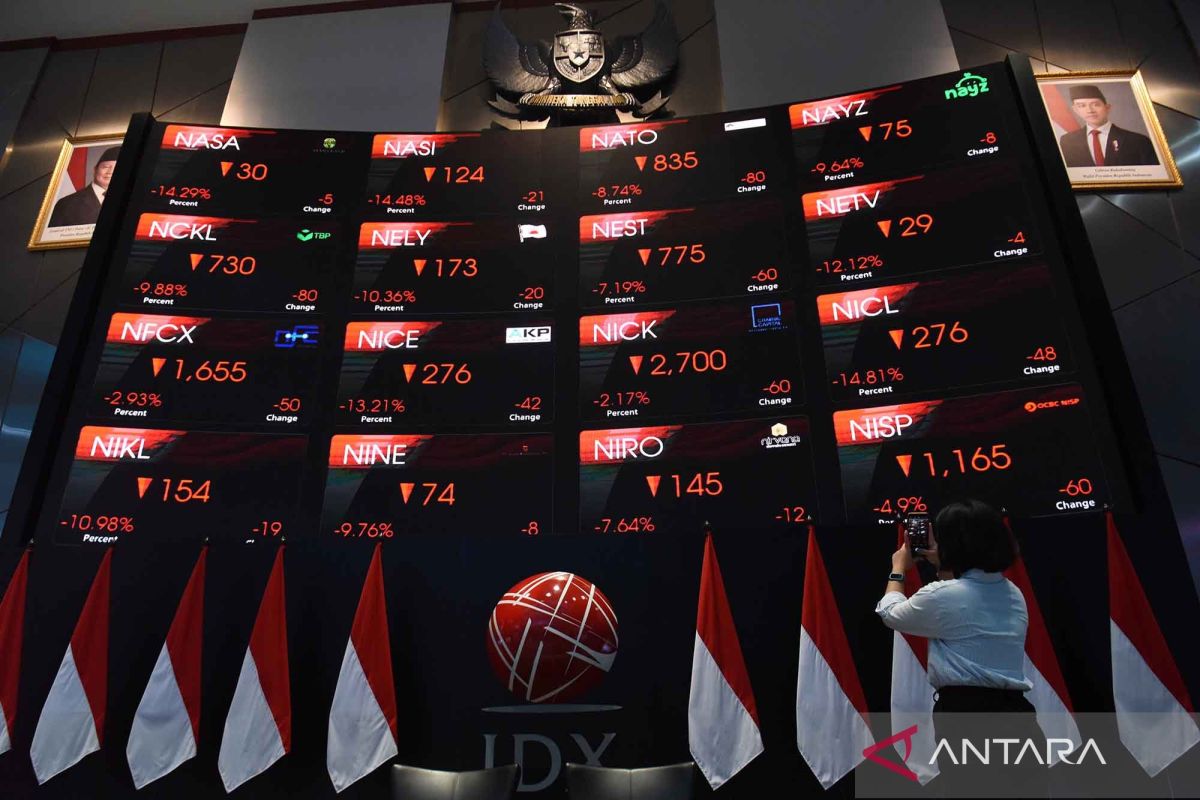
Jakarta (ANTARA) — The Indonesia Stock Exchange’s (IDX) Jakarta Composite Index (JCI) fell on Monday, weighed by the continuing impact of an announcement by global equity index provider Morgan Stanley Capital International (MSCI) that it had opened a consultation on a possible change to the classification of Indonesia’s capital market.
The JCI opened down 223.23 points, or 4.31 per cent, at 4,961.88. The blue-chip LQ45 index fell 28.06 points, or 5.52 per cent, to 480.50.
“As long as the JCI can move back above the 5,326–5,332 area, it has the potential to rebound towards resistance at 5,631. However, if selling pressure continues and the JCI breaks support at 4,999, the index could extend its decline towards 4,471,” said Liza Camelia Suryanata, Head of Research at Kiwoom Sekuritas Indonesia, in a report in Jakarta on Monday.
On Friday (16 October), Indonesia time, MSCI announced that it was consulting global market participants on a proposal to reclassify Indonesia from an Emerging Market to a Standalone Market.
MSCI is accepting feedback on the potential reclassification of the MSCI Indonesia Index until 30 April 2027, and will announce its decision on or before 30 June 2027.
MSCI said market participants’ concerns had risen significantly over the investability of Indonesia’s capital market, including persistent opacity in share-ownership structures and alleged coordinated trading activity.
Although Indonesian capital-market authorities have announced reforms, MSCI said consistent implementation and evidence of a sustained, material impact from those reforms would be necessary.
Domestically, the possibility of a Bank Indonesia (BI) policy-rate increase at its October 2026 Board of Governors meeting remains open, with a 25–50 basis-point rise possible by the end of the year, particularly if pressure on the rupiah intensifies.
Liza said expectations of a US Federal Reserve rate rise, high global oil prices and the risk of currency depreciation were key factors to watch, as they could push up imported inflation and add to pressure on domestic price stability.
“These conditions put BI in the position of having to safeguard rupiah stability while maintaining the momentum of national economic growth,” Liza said.
Meanwhile, BI is promoting stronger international cooperation by expanding the use of local currencies through Local Currency Transactions (LCT), to reduce reliance on third-country currencies and minimise the effects of global exchange-rate volatility.
BI Governor Destry Damayanti made the remarks during meetings of the IMF and World Bank, and the G20 Finance Ministers and Central Bank Governors, held in Bangkok, Thailand, from 12 to 18 October 2026.
Overseas, US economic data showed persistent inflationary pressure, with both consumer price index (CPI) and producer price index (PPI) inflation figures coming in above market expectations.
“That has led market participants to estimate an approximately 85 per cent probability that the Fed will hold rates in October, while the likelihood of a 25-basis-point increase in December is nearly 77 per cent,” Liza said.
At the IMF meetings, Federal Reserve Chair Kevin Warsh gave no clear signal about the prospect of another rate rise, but said that higher-than-expected inflation had not changed his assessment.
Meanwhile, the risk of energy-supply disruption has increased amid escalating security tensions in the Middle East. Iranian attacks on tankers in the Strait of Hormuz reduced daily oil flows to an average of 11.62 million barrels in the week to 13 October, down from a baseline of 17.15 million barrels.
The situation has increased shipping costs and risk premiums for producers transporting oil through the region. Ukrainian drone attacks on Russian refineries have also constrained fuel availability in global markets.
“The combination of distribution disruptions in the Middle East and Russia increases the risk of energy shortages, making oil markets more sensitive to developments in the conflicts and the security of international shipping routes,” Liza said.
European markets broadly rose on Friday (16 October), with the Euro Stoxx 50 up 0.58 per cent, the UK’s FTSE 100 up 0.38 per cent, Germany’s DAX up 0.95 per cent and France’s CAC 40 up 0.28 per cent.
US markets broadly fell on Friday, with the S&P 500 down 1.10 per cent, the Nasdaq Composite down 2.50 per cent and the Dow Jones Industrial Average down 0.34 per cent.
Asian markets were lower in morning trading, with the Nikkei down 1.12 per cent at 64,594.00, the Shanghai Composite down 0.49 per cent at 3,698.96, the Kospi down 0.22 per cent at 5,655.17 and the Straits Times Index down 0.10 per cent at 5,409.95.
The Hang Seng was closed for a Hong Kong market holiday.
Source: jawawa.id (https://jawawa.id/newsitem/jci-falls-on-monday-as-mscis-indonesia-market-classification-review-continues-to-weigh-1792381861)
Originally published by Antara (Indonesian) (https://www.antaranews.com/berita/5795733/ihsg-senin-melemah-imbas-efek-lanjutan-msci-soal-klasifikasi-bursa-ri), translated from Indonesian