
JCI Falls More Than 1%: Here’s Why
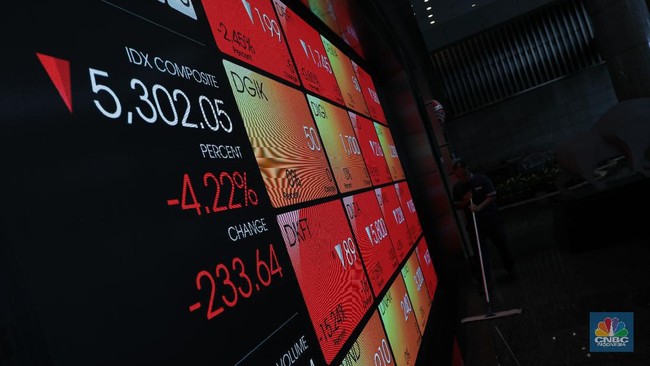
The Jakarta Composite Index (JCI) remained in negative territory midway through the second trading session on Thursday (8 October 2026). At 1.37pm Jakarta time, it stood at 6,083.68, down 63.04 points, or 1.03%. Trading volume totalled 413.83 million lots, with transactions valued at Rp6,424.65 billion.
Refinitiv data showed the decline was led by infrastructure stocks, which fell 2.9%, followed by energy, down 1.6%, and basic materials, down 1.4%.
Among the stocks weighing on the JCI were PT Amman Mineral Internasional Tbk (AMMN), PT Bank Rakyat Indonesia (Persero) Tbk (BBRI), PT Bank Mandiri (Persero) Tbk (BMRI), PT Barito Renewables Energy Tbk (BREN) and PT Bumi Resources Minerals Tbk (BRMS).
Stocks helping to cushion the index’s decline included PT Astra International Tbk (ASII), PT Bank Central Asia Tbk (BBCA), PT Apollo Global Interactive Tbk (APOL), PT Merdeka Gold Resources Tbk (EMAS) and PT Vale Indonesia Tbk (INCO).
Market sentiment on Thursday (8 October 2026) was expected to be shaped by developments in Indonesia’s external resilience and the direction of global monetary policy. Indonesia’s foreign exchange reserves edged down the previous day, although their adequacy remained above international standards; data on Indonesia’s reserve money was also released.
Attention on Thursday turned to minutes from the Federal Open Market Committee (FOMC) meeting, released in the early hours, as well as Indonesia’s consumer confidence report.
A hawkish stance from the Federal Reserve, a surge in the dollar index and high US Treasury yields would put pressure on stock markets and the rupiah.
Minutes from the European Central Bank and US jobless claims would provide further indications of the outlook for interest rates, exchange rates and risk assets.
US Treasury yields fell on Wednesday after strong demand at an auction of nearly US$40 billion in 10-year bonds. The decline followed a rise in yields to levels not seen since 2002.
The 10-year US Treasury yield, an important benchmark for equity markets, briefly reached 5.365% in Wednesday’s trading, its highest level since April 2002.
Yields on longer-dated bonds also rose. The 30-year Treasury yield briefly touched 5.732%, before retreating amid strong auction demand.
The US Treasury Department sold US$39 billion in 10-year bonds at a yield of 5.300%, the highest level this century. Strong demand subsequently helped bring the yield down to around 5.27%. According to Bloomberg, bids totalled 2.77 times the amount on offer.
Indirect investors, including central banks and institutional investors, accounted for 80.34% of demand, while direct buyers accounted for 17.12%, signalling strong interest in the debt.
The 30-year Treasury yield also fell to around 5.65%, in line with strong demand for US government debt.
Rising Treasury yields are a concern for Indonesia because they can increase pressure on emerging-market assets.
Meanwhile, Asian share markets fell on Thursday (8 October 2026), as rising bond yields dampened investor appetite for equities.
Japan’s Nikkei 225 fell 0.4%, South Korea’s Kospi slipped 0.35%, and Australia’s S&P/ASX 200 declined 0.4%.