
JCI Falls Back to the 4,000s as MSCI Concerns Continue to Weigh on Investors
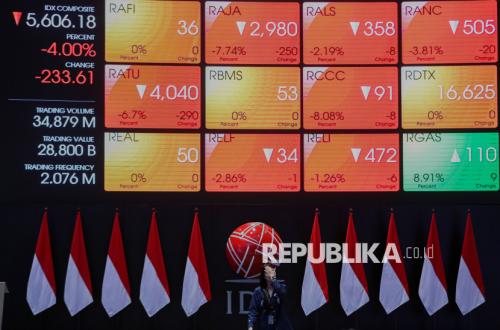
JAKARTA — The Indonesia Stock Exchange’s (IDX) Jakarta Composite Index (JCI) opened lower on Friday (30 October 2026), amid investor concerns over the credibility of the domestic capital market and uncertainty about the direction of US central bank interest-rate policy. The JCI fell 31.12 points, or 0.61 per cent, to 5,066.94 at the open. It soon extended its decline, briefly touching 4,979.34.
Maximilianus Nico Demus, associate director of research and investment at Pilarmas Investindo Sekuritas, said in a market assessment in Jakarta on Friday that the MSCI issue continued to weigh on market participants’ and investors’ confidence.
The pressure had previously been reflected in a 3.49 per cent fall in the JCI. At the same time, bond yields rose to 7.64 per cent.
Domestic financial-market sentiment has also been shaped by concerns that potential foreign capital outflows could put pressure on the rupiah.
Hashim Djojohadikusumo, chair of the Indonesian Chamber of Commerce and Industry’s (Kadin) Advisory Board, previously warned that the rupiah could weaken to Rp 20,000–Rp 22,000 per US dollar if the capital-market issue linked to the MSCI review was not resolved promptly.
“Hashim’s statement about the possibility of the rupiah weakening to Rp 22,000 per US dollar reflects the scale of the risk to investor confidence in the domestic financial market, particularly amid uncertainty over Indonesia’s status in the MSCI indices,” Maximilianus said.
Although Bank Indonesia (BI) Governor Destry Damayanti responded that Indonesia’s economic fundamentals remained relatively sound, investors continued to watch for further rupiah weakness.
“We expect BI’s efforts to support the rupiah to remain a priority, through optimising market intervention and monetary instruments without having to raise the benchmark interest rate immediately,” he said.
Maximilianus said the effectiveness of those policies would also depend on resolving issues around capital-market transparency and governance in order to restore foreign investors’ confidence.
The risk of rupiah depreciation, therefore, is determined not only by external factors but also by the credibility of domestic financial-market reforms.
In addition to domestic sentiment, markets were affected by developments in the US economy, particularly rising inflation, which could influence the Federal Reserve’s monetary-policy direction.
Pilarmas said the US Personal Consumption Expenditures (PCE) price index had risen from 3.4 per cent to 3.6 per cent year on year.
Meanwhile, consumer spending growth slowed from 0.9 per cent to 0.5 per cent.
Rising inflation alongside slower consumer spending has added to uncertainty over the direction of US interest rates. This could put further pressure on global financial markets, including Indonesia’s.
Against this combination of domestic and external factors, Pilarmas expected the JCI to remain at risk of further losses in Friday’s trading. Its technical analysis put support at 4,815 and resistance at 5,185.
Source: jawawa.id (https://jawawa.id/newsitem/jci-falls-back-to-the-4-000s-as-msci-concerns-continue-to-weigh-on-investors-1793335876)
Originally published by Republika (https://ekonomi.republika.co.id/berita/tnpb8l490/ihsg-anjlok-lagi-ke-level-4000an-persoalan-msci-masih-membayangi-investor), translated from Indonesian