
JCI Falls 5.05% by Midday, Sinking Below 5,000
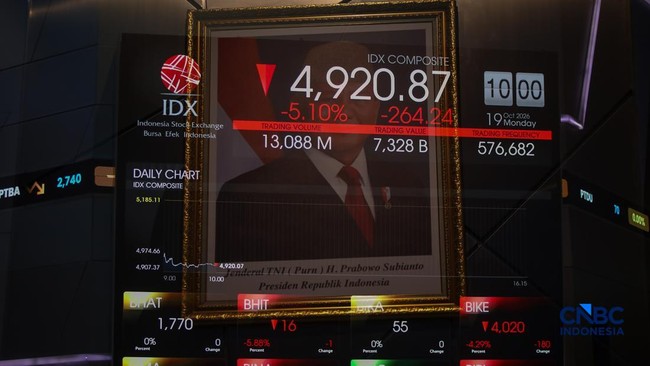
Jakarta, CNBC Indonesia — The Jakarta Composite Index (JCI) ended Monday’s (19 October 2026) first trading session sharply lower. According to Stockbit data, the index stood at 4,923.26, down 261.84 points, or 5.05%, from its previous close of 5,185.11.
Selling pressure was evident from the start of trading. The JCI opened at 4,961.88 and briefly touched its intraday low of 4,907.37. After plunging in the opening minutes, the index moved relatively flat around the 4,920 level through to the end of the session. Its high for the day was 4,974.66, leaving it with a narrow trading range during the first session.
Trading volume reached 159.47 million lots, with transactions valued at Rp9,648.8 billion.
The decline reflected losses in 782 shares, while 138 were unchanged and just 43 rose.
Refinitiv data showed infrastructure stocks fell 6.4%, followed by basic materials, down 6.2%, and energy, down 5.8%.
The stocks weighing on the JCI included PT Bank Central Asia Tbk (BBCA), PT Bank Rakyat Indonesia (Persero) Tbk (BBRI), PT Bayan Resources Tbk (BYAN), PT Telkom Indonesia (Persero) Tbk (TLKM) and PT Amman Mineral Internasional Tbk (AMMN).
Among the shares that limited the index’s decline were PT Pradiksi Gunatama Tbk (PGUN), PT Bank of India Indonesia Tbk (BSWD), PT Bhineka Inovasi Ketahanan Energi Tbk (whose ticker could not be confirmed), PT Guna Timur Raya Tbk (GTRA) and PT Jhonlin Agro Raya Tbk (JARR).
Indonesia’s financial markets are expected to remain under pressure from a range of negative external factors, including the latest MSCI announcement, rising US inflation and conflict.
The markets are also facing continued strain after the JCI’s sharp fall and the rupiah’s weakness at the end of last week. Investors will focus on developments concerning MSCI, enforcement measures by the Financial Services Authority (OJK), and Bank Indonesia’s (BI) interest-rate decision, due this week.
Internationally, renewed Middle East tensions, which have pushed up global oil prices, are also in focus. China is due to release third-quarter 2026 economic growth figures and announce its benchmark lending rates.
Indonesia’s stock market began the new week under heavy pressure. After the JCI plunged by more than 11% last Friday, concerns have emerged that it could fall again on Monday.
The pressure is linked in part to an MSCI announcement that it is considering changing Indonesia’s equity-market classification from Emerging Market to Standalone Market.
The proposal is still under consultation with market participants and is not a final decision. MSCI has invited responses until 30 April 2027, with a final decision to be announced no later than 30 June 2027.
“MSCI will announce its final decision at the end of June 2027 and may provide interim updates on market participants’ feedback during the consultation period,” MSCI said in its announcement, quoted on Friday (16 October 2026).
MSCI said several issues need to be addressed for Indonesia to continue meeting the requirements for emerging-market status. These include transparency over share ownership structures, ease of investor access, and concerns about alleged coordinated stock-trading practices.
Standalone Market is a classification for equity markets placed outside MSCI’s main categories: Developed Markets, Emerging Markets and Frontier Markets.
If Indonesia is moved into that category, domestic shares would no longer be included in the main MSCI Emerging Markets indices, which are widely used as benchmarks by global investment managers.
That could prompt foreign capital outflows, particularly from investors tracking MSCI indices. Reduced inflows could also dampen share-trading activity and add to downward pressure on prices.