
JCI Falls 0.2% to 7,544 as Investors Offload DSSA and BREN Shares
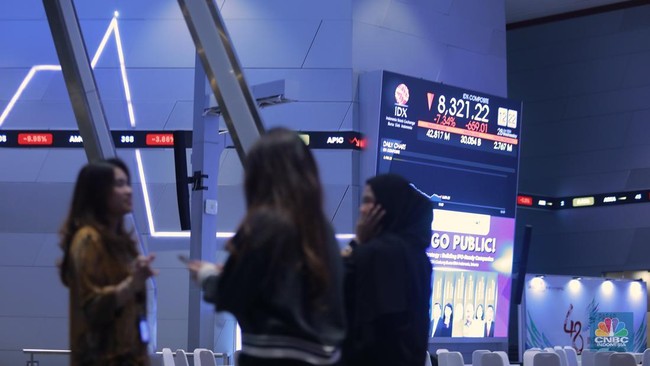
Jakarta, CNBC Indonesia - The Composite Stock Price Index (JCI) weakened again today, Wednesday (22/4/2026). The index fell 15.01 points or 0.20% to the level of 7,544.36 at the end of the first trading session.
402 stocks rose, 253 fell, and 163 remained unchanged. The morning trading value reached Rp 9.25 trillion, involving 26.58 billion shares in 1.67 million transactions. Market capitalisation also declined to Rp 13,387 trillion.
The majority of trading sectors were in the red zone, with the largest corrections recorded in the infrastructure, energy, and property sectors. Meanwhile, the industrial, financial, and primary consumer sectors posted the highest gains today.
Conglomerate issuers weighed on the JCI’s performance today, including issuers from the Barito Group owned by Prajogo Pangestu and issuers from the Sinar Mas Group.
The new coal issuer Dian Swastatika Sentosa (DSSA) became the main drag on the JCI’s performance, contributing a weakening of 26.46 index points. DSSA shares fell 10.79% to Rp 2,480 per share today.
This was followed by Barito Renewables Energy (BREN), which dropped 7.53% to Rp 5,525 per share today and contributed to a weakening of 16.6 index points.
Both issuers are known to have faced significant selling pressure from investors following the MSCI announcement that could result in the removal of BREN and DSSA shares from the MSCI Global Standard index.
Market participants will monitor several market sentiments today, both domestic and international.
Interest rate policies and the impact of the MSCI decision are expected to be the biggest domestic sentiments, while the confirmation hearing for the new Fed Chairman candidate, Kevin Warsh, and developments in the war will be market drivers from abroad.
President Donald Trump officially extended the ceasefire between the United States and Iran on Tuesday local time. Trump reasoned that the Tehran government is currently seriously divided, thus needing additional time to formulate a peace proposal.
Trump stated that the ceasefire, originally ending on Wednesday, will continue until the Iranian leaders submit a unified proposal to end the conflict with the US and Israel.
This move comes amid stalled diplomatic channels. Plans for Vice President JD Vance’s visit to Pakistan for the second round of peace negotiations have reportedly been postponed.
Iranian state media Tasnim News Agency also stated that the Tehran delegation refused to attend further negotiations, deeming that the US is obstructing the achievement of an agreement.
Tensions have not yet subsided. Adviser to the Iranian Parliament Speaker Mohammad Baqer Qalibaf assessed Trump’s decision as merely a tactic to buy time before launching a new attack. He also emphasised that the US Navy’s blockade of Iranian ports is equivalent to a bombing action and warrants a military response.
For global markets, the main focus is now on the Strait of Hormuz, a vital route for world oil trade. Iran previously closed access to the strait at the start of the war. Trump stated that the ceasefire can only hold if that shipping lane is fully opened.
Although the war has not ended, Trump’s decision to extend the temporary ceasefire eases the risk of a new surge in energy prices and global financial market volatility.
Next, there is sentiment from Kevin Warsh, who recently underwent confirmation hearings in the US Senate as the new candidate for Chairman of the US central bank, the Federal Reserve (The Fed). He affirmed that the Fed will remain independent from the White House if he is selected.
Warsh faced questions on monetary policy, his personal wealth, and his closeness to President Donald Trump. If approved, he would become the richest Fed Chairman in history.
Warsh emphasised that he never promised President Trump to cut interest rates if he officially leads the central bank. This statement was made during the confirmation hearing in the US Senate, as global markets focus on the future direction of monetary policy in the Land of Uncle Sam.
Warsh stated that Trump never requested a commitment on interest rate levels, although Trump had previously repeatedly expressed hope that Warsh would lower rates if selected.
Domestically today, Bank Indonesia (BI) will announce its interest rate policy. Market participants expect the central bank to hold its benchmark interest rate at this meeting.
The consensus gathered by CNBC Indonesia from 14 institutions shows a compact result. All respondents project that BI will maintain the BI Rate at 4.75% in this RDG meeting.
In BI’s last RDG in March 2026, BI again decided to maintain the BI Rate at 4.75%. This decision marked the sixth time BI has held its benchmark interest rate consecutively. If maintained again in this April RDG, it would be the seventh time in a row.
In its official statement last March, BI affirmed that the decision was aimed at strengthening the stability of the rupiah exchange rate amid deteriorating global conditions due to the war in the Middle East, while also safeguarding the inflation target achievement.
There is also sentiment from Morgan Stanley Capital International (MSCI), which issued an announcement assessing Indonesia’s capital market reforms on 20 April 2026. This announcement follows up on the previous release on 27 January 2026, when the rebalancing freeze for the Indonesia index was announced.
In the May 2026 index review, MSCI decided to maintain the temporary policy that has been in place for Indonesian securities. That policy includes freezing increases in Foreign Inclusion Factors (FIF) and Number of Shares (NOS), as well as not adding new shares to the MSCI Investable Market Indexes (IMI).
In addition, one of MSCI’s steps consistent with its treatment of similarly identified securities in other markets is to remove securities identified by Indonesian authorities as part of the new High Shareholding Concentration (HSC) framework.
MSCI’s decision