
JCI Ends in the Red, Dropping 1.2% to Level 6,298
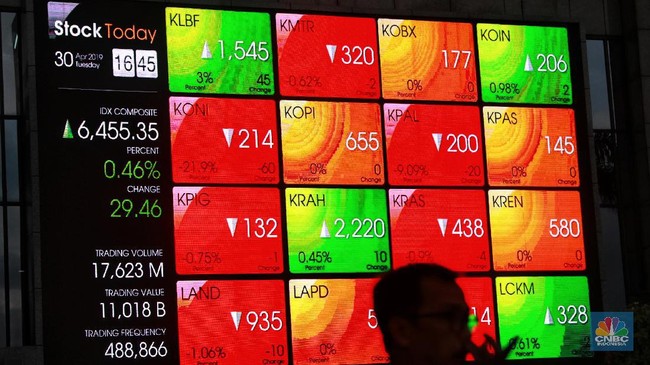
The Indonesia Composite Index (JCI) ended trading on Thursday, 24 September 2026, in the red zone. The index closed at the 6,298.61 level, down 76.31 points or 1.20% compared to the previous close of 6,374.91.
The JCI opened weaker at 6,364.98, approximately 10 points below the previous close. The highest level today was reached at 6,368.57 during early trading, while the lowest level hit 6,287.46.
Throughout today’s trading, only 198 stocks strengthened, 487 stocks weakened, and 278 stocks remained unchanged.
Based on intraday charts, the index fell rapidly a few minutes after the opening. The JCI briefly rebounded to the 6,340 to 6,350 range in the morning but failed to break through previous highs. Selling pressure intensified towards midday and continued into the second session, leading the index to record its daily low.
Afterward, the JCI moved sideways in the 6,290 to 6,310 range until the afternoon, strengthening slightly in the final minutes to hold above 6,300 before closing just below that level. This pattern indicates that selling pressure was quite dominant since the morning, while new buyers appeared only limitedly after the index touched its lowest area.
According to Stockbit data, approximately 25.3 billion shares or 2’53 million lots were traded today, with a transaction value of around Rp9.69 trillion. This volume was about 145% of the average daily volume of 17.44 billion shares, or higher by approximately 7.9 billion shares.
Entering Thursday’s trading, the domestic financial market continues to closely observe the market’s response following Bank Indonesia’s decision to maintain its benchmark interest rate. Additionally, attention is focused on new stock trading regulations and the release of money supply data. From abroad, Chinese President Xi Jinping’s visit to the United States will also be a point of interest. A surge in US Treasury yields and the US dollar index could also present a new ‘storm’ for the JCI.
Domestically, the Bank Indonesia Board of Governors Meeting on 22-23 September 2026 decided to maintain the benchmark interest rate, or BI Rate, at 5.75%. The Deposit Facility rate also remained at 4.75%, and the Lending Facility at 6.50%.
“The BI Board of Governors Meeting on 22-23 September 2026 decided to maintain the BI Rate at 5.75%,” said BI Governor Destry Damayanti during a press conference on Wednesday (23/9/2026).
This decision aligned with the results of a CNBC Indonesia poll of 11 institutions and agencies. Eight respondents predicted the BI Rate would remain at 5.75%, while three others projected a 25 basis point increase to 6.00%.
With this decision, BI has held interest rates steady for three consecutive meetings since July 2026. The BI Rate has remained at 5.75% after being cumulatively raised by 100 basis points throughout May and June. BI raised the rate from 4.75% to 5.25% on 20 May 2026, then subsequently raised it to 5.50% on 9 June and reached 5.75% on 18 June 2026.
Meanwhile, globally, US 10-year government bond yields surged during Wednesday’s (23/9/2026) trading, hitting their highest level in nearly two decades. The surge occurred after economic data showed strong business activity, while simultaneously increasing inflation concerns.
The 10-year Treasury yield jumped 15 basis points to 5.11%, the highest level since 2007. The yield even touched 5.14% during trading.
The rise in the 10-year Treasury yield is significant as it serves as a benchmark for borrowing costs across various economic sectors. When yields rise, costs for mortgages, vehicle loans, and business financing are also pushed higher.
The surge in yields occurred after S&P Global data showed that US business activity in September grew at the fastest rate since July 2021. At the same time, input costs surged due to rising energy prices.
This data reinforces speculation that the Federal Reserve (The Fed) still has room to raise interest rates to curb inflation, particularly because the US economy continues to show strength.
The 30-year Treasury yield jumped 11 basis points to 5.4%, the highest level this year. This figure represents the highest intraday level since 2007 and the highest closing level since 2004.
Furthermore, the 2-year Treasury yield, which is sensitive to Fed policy expectations, rose by approximately 16 basis points to reach 4.9%, the highest since 2024.
The 5-year Treasury yield also broke above 5% for the first time since 2007 following a routine bond auction on Wednesday.
This surge in yields is bad news for Indonesia, as it could trigger an increase in Indonesian Government Bond (SBN) yields and the government’s debt burden.
Source: jawawa.id (https://jawawa.id/newsitem/jci-ends-in-the-red-dropping-1-2-to-level-6-298-1790243822)
Originally published by CNBC Indonesia (https://www.cnbcindonesia.com/market/20260924160839-17-770637/ihsg-parkir-di-zona-merah-merosot-12-ke-level-6298), translated from Indonesian