
JCI edges higher as recovery continues after correction
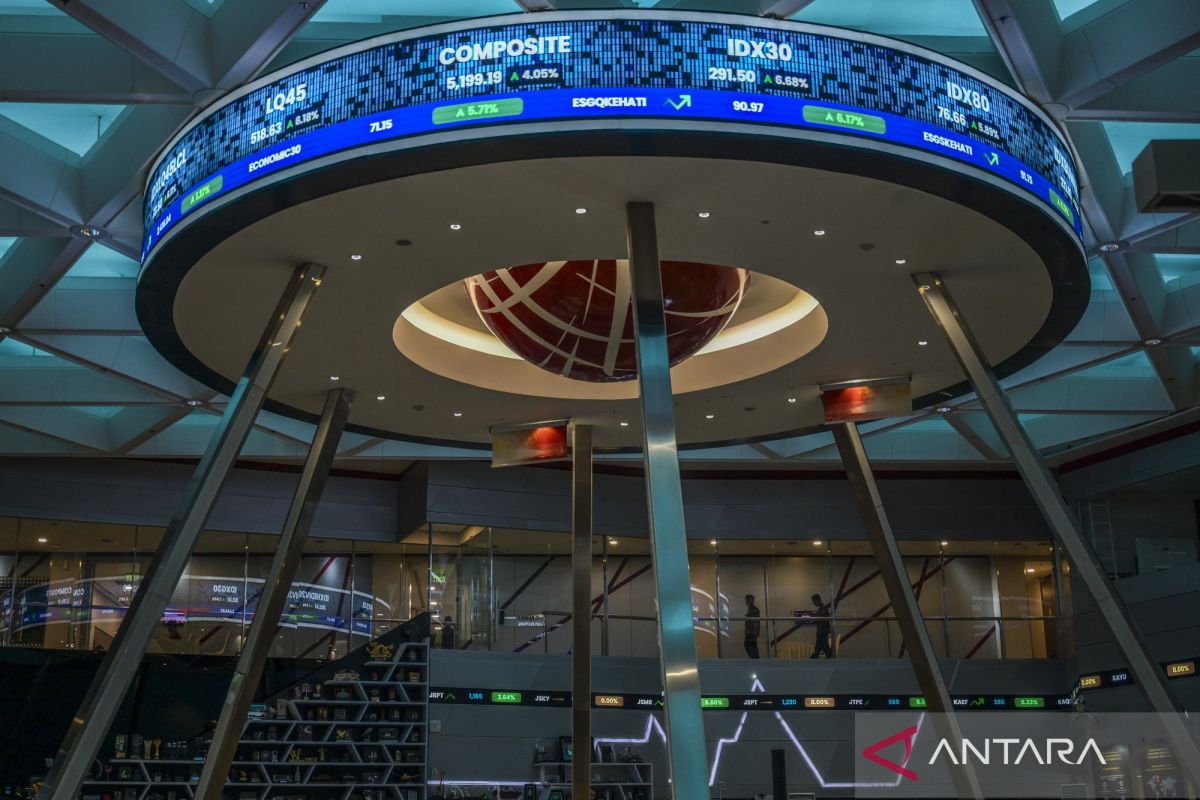
The Indonesia Stock Exchange (IDX) Composite Index (JCI) edged higher on Friday morning, extending its recovery after a significant correction on Friday (16 October) and Monday (19 October).
The JCI opened up 9.44 points, or 0.18 per cent, at 5,397.34. The LQ45 index of 45 leading shares rose 0.56 points, or 0.10 per cent, to 545.13.
“Technically, the JCI could test resistance at 5,400 and, if it holds above that level, could continue to strengthen. The 5,300 level is the nearest support, helping to maintain positive momentum and guard against potential selling pressure. A break below that level could lead to a test of the next support range at 5,180–5,200,” Phintraco Sekuritas Head of Research Ratna Lim said in a note in Jakarta on Friday.
Domestically, the IDX will exclude shares classified as having High Shareholding Concentration (HSC) from its JCI calculation from 2 November 2026. The exchange said there are currently 80 HSC shares, some of which have also been sanctioned for capital-market violations.
The IDX has issued sanction letters to parties that breached capital-market rules, including DSSA, BREN and CUAN.
The exchange had previously adjusted the shares’ lower auto-rejection limit (ARB), making it asymmetric and reducing it from 15 per cent to 7 per cent from 19 October to 31 December 2026.
The IDX also announced an initiative to add information on share affiliations where ownership reaches 1 per cent.
The regulatory measures are intended to respond to MSCI’s announcement that it is consulting market participants on a proposal to reclassify Indonesia’s capital market from Emerging Market to Standalone Market.
Meanwhile, Lim said rising oil prices could add to global inflationary pressure and limit the scope for monetary easing.
“This raises the risk that Bank Indonesia and the US Federal Reserve will keep interest rates high or raise them again, potentially weighing on share and bond markets and increasing financial-market volatility,” Lim said.
She said energy stocks, particularly oil and gas companies, could benefit from higher oil prices, while coal stocks could receive positive sentiment amid growing concerns about global energy supply security.
“However, the impact will still depend on commodity prices and the fundamentals of each listed company,” she said.
Overseas, policy decisions by the Federal Reserve and the Bank of Japan (BOJ) are in focus next week.
Higher energy prices could complicate the Fed’s decisions, as inflationary pressure may limit its ability to ease monetary policy. The BOJ decision will also be watched by investors assessing the direction of Japanese interest rates and the outlook for the yen.
Brent crude rose 4 per cent to US$99 a barrel on Thursday (22 October), amid concerns about escalating tensions in the Middle East.
Reports said the US and Israeli militaries had drawn up plans for renewed strikes against Iran after next month’s midterm elections. New attacks by Iran-backed Houthi forces on energy facilities and airports in Saudi Arabia have also fuelled concerns about possible supply disruptions.
European markets closed broadly lower on Thursday (22 October). The Euro Stoxx 50 fell 1.96 per cent, the UK’s FTSE 100 lost 0.26 per cent, Germany’s DAX declined 1.07 per cent and France’s CAC 40 dropped 1.39 per cent.
Most US markets also fell on Thursday (22 October). The S&P 500 declined 1.21 per cent and the Nasdaq Composite slid 2.60 per cent, while the Dow Jones Industrial Average gained 0.02 per cent.
Asian markets were mixed on Friday morning. The Nikkei fell 1.44 per cent to 62,028.00, the Shanghai Composite declined 1.40 per cent to 3,606.96, the Hang Seng rose 0.07 per cent to 22,950.95, the Kospi fell 2.21 per cent to 5,411.17 and the Straits Times Index gained 0.57 per cent to 5,384.95.