
JCI Drops Further, Rupiah Nears 17,700 Ahead of BI Rate Decision - Jakarta Globe
JCI Drops Further, Rupiah Nears 17,700 Ahead of BI Rate Decision
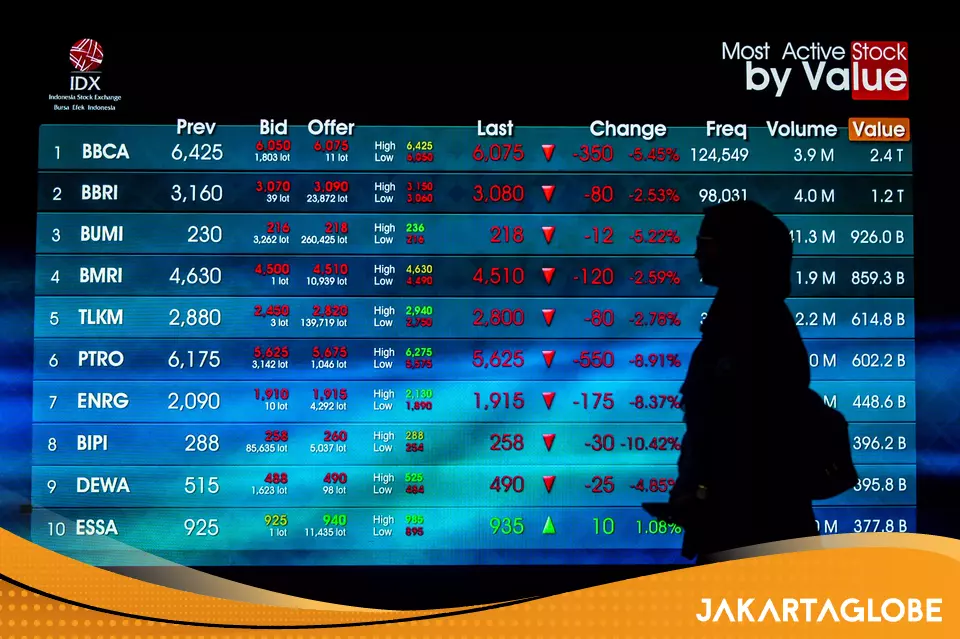
Jakarta. Indonesia’s financial markets extended losses on Tuesday, with equities and the rupiah under pressure as investors positioned ahead of the central bank policy decision and global risk-off sentiment.
The Jakarta Composite Index (JCI) fell as much as 0.5% in early trading to 6,565.3, deepening a rout that saw the benchmark drop nearly 2% on Monday to 6,599. The index has declined about 24% year-to-date, according to RTI data, indicating sustained foreign outflows and fragile sentiment in Southeast Asia’s largest equity market.
The rupiah also weakened, sliding 0.18% to Rp 17,699 per US dollar, extending its depreciation trend as investors remain cautious over external financing conditions and domestic policy signals.
“Pressure on the rupiah continues, approaching 17,700,” said Rully Arya Wisnubroto, analyst at Mirae Asset Sekuritas. He added that the JCI had briefly fallen nearly 5% intraday on Monday to 6,398 before recovering some losses, driven largely by spillovers from global bond market volatility. Foreign investors, however, were seen selectively buying banking blue chips, including BBCA, BMRI, and BBRI, suggesting tactical positioning amid broader outflows.
Markets are now focused on Wednesday’s Bank Indonesia Board of Governors meeting, where economists are divided over the policy path. Consensus expectations point to a 25 basis-point rate hike to 5% to support the rupiah, while Mirae expects the central bank to hold at 4.75%.
Mirae Asset Sekuritas expects Bank Indonesia to keep rates unchanged in what it describes as a “hawkish hold,” arguing that further tightening may have a limited impact given that currency weakness is being driven by seasonal and structural factors rather than purely interest rate differentials.
“These include dividend repatriation flows, seasonal foreign exchange demand linked to the Hajj period, and broader fiscal sustainability concerns that cannot be resolved through monetary tightening alone,” the firm said in a note. It expects BI to rely instead on foreign exchange intervention and liquidity management to stabilize markets.
The government has already signaled additional support for the currency. Finance Minister Purbaya Yudho Sadewa said Monday that Indonesia will inject around Rp 2 trillion ($113.2 million) per day into the domestic bond market to help stabilize the rupiah.
“We have started entering the bond market gradually, so the rupiah should become more stable this week,” Purbaya said after a limited cabinet meeting with President Prabowo Subianto in Jakarta. “I will enter the bond market every day and inject Rp 2 trillion daily.”
He added that the intervention will be financed through cash management rather than new budget allocations, drawing from excess fiscal balances of roughly Rp 420 trillion. The move is aimed at improving sentiment and curbing further capital outflows.
Global markets remain volatile as geopolitical tensions and bond market repricing continue to drive risk appetite. Oil prices swung sharply on Monday amid uncertainty over developments in the Middle East, with Brent crude moving between $112 and below $107 per barrel before settling near $109–$112 levels as investors reacted to shifting signals on potential military escalation involving Iran.
Equity markets in the United States ended mixed. The S&P 500 slipped 0.1%, the Dow Jones Industrial Average gained 0.3%, and the Nasdaq Composite fell 0.5% after a volatile session driven by bond yield movements and energy price swings.
In Asia, Hong Kong’s Hang Seng Index and Singapore’s Straits Times Index rose about 0.5% in early trading, while mainland Chinese markets were weaker, with the Shanghai Composite down 0.15% and Shenzhen falling 1.13%. South Korea’s Kospi led regional declines, dropping about 4%.
Tags: Keywords: