
JCI Drops 1% and US Dollar Nears Rp 18,000, Here Are the Causes
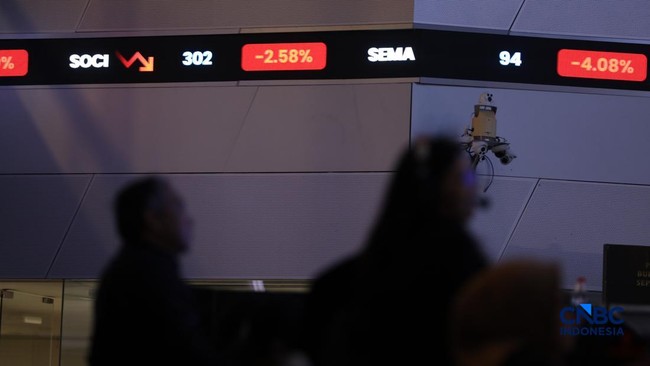
The Indonesian financial markets weakened simultaneously during trading on Monday (28/09/2026). The Jakarta Composite Index (JCI) plummeted by 1.51%, or a correction of 94 points, to the level of 6,147.86 at the close of the second session.
Meanwhile, the Rupiah also faced sharp pressure against the US Dollar, approaching the psychological level of Rp 18,000/US.TheRupiahendedthedayatRp17, 965/US, a depreciation of 0.53%, leaving it just 35 points away from the Rp 18,000 threshold.
On the Indonesia Stock Exchange (IDX), 532 stocks declined, 180 gained, and 81 remained stagnant. Total transaction value was relatively low, reaching only Rp 12.58 trillion, involving 37.37 billion shares across 1.66 million transactions.
According to Refinitiv, all trading sectors weakened, with the deepest corrections recorded in non-primary consumer goods, property, and technology. The energy sector recorded the smallest decline.
Key stocks weighing down the JCI included PT GoTo Gojek Tokopedia Tbk (GOTO), PT Amman Mineral Internasional Tbk (AMMN), and PT Bumi Resources Minerals Tbk (BRMS).
Causes of Rupiah Weakness
The Rupiah’s decline occurred as the US Dollar strengthened against various global currencies. Bank Indonesia (BI) Governor Destry Damayanti assessed that this ‘strong dollar’ phenomenon was primarily triggered by interest rate hikes by the US Federal Reserve.
The Fed recently raised interest rates by 25 basis points to a range of 3.75%-4.00%. BI also anticipates that the US central bank will raise rates once more in the fourth quarter of 2026.
These expectations have made dollar-denominated assets increasingly attractive, pushing the DXY index back above the 101 level. This condition simultaneously increased pressure on other currencies, including the Rupiah.
According to Destry, global monetary tightening is inseparable from persistent high inflation. Global inflation has reached 4.6%, prompting central banks to maintain tight monetary policies.
Inflationary pressures are also driven by rising energy commodity prices due to unresolved conflicts in various regions, particularly the Middle East. Destry noted that oil prices reached US$125.53 per barrel on 24 September 2026, significantly higher than the August 2026 average of approximately US$90.88 per barrel.
High US interest rates have also pressured foreign capital flows. Consequently, BI is directing its monetary policy towards maintaining external stability and the Rupiah’s exchange rate. “Monetary policy will be more pro-stability, while other aspects will be directed towards encouraging economic growth,” Destry stated during a working meeting with Commission XI of the House of Representatives (DPR) on Monday.
Causes of JCI Decline
The JCI’s decline today followed the Indonesia Stock Exchange’s (IDX) decision to remove the minimum trading price for stocks in the regular and cash markets. Starting Monday, 28 September 2026, the minimum stock price, previously set at Rp 50 per share, has been lowered to just Rp 1 per share.
This policy allows stocks that were previously at the Rp 50 level to be traded at lower prices. This change applies to trading mechanisms in both the regular and cash markets.
In conjunction with this, the IDX has also adjusted the Auto Rejection (AR) limits for equity securities and Infrastructure Investment Funds (DINFRA) traded in the regular and cash markets. The primary adjustment is the change in the minimum price from Rp 50.00 to Rp 1.00, accompanied by corresponding adjustments to the Auto Rejection limits.
“With this change, stocks previously at Rp 50.00 can be traded within a wider price range to improve price discovery quality, encourage increased liquidity, and provide flexibility for market participants in managing their investment portfolios,” the IDX stated in an official release.
This regulatory change is governed by two Board of Directors’ Decrees (SK) from the IDX, both issued today and effective as of Monday, 28 September 2026. The Auto Rejection Upper (ARA) and Auto Rejection Lower (ARB) provisions valid until 31 December 2026 will maintain an asymmetric ARB of 15% for equity securities priced above Rp 10. For securities in the Rp 1 to Rp 10 range, the ARA and ARB limits are set at Rp 1. Starting 1 January 2027, ARB provisions will return to a symmetric system based on the price range.
Source: jawawa.id (https://jawawa.id/newsitem/jci-drops-1-and-us-dollar-nears-rp-18-000-here-are-the-causes-1790592838)
Originally published by CNBC Indonesia (https://www.cnbcindonesia.com/market/20260928161806-17-771517/ihsg-anjlok-1-dan-dolar-as-nyaris-rp-18000-ini-penyebabnya), translated from Indonesian