
JCI Closes Stronger by 1.21% to Level 6,192
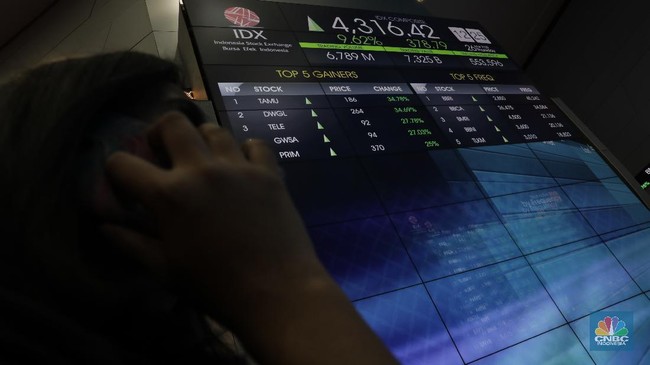
The Indonesia Composite Index (JCI) ended trading on Tuesday (6/10/2026) in the green zone. The JCI stood at level 6,192.93, up 74.07 points or 1.21%.
The JCI opened at level 6,139.13 and briefly touched an intraday low of 6,120.24. The index then moved gradually stronger until reaching a peak of 6,216.44. Towards the end of the session, the index underwent a slight correction from its peak but remained in the green zone until trading concluded.
In terms of trading activity, transaction volume was recorded at 468.95 million lots, with a transaction value reaching Rp10,970.84 billion, or approximately Rp10.97 trillion.
The drivers of the JCI’s rise throughout the day came from the energy sector, which surged by 4.14%, followed by the technology sector, up 2.7%, and the basic materials sector, up 2.2%.
Stocks that acted as levers for the JCI today included PT Bayan Resources Tbk (BYAN), PT Amman Mineral Internasional Tbk (AMMN), PT Mora Telematika Indonesia Tbk (MORA), PT DCI Indonesia Tbk (DCII), and PT GoTo Gojek Tokopedia Tbk (GOTO).
Meanwhile, stocks that pressured the JCI included PT Bank Central Asia Tbk (BBCA), PT Bank Rakyat Indonesia (Persero) Tbk (BBRI), PT Barito Renewables Energy Tbk (BREN), PT Capital Financial Indonesia Tbk (CASA), and PT Sinar Mas Multiartha Tbk (SMMA).
Trading sentiment today originated from both domestic and international sources. Japanese service activity slowed and consumer confidence weakened slightly, while the Eurozone service sector recorded an increase. However, rising producer prices in the region indicate that inflationary pressures have not yet subsided, meaning growth prospects must still be weighed against the risks of monetary policy tightening.
Today, attention shifted to the speech by Bank of Japan (BOJ) Governor Kazuo Ueda and the United States (US) trade balance. Long-term US Treasury yields surged to their highest levels in over two decades on Monday (5/10/2026), as investors scrutinised the latest economic data and awaited the minutes from the September Fed meeting. The 10-year Treasury yield rose 3 basis points to 5.307%, briefly spiking 7 basis points to 5.349%, the highest level since 3 April 2002. Meanwhile, the 30-year Treasury yield rose 3 basis points to 5.661%, after briefly touching 5.703%, the highest level since late May 2002. One basis point is equivalent to 0.01%.
Domestically, the queue of public offerings has become a point of focus regarding corporate funding, while regulations on the transfer of mineral exchange supervision add another important development in financial market restructuring. The OJK (Financial Services Authority) stated yesterday that there are 29 planned public offerings in the queue with a total indicative value of Rp26.47 trillion. Meanwhile, funds raised through public offerings up to September have reached Rp186.03 trillion, with a target of Rp250 trillion for the whole of 2026. This queue indicates that companies are still utilising the capital market as a source of funding. However, the indicative value does not represent realised funds, and public offerings do not entirely refer to equity IPOs.
Source: jawawa.id (https://jawawa.id/newsitem/jci-closes-stronger-by-1-21-to-level-6-192-1791280528)
Originally published by CNBC Indonesia (https://www.cnbcindonesia.com/market/20261006160351-17-773832/ihsg-ditutup-menguat-121-ke-level-6192), translated from Indonesian