
JCI Closes Lower Impacted by Rupiah Weakness and Rising Oil Prices
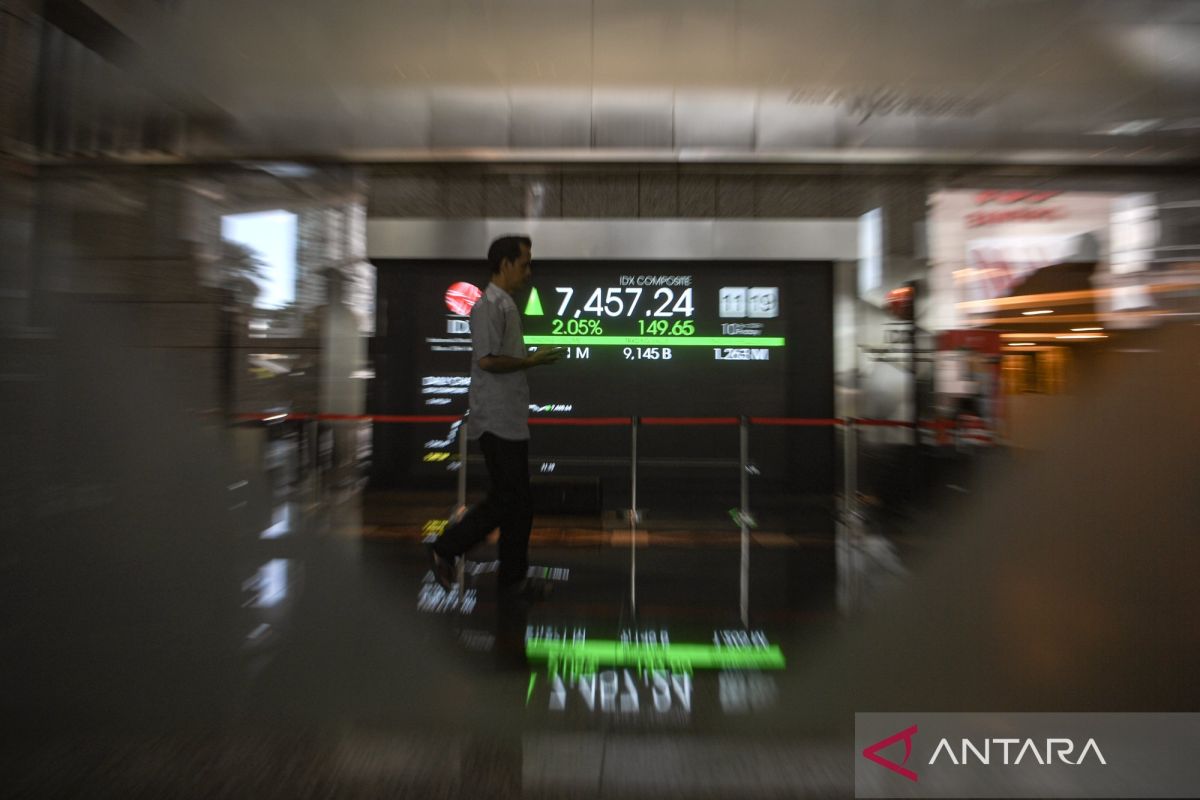
Jakarta (ANTARA) - The Composite Stock Price Index (JCI) of the Indonesia Stock Exchange (BEI) closed weaker on Thursday afternoon, burdened by the weakening rupiah exchange rate and the rise in global crude oil prices.
The JCI closed down 163 points or 2.16% at 7,378.61. Meanwhile, the LQ45 index of 45 leading stocks fell 20.09 points or 2.73% to 715.88.
“Negative sentiment partly stems from the rupiah’s weakening, which briefly touched Rp17,300 per US dollar and closed at Rp17,286 per US dollar in the spot market. This marks the worst closing level for the rupiah ever and the deepest depreciation in Asia,” said Head of Research at Phintraco Sekuritas, Ratna Lim, in her analysis in Jakarta on Thursday.
Domestically, the rupiah’s relatively rapid weakening was beyond market participants’ prior estimates.
Bank Indonesia’s (BI) decision to keep the BI-Rate unchanged for the seventh consecutive time provided limited support, as the rupiah repeatedly hit all-time lows this month.
The pressure was further exacerbated by Indonesia’s reliance on energy imports, despite the recent increase in non-subsidised fuel prices.
BI Governor Perry Warjiyo warned that rising oil prices could widen the current account deficit to 0.5-1.3% of GDP, up from the previous estimate of 0.1-0.9%.
Meanwhile, broad money supply (M2) grew 9.7% year-on-year (yoy) to Rp10,355 trillion in March 2026, accelerating from 8.7% (yoy) growth in February 2026.
This increase was driven by a 14.4% (yoy) rise in M1 circulation and a 5.2% (yoy) increase in quasi-money.
M2 developments were also influenced by net claims on the central government and credit disbursements.
“This is estimated to coincide with Eid al-Fitr in March 2026, leading to increased money circulation for transactions, investments, and consumption,” said Ratna.
From abroad, the prolonged closure of the Strait of Hormuz has kept oil prices high, raising concerns about potential inflation and widening budget deficits.
Opening higher, the JCI moved into negative territory until the close of the first trading session. In the second session, the JCI remained in the red zone until the close of stock trading.
Based on the IDX-IC Sectoral Index, ten sectors weakened, with the non-primary consumer goods sector falling the most at minus 3.18%, followed by the industrials sector and technology sector, each down 2.83% and 2.32% respectively.
Only one sector strengthened: transportation & logistics, which rose 2.42%.
The stocks with the largest gains were KOBX, MAXI, SKBM, WBSA, and PGLI. The stocks with the largest declines were DEFI, BOBA, HOPE, COCO, and KICI.
Stock trading frequency was recorded at 3,079,440 transactions, with 54.16 billion shares traded worth Rp20.49 trillion. 192 stocks rose, 505 fell, and 123 remained unchanged.
Regional Asian stock markets closed lower this afternoon, including the Nikkei index down 442.36 points or 0.74% to 59,143.50, the Hang Seng index down 248.04 points or 0.95% to 25,915.20, the Shanghai index down 13.01 points or 0.32% to 4,093.25, and the Straits Times index down 58.61 points or 1.17% to 4,944.11.