
JCI Closes in Positive Territory, Rising 0.40% to 5,050.43
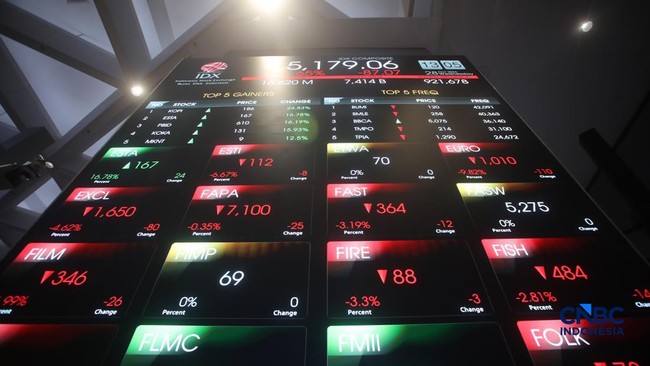
The Jakarta Composite Index (JCI) ended the week’s trading in positive territory on Friday (6 November 2026), closing at 5,050.43, up 20.17 points or 0.40%.
At the open, the JCI fell sharply to 4,955.83. Selling pressure continued until the index reached its intraday low of 4,925.10.
During the first session, the index moved largely sideways between 4,930 and 4,960, with several attempts to rebound that were not strong enough to break above 5,000.
At around 2pm WIB, in the second session, the JCI surged and moved above 4,960. Gains continued towards 4,980 before the index broke through the psychological 5,000 level in the afternoon. It ultimately closed at its intraday high of 5,050.43.
Trading volume totalled 411.29 million lots, with transactions valued at Rp7,765.86 billion, or about Rp7.77 trillion.
Refinitiv data showed that the day’s gains were supported by two sectors: financials, up 2%, and non-cyclical consumer shares, up 1.1%.
The stocks that lifted the JCI included PT Bank Rakyat Indonesia (Persero) Tbk (BBRI), PT Bank Mandiri (Persero) Tbk (BMRI), PT Bank Central Asia Tbk (BBCA), PT Sinar Mas Multiartha Tbk (SMMA) and PT Astra International Tbk (ASII).
Among the stocks that limited the index’s gains were PT Barito Pacific Tbk (BRPT), PT Merdeka Gold Resources Tbk (EMAS), PT Merdeka Copper Gold Tbk (MDKA), PT Chandra Asri Pacific Tbk (TPIA) and PT Bumi Resources Minerals Tbk (BRMS).
Indonesia’s financial markets had been expected to extend their gains on Friday (6 November 2026), after the JCI and rupiah both strengthened the previous day. Investors were keeping a close watch on US political developments following the midterm elections and movements in global oil prices.
Domestically, market participants were monitoring Indonesia’s stronger-than-expected third-quarter 2026 economic growth, the outcome of the Financial Services Authority (OJK) meeting, and the government’s policy direction on investment incentives and tax holidays.
Externally, Wall Street’s sharp decline and technology shares were major concerns. A surge in eurozone producer inflation and the release of the UN Food and Agriculture Organization’s global food price index were also key factors for global financial markets.
Here are some of the key developments and market drivers for investors to watch.
1. Indonesia’s economy grows 5.47%, its fastest since the first quarter of 2026
On Thursday (5 November 2026), Statistics Indonesia (BPS) reported that Indonesia’s gross domestic product (GDP) grew by 5.47% year on year in the third quarter of 2026. This was the fastest rate since the first quarter of 2026, when growth reached 5.61%.
Growth accelerated from 5.29% year on year in the second quarter and exceeded the 5.20% consensus forecast compiled by CNBC Indonesia.
Quarter on quarter, the Indonesian economy grew by 1.59%, below the 3.73% expansion recorded in the previous quarter.
2. Eurozone producer inflation jumps 11.1%, its highest since February 2023
Internationally, market participants were also focused on a surge in producer inflation across the eurozone, signalling mounting price pressures, particularly due to rising energy costs.
According to Eurostat data released on Thursday (5 November 2026), the eurozone Producer Price Index (PPI) rose 11.1% year on year in September 2026.
The figure exceeded market expectations of 10.9% and was the highest since February 2023.
On a month-on-month basis, eurozone producer prices rose 2.5% in September, up from a 2.0% increase in August.
Across the European Union, producer prices rose 10.9% year on year and 2.6% month on month.
3. Bank of England raises interest rates
The Bank of England (BoE) decided to raise its benchmark interest rate by 25 basis points to 4% in November 2026. The decision was taken by a majority of 8-1, in line with market expectations.
It was the first increase since August 2023. One member of the Monetary Policy Committee (MPC), Catherine Mann, wanted a larger 50-basis-point increase to 4.25%.
The BoE said its interest-rate policy was not on a predetermined course. The committee would continue to assess economic data at each meeting and adjust rates as necessary to ensure consumer inflation returns to its 2% target over the medium term.
Source: jawawa.id (https://jawawa.id/newsitem/jci-closes-in-positive-territory-rising-0-40-to-5-050-43-1793958632)
Originally published by CNBC Indonesia (https://www.cnbcindonesia.com/market/20261106151108-17-783037/ihsg-ditutup-di-zona-hijau-menguat-040-ke-505043), translated from Indonesian