
JCI Closes Down 3.49% at 5,098
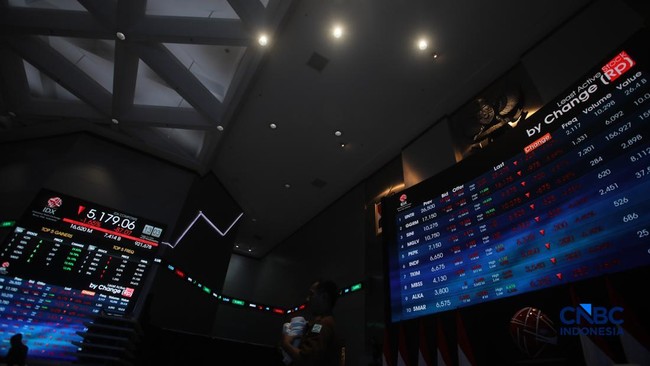
Jakarta, CNBC Indonesia – The Composite Stock Price Index (JCI) ended Thursday’s (29 October 2026) trading in negative territory. It closed at 5,098.06, down 184.26 points, or 3.49%.
The index had opened slightly higher at 5,305.20 and briefly reached around 5,320 early in the session. The gains were short-lived, however. Selling pressure emerged in the morning and sent the JCI sharply lower before 10am Western Indonesia Time (WIB).
From midday through the afternoon, the index traded in the 5,125–5,175 range as pressure continued. It briefly rebounded to around 5,120 towards the end of the session, but fell again in the final minutes to close near its low for the day.
Trading volume reached 217.69 million lots, with a transaction value of Rp10.13 trillion. The sectors weighing on the JCI included utilities, down 5.99%; education services, down 4.60%; and basic materials, down 4.02%.
The shares weighing most heavily on the index were PT Bank Central Asia Tbk (BBCA), PT Astra International Tbk (ASII), PT Bank Rakyat Indonesia (Persero) Tbk (BBRI), PT Telkom Indonesia (Persero) Tbk (TLKM), and PT Bank Mandiri (Persero) Tbk (BMRI).
Among the shares that helped limit the decline were PT Dian Swastatika Sentosa Tbk (DSSA), PT Chandra Asri Pacific Tbk (TPIA), PT Cisarua Mountain Dairy Tbk (CMRY), PT Temas Tbk (TMAS), and PT Bank Ina Perdana Tbk (BINA).
Earlier, pressure on Indonesia’s financial markets was expected to ease after the Federal Reserve held interest rates. However, the release of US PCE inflation data and developments in the war could weigh on shares and the rupiah. A rise in yields on Indonesian government bonds (SBN) was also in focus.
The day’s key market factors included:
- The Fed holds interest rates
The Federal Reserve (Fed) kept its benchmark interest rate at 3.75%–4.00%, although Thursday’s (29 October 2026) decision was not unanimous. Two officials, Lisa Cook and Beth Hammack, supported a 25-basis-point increase.
The Fed said inflation remained high and left open the possibility of further rate adjustments. Fed Chair Kevin Warsh declined to signal the likely direction of the next policy move, stressing that the central bank was still working to bring inflation back to its 2% target.
Warsh also said the US economy was gaining strength, with first-half 2026 growth revised up to 2.4%. However, high interest rates continue to raise borrowing costs and affect investment, including construction of artificial intelligence (AI) infrastructure.
Markets put the probability of a rate increase in December at about 80%. The yield on the 10-year US Treasury rose to 5.042% after the decision was announced.
- US PCE inflation for September 2026
The US was due to release September Personal Consumption Expenditures (PCE) inflation data on Thursday (29 October) at 7.30pm WIB.
In August 2026, PCE inflation stood at 3.4% year on year, while core inflation was 3.0% year on year.
Core PCE inflation, which excludes food and energy, was expected to rise by 0.3% month on month in September 2026, up from 0.2% in August. The annual rate was forecast to increase to 3.1% from 3.0%.
The data are important because PCE is one of the key inflation indicators the Fed uses to guide monetary policy.
- US unemployment claims
The US was also due to announce unemployment claims data for the week ended 24 October 2026.
Initial US jobless claims fell by 6,000 to 194,000 in the week ended 17 October 2026, their lowest level since mid-July and below the market expectation of 200,000, according to the US Department of Labour.
The decline indicated that the labour market remained solid amid economic uncertainty. Strong corporate profits and resilient domestic demand helped contain a wave of redundancies.
However, high energy costs amid the US-Israel war with Iran, uncertainty over Federal Reserve (Fed) interest rates and trade policy were weighing on companies’ hiring decisions.
- ECB interest rates in October 2026
The European Central Bank (ECB) was due to announce its decision at 8.15pm WIB, followed by a press conference at 8.45pm. The consensus forecast was for the main refinancing rate to remain at 2.65% and the deposit facility rate at 2.50%.
Attention was focused on the ECB’s response to inflation risks alongside slowing growth. Any decision to hold rates needed to be considered alongside the accompanying guidance, particularly on the possibility of further tightening and the assessment of energy-cost pressures.
For global markets, a change in the ECB’s tone could affect the euro, European bonds and the dollar’s relative performance. As the announcement was scheduled close to major US data releases, investors needed to consider the two developments together rather than in isolation.