
JCI Closes Down 0.80% at 5,057.05
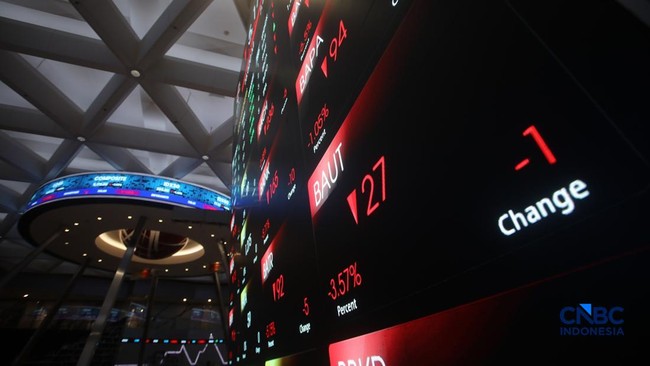
Jakarta, CNBC Indonesia — The Jakarta Composite Index (JCI) closed lower on Friday (30 October 2026). The benchmark index of the Indonesia Stock Exchange (IDX) fell 41.01 points, or 0.80%, to 5,057.05.
Total trading volume reached 351.48 million lots, equivalent to around 35.15 billion shares. Transaction value stood at Rp10.38 trillion.
The JCI fluctuated considerably throughout the day. Although it opened lower, the index briefly surged to around 5,110 in the opening minutes, above the previous day’s close.
The gains did not last. The JCI reversed course and remained under pressure, touching a low of around 4,980 at about 9.40am WIB, down more than 100 points from its intraday high.
The index then gradually recovered and traded in a range of 5,000 to 5,060 for the rest of the session. Shortly before the close, it briefly reached around 5,073 at 3.30pm WIB, before ending slightly lower at 5,057.05.
According to Refinitiv data, the sectors weighing on the JCI included utilities, down 4.85%; basic materials, down 2.72%; and real estate, down 2.22%.
The stocks that dragged on the index included PT Bayan Resources Tbk. (BYAN), PT Bank Rakyat Indonesia (Persero) Tbk. (BBRI), PT Barito Renewables Energy Tbk. (BREN), PT Barito Pacific Tbk. (BRPT) and PT Chandra Asri Pacific Tbk. (TPIA).
Meanwhile, shares that helped limit the JCI’s losses were PT Astra International Tbk. (ASII), PT GoTo Gojek Tokopedia Tbk. (GOTO), PT Bank Central Asia Tbk. (BBCA), PT Perusahaan Gas Negara Tbk. (PGAS) and PT Olympus Strategic Indonesia Tbk. (NATO).
At the end of the week, Indonesia’s financial markets were contending with a packed schedule of news, data releases and events.
Wall Street’s fall, robust US economic data and rising US PCE inflation could prove negative catalysts for Indonesian shares and the rupiah.
In the bond market, the yield on 10-year government bonds (SBN) eased to 7.643% on Thursday, from 7.706% on Wednesday.
The decline in yields indicates that SBN prices have risen as investors have returned to the bonds. Despite the easing, yields remain near their highest level in six years.
Here are some of the day’s market drivers:
- BI will not automatically follow the Fed; Destry prepares measures to support the rupiah
Bank Indonesia (BI) said its decision on the BI Rate in November 2026 would depend on domestic and global economic developments, rather than automatically following the US Federal Reserve (the Fed).
BI Governor Destry Damayanti said the central bank had a range of instruments to respond to economic pressures, including the rupiah’s weakening, which had at one point breached Rp18,100 per US dollar.
Destry said the design of BI’s benchmark rate would remain consistent with developments in Indonesian economic data and global conditions.
- IDX removes five shares from short-selling list, including BBCA and BUMI
The Indonesia Stock Exchange removed five shares from its list of securities eligible for short selling in November 2026. They were PT Bank Central Asia Tbk. (BBCA), PT Bumi Resources Tbk. (BUMI), PT Astra International Tbk. (ASII), PT Barito Pacific Tbk. (BRPT) and PT Indofood Sukses Makmur Tbk. (INDF).
- US PCE inflation rises
The US Personal Consumption Expenditures (PCE) price index rose 0.5% month on month in September 2026. This was its largest increase in six months, following a 0.3% rise in August, and was in line with market expectations.
Goods prices rose 0.8%, up from 0.3% the previous month. The main driver was a 1.1% increase in non-durable goods prices, particularly a 9.2% jump in petrol and other energy products.
The core PCE price index, which excludes food and energy, rose 0.3% month on month. This was its largest increase in four months and matched market forecasts.
The PCE index is a key inflation measure used by the Federal Reserve when setting monetary policy. Inflation measured by this indicator has remained above the central bank’s 2% target since 2021.
- European Central Bank holds interest rates
The European Central Bank (ECB) kept its benchmark interest rates unchanged at its October 2026 meeting, in line with market expectations.
The ECB held its main refinancing rate at 2.65% and its deposit facility rate at 2.50%.
- US economy accelerates
The US economy grew at an annualised rate of 3.4% in the third quarter of 2026, its fastest growth in a year. This was up from 2.2% in the second quarter and exceeded the market forecast of 3.2%.
The largest contribution came from private domestic investment, which surged 19.4%, far above the 4.6% growth recorded in the previous quarter. The increase was driven by strong investment in artificial intelligence (AI).
- BOJ interest-rate decision for October 2026
The Bank of Japan (BOJ) was scheduled to announce its interest-rate decision on Friday. The consensus forecast was for the BOJ to hold its rate at 1.25%, following an increase from 1.00% in September.
Alongside the rate decision, markets would watch the bank’s economic and price outlook, including any changes to growth and inflation forecasts and its assessment of wage and consumption trends.
- Eurozone third-quarter growth and unemployment rate
The eurozone’s preliminary GDP estimate was due on Friday (30 October) at 5pm WIB.
The economy was forecast to grow 0.2% quarter on quarter, slowing from 0.6% in the previous quarter.
Annual growth was projected at 1.1%, down from 1.2%. A sharper slowdown could increase concerns about the regional economy and become an important consideration for the ECB’s policy direction.
The eurozone unemployment rate was also due to be released on Friday at 5pm WIB and was expected to remain at 6.4%.
A stable labour market could support incomes and consumption amid slowing economic growth. Conversely, rising unemployment alongside weaker GDP could heighten concerns about the region’s economic outlook.