
JCI Closes 1.88% Lower Amid Heavy Foreign Sell-Off
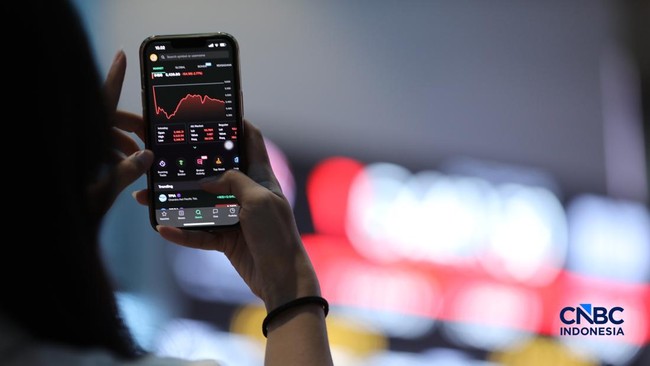
Jakarta, CNBC Indonesia – The Composite Stock Price Index (IHSG) slumped further in Friday’s trading session (24/7/2026), weakening by nearly 2% amid heavy selling in large-capitalisation (big cap) stocks.
External sentiment, in the form of a surge in world oil prices above US$100 per barrel and new tariff policies from United States President Donald Trump, continued to weigh on market movements.
By the close of the first session, the IHSG had plunged 117 points, or 1.88%, to 6,196.43. Of all shares traded, 587 stocks declined, only 104 advanced, while 105 were unchanged.
Transaction value reached Rp 17.71 trillion with a trading volume of 37.84 billion shares across 2.25 million transactions, reflecting intense selling pressure from the start of the session.
The index’s decline was dominated by selling in blue-chip stocks, particularly the banking sector, which had also been targeted by foreign investors’ selling a day earlier.
All sectors weakened, with BMRI, AMMN, BREN, BRPT, BRMS and BUMI shares the main drags on the IHSG’s performance today.
According to Stockbit Sekuritas data, amid the index’s decline, foreign investors also recorded net selling of Rp 759.46 billion across the whole market throughout session I today.
Overall, foreign transaction value in session I reached Rp 6.54 trillion, comprising foreign buys of Rp 2.89 trillion and foreign sells of Rp 3.65 trillion.
The largest foreign selling occurred in the state-owned banking stock, PT Bank Mandiri (Persero) Tbk. (BMRI), worth Rp 386.06 billion. Next was PT Bumi Resources Tbk. (BUMI), offloaded by foreigners to the tune of Rp 142.89 billion, followed by PT Petrindo Jaya Kreasi Tbk. (CUAN) at Rp 123.37 billion.
Foreign investors also sold PT Chandra Asri Pacific Tbk. (TPIA) shares worth Rp 113.07 billion, PT Petrosea Tbk. (PTRO) Rp 55.68 billion, PT Amman Mineral Internasional Tbk. (AMMN) Rp 43.90 billion, and PT Darma Henwa Tbk. (DEWA) Rp 43.49 billion.
Selling pressure was also seen in PT Timah Tbk. (TINS) at Rp 30.17 billion, PT Energi Mega Persada Tbk. (ENRG) Rp 26.34 billion, and PT Dian Swastatika Sentosa Tbk. (DSSA) Rp 25.73 billion.
The pressure was also influenced by increasingly deteriorating global sentiment. US President Donald Trump officially imposed new import tariffs of 10%-12.5% on 60 trading partners, including Indonesia, reigniting concerns over global trade prospects. At the same time, the conflict in the Middle East pushed Brent crude oil prices to surge to US$100.69 per barrel, the highest level in two months. The spike in energy prices heightened worries that global inflation could re-accelerate and increased the likelihood that central banks will keep interest rates higher for longer.
The combination of external pressures and continued selling in banking stocks led market players to reduce their exposure to risky assets, making the IHSG one of the more deeply pressured indices at the start of today’s trading.