
JCI Closes 0.82% Higher at the End of Session I
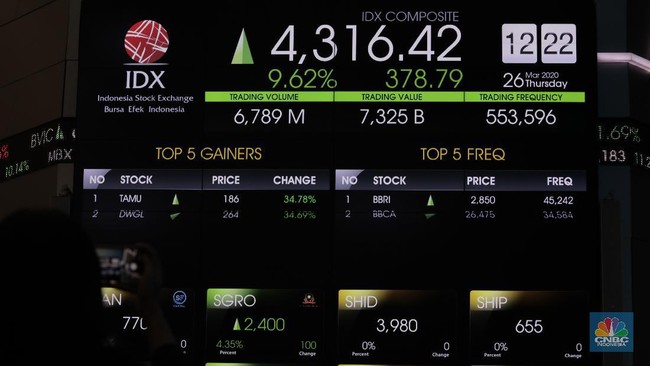
Jakarta, CNBC Indonesia – The Jakarta Composite Index (JCI) ended the first trading session in positive territory, closing at 5,974.29, up 48.31 points or 0.82%.
The JCI opened at 5,940.68 at 9am Western Indonesian Time. After briefly coming under pressure and falling to around 5,920 early in the session, the index rebounded and continued to climb. Shortly before 10.30am, it reached an intraday high of 6,009.96, before retreating and trading between 5,970 and 5,990 towards the end of the session. The day’s low was 5,906.74.
Trading during the first session recorded a volume of about 172.1 million lots, with transactions worth Rp4,771.11 billion, or approximately Rp4.77 trillion.
Pressure on Indonesia’s financial markets was expected to ease somewhat on Wednesday, with the weakening US dollar index and US Treasury yields providing welcome news. However, the volume of economic data due to be released could make markets volatile.
The following factors influenced market sentiment:
- US dollar and Treasury yields weaken in tandem
The US dollar index (DXY) and US Treasury yields both fell on Tuesday, 13 October 2026, as investors followed global market developments and awaited US inflation data.
The dollar index fell 0.37% to 102.18, retreating from an 18-month high. The 10-year US Treasury yield declined by around 2.3 basis points to 5.217%.
The weaker dollar and bond yields were influenced by falling oil prices and easing selling pressure in the bond market. Nevertheless, concerns about inflation caused by high energy prices and the prospect of further Federal Reserve rate rises continued to weigh on markets.
Investors were awaiting US inflation data, due on Wednesday, 14 October 2026, for clues about the Federal Reserve’s interest-rate policy.
Movements in the dollar and Treasury yields are closely watched in emerging markets, including Indonesia, because they can affect foreign capital flows, the rupiah exchange rate and the domestic bond market. A weaker dollar suggests investors are selling US dollar-denominated assets, potentially shifting funds towards emerging markets such as Indonesia.
- IMF revises global growth outlook
The International Monetary Fund (IMF) forecasts global economic growth of 3.1% in 2026, slowing from actual growth of 3.5% in 2025. The projection is nevertheless 0.1 percentage points higher than the estimate in the April 2026 edition of its World Economic Outlook (WEO).
In its October 2026 WEO, released on Tuesday, 13 October, the IMF forecast global growth to rise again to 3.4% in 2027.
Global inflation is expected to increase to 4.7% in 2026 before easing to 4.1% in 2027. The IMF also warned that low-income developing countries face severe pressure from energy price rises triggered by the Iran war. Oil-importing countries with heavy debt burdens have limited fiscal room to shield their populations from the effects of the crisis.
- China inflation
China was due to release its Consumer Price Index (CPI) data for September 2026 on Wednesday, 14 October.
China’s CPI rose 0.8% year on year in August 2026, up from 0.5% in July, which was a six-month low. The increase was driven mainly by higher transport, clothing, healthcare, education and housing costs.
Food prices, by contrast, fell for a fifth consecutive month. Core inflation, which excludes food and energy prices, rose to 1.0% year on year from 0.9% in July. On a monthly basis, consumer prices increased by 0.4% in August, above the market forecast of 0.3% and reversing July’s 0.1% deflation.
China was also due to release producer inflation data for September on the same day.
- China’s trade balance
China was also due to publish its trade data for September 2026 on Wednesday, 14 October. The figures are important for Indonesia, given that China is the country’s largest trading partner.
An increase in Chinese imports could signal stronger demand for Indonesian goods.
China’s trade surplus widened to US$119.09 billion in August 2026, from US$101.01 billion in the same period a year earlier.
Chinese exports surged 25% year on year to US$401.44 billion, following growth of nearly 24% in July. The increase was driven by global investment in artificial intelligence (AI) infrastructure, which continued to boost trade across Asia.
Imports rose 28.2% to US$282.36 billion. This was slightly below market expectations, but above the 27.5% growth recorded in July.
- US inflation
Markets were awaiting a key US release on Wednesday, 14 October 2026: inflation data for September. The figures are among the factors the Federal Reserve considers when setting interest rates. If inflation rises, the Fed is expected to raise rates again soon.
US annual inflation stood at 3.4% in August 2026, unchanged from July and in line with market expectations.
Monthly inflation rose by 0.4%, its highest level in three months, driven mainly by petrol prices.
Core CPI increased by 0.3% month on month, above July’s 0.2% rise and market expectations. However, annual core inflation eased to 2.4% from 2.5%, its lowest level since March 2021.
Source: jawawa.id (https://jawawa.id/newsitem/jci-closes-0-82-higher-at-the-end-of-session-i-1791957028)
Originally published by CNBC Indonesia (https://www.cnbcindonesia.com/market/20261014121006-17-776063/ihsg-ditutup-menguat-082-pada-akhir-sesi-i), translated from Indonesian