
Java's North Coast Condition is Already Dire and Horrific, This Approach Could Be the Solution
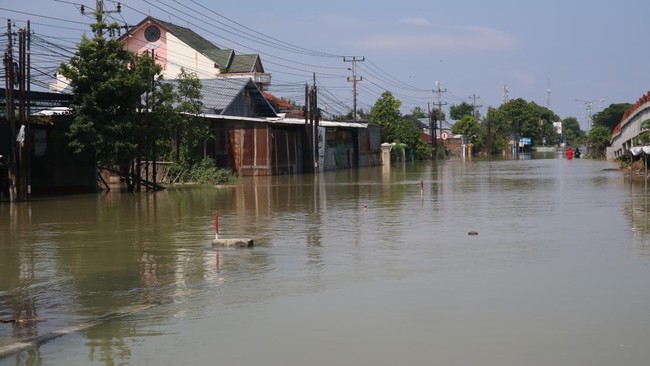
Jakarta, CNBC Indonesia - The National Research and Innovation Agency (BRIN) is preparing a range of flagship technologies as concrete solutions to protect Java’s North Coast (Pantura) from the increasing threat of tidal flooding. There are five technologies currently being developed and refined by BRIN.
BRIN Head Arif Satria explained that these technologies include multifunctional modular upright seawalls and modular concrete blocks designed as coastal protectors with added value, such as wave energy capture and transportation pathways.
He conveyed this during the Kick Off Meeting for Integrated Infrastructure Protection of Java’s North Coast, on Monday (4/5/2026). According to him, mastery of technology by the nation’s own people can be the key to resolving the tidal flooding issue in Pantura while strengthening national technological independence.
In addition, BRIN is developing interlocking protective layer units for breakwaters with an automatic locking system, which is considered more stable and efficient. These protective layer units have been implemented in 11 regions, with the latest development in Nusa Penida in 2025, following previous implementations in Pacitan, Sanur, Tuban, and Nias.
“So this is a form of technology that I think is very important because it has high stability, is more economical, and its production is simpler,” Arif clarified.
Furthermore, BRIN is introducing a sea current platform that enables seawalls and docks to function as independent energy generators.
“We are building seawalls while at the same time harvesting tidal energy,” Arif stated.
Another approach being developed is hybrid eco-engineering. He explained that this approach combines technical engineering and nature-based solutions to strengthen coastal protection while restoring ecosystems.
“This combination can reduce waves, capture sediment, and restore mangroves,” Arif said.
Arif emphasised that the technologies developed by BRIN are ready for implementation and supported by a high level of domestic components. The Domestic Component Level (TKDN) is said to exceed 70%.
Meanwhile, Head of the Java North Coast Management Authority (BOPPJ) Didit Herdiawan Ashaf stated that President Prabowo Subianto has requested that a master plan for protecting the North Coast or Pantura of Java be prepared immediately. Didit said his agency is collaborating with various parties, such as relevant ministries and institutions, universities, and experts, in drafting the master plan.
In this meeting, an MoU was also signed between BOPPJ, the Ministry of Education, Culture, Research, and Technology (Kemdiktisaintek), and BRIN regarding synergy of duties and functions to support the management of Java’s North Coast based on higher education, research, and innovation.
“For the technology, we are assisted by BRIN. With our friends from BRIN, we have discussed for more than six months about the technologies to be used. There are those used from Indonesia itself, domestically, as well as from abroad,” Didit said.
On that occasion, Coordinating Minister for Infrastructure and Regional Development Agus Harimurti Yudhoyono (AHY) underscored the importance of an integrated approach in handling Pantura, both through adaptive infrastructure development and environment-based mitigation measures.
“The Pantura region faces serious threats due to a combination of land subsidence and rising sea levels. These two factors pose real threats that must be addressed immediately through concrete and measurable steps,” AHY stated.
Moreover, the Java North Coast region makes a significant contribution to the national economy, accounting for around 27% of Gross Domestic Product (GDP). Therefore, protection of the coastal Giant Sea Wall area is urgent.
“Considering that around 55 million residents live in 20 regencies and five cities in the Java Pantura region. Meanwhile, about 26% of the population lives in coastal areas. Therefore, this is an urgency that we hope will drive and mobilise everyone,” AHY emphasised.