
Java's First Chinese Regent Rediscovered the Forgotten 'Treasure'
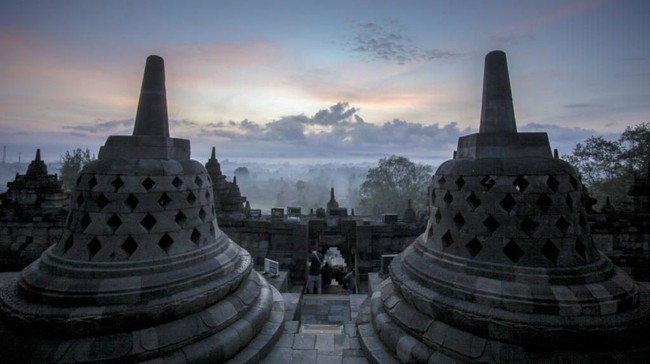
Jakarta, CNBC Indonesia - A Chinese-Indonesian figure played a major role in rediscovering the forgotten ‘treasure’ now known as Borobudur. Tan Jin Sing, the first Chinese regent in Java, provided initial information to the British government about the temple’s existence in the early 19th century. This story begins when the British took control of Java in 1811. During this period, Tan Jin Sing was a prominent Chinese-Indonesian figure close to the British colonial administration and the Yogyakarta Sultanate. His relationship earned him a significant position in the government. As a reward for his support to the Yogyakarta Sultanate and the British, Tan Jin Sing was appointed regent by Raden Mas Surojo, later known as Sultan Hamengkubuwono III. He received the title Raden Tumenggung Secodiningrat, becoming the first Chinese-Indonesian to hold the regent position in Java. Shortly after taking office, the former Chinese Captain converted to Islam and underwent circumcision. He also cut his queue, a traditional Chinese hairstyle. While serving as a government official, Tan Jin Sing frequently assisted Thomas Stamford Raffles with administrative tasks. Around 1813, he informed Raffles that his overseer in Bumisegoro Village had spotted a large temple structure in inland Java. This immediately caught Raffles’ attention, given his interest in Javanese history and ancient structures. At the time, the temple was nearly overlooked by locals, overgrown with weeds and buried under soil. Raffles then asked Tan Jin Sing to inspect the site with local residents familiar with the area. Upon arrival, Tan found the ancient structure in a dire state. Most of the structure was covered in wild vegetation and buried under earth due to prolonged neglect. Local residents accompanying Tan referred to it as Borobudur. ‘Estimated to be over 100 years old,’ Tan said, according to his descendant T.S. Werdoyo in Tan Jin Sing: From Chinese Captain to Yogyakarta Regent (1990). Following the report, Raffles immediately ordered the excavation and initial restoration of Borobudur. The project was assisted by Dutch archaeologist Christian Cornelius, experienced in handling Javanese temples. According to Hanningan’s Raffles and the British Invasion of Java (2015), Raffles’ team, including Tan Jin Sing, Cornelius, and around 200 local residents, began clearing the site by cutting through weeds and slowly excavating the soil. After two weeks of work, Borobudur’s grandeur began to emerge. From then on, the temple, which was nearly forgotten ruins, gradually transformed into one of the world’s most significant historical sites. Waisak Celebration Site Thanks to Tan Jin Sing’s rediscovery, Borobudur has become an annual site for Waisak celebrations. As one of the world’s largest Buddhist sites, it symbolises the spiritual journey of Buddhists. The tiered structure represents stages towards enlightenment, from the world of desire to spiritual perfection. Each year, celebrations begin with rituals involving the sacred flame and holy water, followed by a procession to Borobudur and the release of lanterns symbolising hope, peace, and enlightenment.