
Javanese People's Love for Collecting Gold Surprises Chinese and Europeans
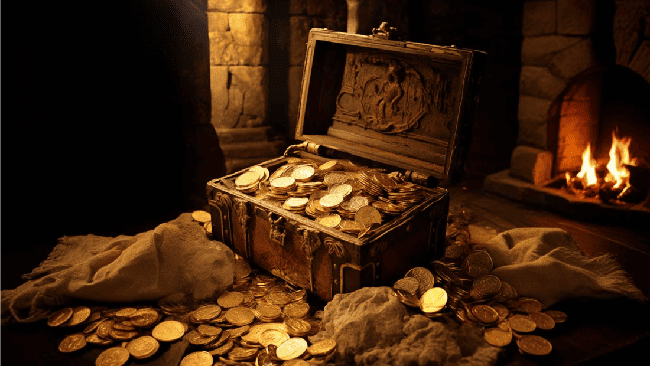
Gold has been a favourite since the time of ancient Javanese society. This trend was not only practised by the royal elite but also permeated the daily lives of ordinary people, to the point of astonishing explorers from China and Europe who visited the Nusantara archipelago. In the past, gold could indeed be obtained easily and cheaply. As a result, this precious item became embedded in the lives of ancient Javanese society. Various records show that in the Majapahit era (1293-1527 AD), for example, nobles often possessed large amounts of gold. Various objects were coated with gold, from carriages to fans. In addition, as explained by Stuart Robson in Desawarna by Mpu Prapanca (1995), the Daha kingdom, contemporary with Majapahit, had similar habits. He highlighted the habit of the daughter of the King of Daha who often used a gold-plated carriage. Then, archaeologist Slamet Mulyana in Menuju Puncak Kemegahan (2012) recounts how gold became a coveted item in the Majapahit era as written by Empu Prapanca in Nagarakertagama. “He wanted to be like Empu Winada who aspired to collect a lot of money and gold,” wrote Prapanca, rewritten by Slamet Mulyana. The fondness for collecting gold was not only for aesthetics but also for trade transactions. Erwin Kusuma in Uang Indonesia: Sejarah dan Perkembangannya (2021) notes that ancient Javanese society commonly used gold in market trade transactions. However, gold transactions were used on a large scale, such as land sales and purchases, not market transactions. The connection between Javanese society and gold often drew attention from foreign explorers. When visiting Java, Chinese explorers were amazed to see kings living luxuriously. As recounted in Nusantara dalam Catatan Tionghoa (2009), those Chinese explorers saw gold scattered around the king. Even when eating, they used gold implements. Meanwhile, European explorer Tome Pires in Suma Oriental (1944) said the same. When visiting Java in 1513, he saw the Javanese king who was very wealthy. His appearance from head to toe was fully adorned with gold. Even the guards and pet dogs wore gold necklaces and bracelets. Although fond of wearing gold, they could not obtain it on the island of Java. Therefore, to acquire it, ordinary residents imported gold from Sumatra, an island known as the ‘Gold Paradise’. Or they could get it from India. Farmer’s Hoe Unearths Gold As time passed, the habit of using gold continued. However, with the fall of ancient kingdoms and the emergence of colonialism, there was a change in lifestyle patterns. At one point, gold jewellery became a buried treasure. The item was hidden underground in unknown places and continued to be the object of treasure hunters. Finally, royal gold was discovered on a large scale in Wonoboyo. The Wonoboyo treasure is now stored in the National Museum, Jakarta. How did it happen? One day, there was a discovery of ‘treasure’ in Indonesia, specifically on the island of Java. A farmer found a pile of gold that later became known as a very valuable treasure discovery. That incident was experienced by a farmer named Cipto Suwarno in 1990. At that time, he was tilling his agricultural land in Wonoboyo Village, Klaten, Central Java. For more than a week, Suwarno worked hard digging his rice field from morning until sunset. He kept hoeing without realising that there was treasure hidden under the ground where he was working. His initial purpose of digging was to repair the irrigation channel disrupted by a project around his rice field. However, on 17 October 1990, when he reached a depth of 2.5 metres, his hoe suddenly hit a hard object. Initially, he thought it was just a stone and pushed it aside. However, when the hard object was lifted, he was immediately stunned. “Gold, gold, gold!!!” shouted Suwarno. How shocked he was to see that the hard object was not a stone, but a ceramic jar wrapped in gold. A crowd immediately gathered. In front of village officials, he continued digging and found a fantastic treasure: 16 kg of gold. “In detail, the found items consist of a bulging bokor, 6 bokor lids, 3 ladles, 1 tray, 97 bracelets, 22 bowls, a tobacco pipe, a large jar, 2 small jars, 11 rings, 7 plates, 8 earrings, a handbag, a keris, beads, and coins,” wrote Tempo (3 November 1990). Suwarno’s discovery was later recorded in history as the Wonoboyo Treasure, which is considered the largest gold archaeological find in history. Archaeologists concluded that the entire treasure dates from the late 9th to mid-10th century. This conclusion was reached because the form of the gold finds matches the era. In the gold bowl, there is a Ramayana relief. Then, on the gold coin, there is the inscription “Saragi Diah Bunga.” Regardless of when and from where the treasure originated, the Wonoboyo Treasure can indicate how Javanese people in the ancient kingdom era of the 9th and 10th centuries, both elites and ordinary people, used gold in daily life. Even long before that time.
Source: jawawa.id (https://jawawa.id/newsitem/javanese-peoples-love-for-collecting-gold-surprises-chinese-and-europeans-1777739535)
Originally published by CNBC Indonesia (https://www.cnbcindonesia.com/market/20260502184843-17-731710/orang-jawa-doyan-kumpulkan-emas-sampai-mengejutkan-orang-china-eropa), translated from Indonesian