
Javanese Farmer Discovers 16 Kg 'Treasure Trove' of Gold: The Story
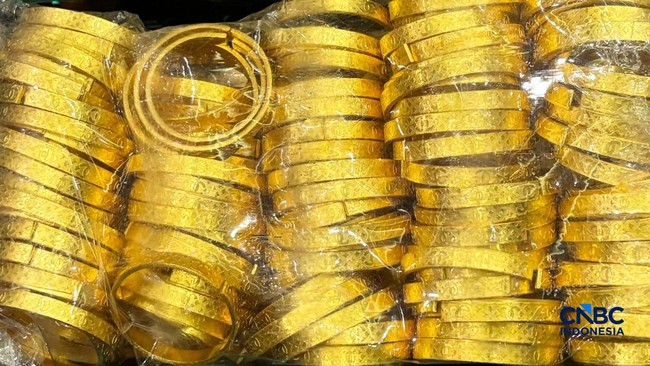
Jakarta, CNBC Indonesia - The people of Wonoboyo Village in Klaten, Central Java, were once shocked by the actions of a farmer named Cipto Suwarno, who accidentally discovered a hoard of gold weighing 16 kilograms. This phenomenal find occurred in 1990 while he was working on his agricultural land.
Initially, Cipto only intended to repair the irrigation channel in his rice field, which had been affected by a construction project nearby. However, when digging to a depth of 2.5 metres, his hoe struck a hard object that turned out to be a ceramic jar containing hundreds of pure gold artefacts from an ancient kingdom.
“Gold, gold, gold!!!,” Suwarno shouted at the time, as reported on the Tempo website (3 November 1990).
He was astonished to see that the hard object was not a stone, but a ceramic jar wrapped in gold. A crowd quickly gathered. In front of village officials, he continued the excavation and discovered a fantastic treasure: 16 kg of gold.
“If detailed, the items found consist of a bulging basin, 6 basin lids, 3 ladles, 1 tray, 97 bracelets, 22 bowls, a tobacco pipe, a large jar, 2 small jars, 11 rings, 7 plates, 8 earrings, a handbag, a kris dagger, beads, and coins,” the website reported.
Suwarno’s discovery was later recorded in history as the Wonoboyo Treasure, considered the largest archaeological gold find throughout history.
Archaeologists concluded that the entire treasure originated from the late 9th to mid-10th century. This conclusion was reached because the form of the gold items matched that era. In the gold bowl, there is a Ramayana relief. Then, on the gold coin, there is the inscription “Saragi Diah Bunga.”
Regardless of when and from where the treasure came, the Wonoboyo Treasure can indicate how Javanese people in the ancient kingdoms of the 9th and 10th centuries, both elites and ordinary citizens, used gold in daily life. Even long before that time.
Javanese People Fond of Wearing Gold
In the past, gold could indeed be obtained easily and cheaply. As a result, the valuable item was embedded in the lives of ancient Javanese society.
Various records show that in the Majapahit era (1293-1527 AD), for example, nobles often possessed large amounts of gold. Various objects were coated with gold, from carriages to fans.
In addition, as explained by Stuart Robson in Desawarna by Mpu Prapanca (1995), the Daha kingdom, contemporary with Majapahit, had similar habits. He highlighted the habit of the daughter of the King of Daha who often used a gold-plated carriage.
Then, archaeologist Slamet Mulyana in Menuju Puncak Kemegahan (2012) recounts how gold became a coveted item in the Majapahit era as written by Empu Prapanca in Nagarakertagama. “He wanted to be like Empu Winada who aspired to collect a lot of money and gold,” wrote Prapanca, rewritten by Slamet Mulyana.
The fondness for collecting gold was not only for aesthetics but also for trade transactions. Erwin Kusuma in Uang Indonesia: Sejarah dan Perkembangannya (2021) notes that ancient Javanese society commonly used gold in trade transactions at markets. However, gold transactions were used on a large scale, such as land sales and purchases, not market transactions.
The connection between Javanese society and gold also often caught the attention of foreign explorers. When visiting Java, Chinese explorers were amazed to see kings living luxuriously. As told in Nusantara dalam Catatan Tionghoa (2009), those Chinese explorers saw gold scattered around the king. Even when eating, they used gold utensils.
Meanwhile, European explorer Tome Pires in Suma Oriental (1944) said the same. When visiting Java in 1513, he saw the Javanese king who was very wealthy. His appearance from head to toe was fully adorned with gold. Even the guards and pet dogs wore gold necklaces and bracelets.
Although fond of wearing gold, they could not obtain it on the island of Java. Therefore, to acquire it, ordinary residents imported gold from Sumatra, an island indeed called the ‘Gold Paradise’. Or they could get it from India.
Over time, the habit of using gold continued. However, with the fall of ancient kingdoms and the emergence of colonialism, there was a change in lifestyle patterns. At one point, gold jewellery then became buried treasure. Those items were buried underground in unknown places and continued to be the object of treasure hunters.
Finally, the kingdom’s gold was discovered on a large scale in Wonoboyo. The Wonoboyo Treasure is now stored at the National Museum in Jakarta.