
Javan Rhino, Krakatau and the Tsunami
By: Azhar, Founder of the Wakaf Forest Conservation Initiative (IKHW)
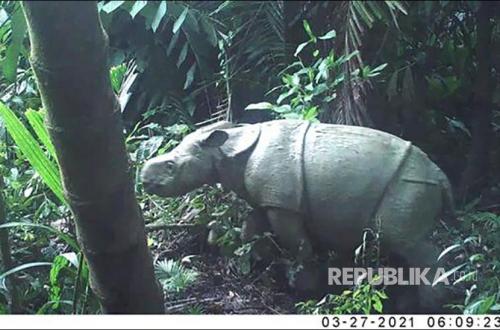
REPUBLICA.CO.ID — In the conservation history of the Javan rhinoceros (Rhinoceros sondaicus), this animal — now one of the most endangered mammals in the world — lives in a landscape that is geologically highly dynamic. Ujung Kulon National Park is not only the last home of the Javan rhino, but also sits in an area facing the volcanic and tectonic activity of the Sunda Strait directly. Behind the tranquillity of the forests and swamps where the rhino forages lies a history of volcanic eruptions, earthquakes, tsunamis, and ongoing landscape change.
The important question is: how did the Javan rhino survive the great eruption of Krakatau in 1883, and can that success guarantee its safety in the face of future disasters? Historical research shows that the Javan rhino did not suddenly reappear after the Krakatau eruption. Before 1883, the presence of rhinos in Ujung Kulon had been recorded in various reports, and observations of the rhino continued after the eruption as well.
The studies by van Strien and Rookmaaker show no evidence that the entire Javan rhino population in Ujung Kulon was wiped out by the 1883 Krakatau eruption; the population subsequently recorded even stood at around 40–50 individuals for most of the period up to 1949 (van Strien & Rookmaaker, 2010).
This fact matters because for years there has been an assumption that the Krakatau eruption actually ‘saved’ the Javan rhino by destroying human settlements and creating new forest. That view needs to be placed on a more scientific footing. Krakatau was indeed a large-scale ecological disturbance that altered the soil, vegetation, and landscape structure of Ujung Kulon. Volcanic ash, substrate changes, and the succession processes following the eruption produced changes in vegetation composition and a habitat mosaic different from pre-eruption conditions (Hommel, 1987).
However, saying that Krakatau saved the rhino is an oversimplification. Rhinos had already lived in the area before the eruption. It is more accurate to say that the Krakatau eruption transformed the landscape, whilst the process of ecological succession, the remoteness of Ujung Kulon, and the subsequent protection of the area shaped the conditions that allowed the rhino population to persist.
Another point often overlooked is that the Javan rhino does not require uniform forest. Research on space use and habitat selection shows that rhinos make extensive use of scrubland, swamps, relatively open habitats, lowland areas, places near rivers and coasts, wallows, and gaps in the vegetation (Santosa et al., 2013). Studies on habitat preference also show a relationship between habitat choice and soil conditions, salinity, and distance from the coastline (Rahmat et al., 2008).
Thus, the ecological history of Ujung Kulon demonstrates that the Javan rhino is able to live in a landscape that has undergone major change. But the ability to adapt to habitat change must not be equated with the ability to withstand catastrophic disasters.
The Ujung Kulon area lies on the western side of Java, facing the tectonic zone of the Sunda Strait directly. The area sits close to a subduction system capable of producing earthquakes and tsunamis. Indeed, the tsunami of 22 December 2018 provided concrete proof that the region does not merely carry a theoretical risk. The 2018 tsunami was triggered by an underwater landslide linked to the activity of Anak Krakatau, not directly by a major tectonic earthquake (Widiyanto et al., 2020).
Source: jawawa.id (https://jawawa.id/newsitem/javan-rhino-krakatau-and-the-tsunami-1788762199)
Originally published by Republika (https://analisis.republika.co.id/berita/tkz9q8483/badak-jawa-krakatau-dan-tsunami), translated from Indonesian