
Java Volcano Erupts, Killing 341; Resident Found Dead in Prayer
Jakarta, CNBC Indonesia – Mbah Maridjan took a different approach when Mount Merapi began showing signs of an impending eruption. Rather than join the evacuation, the volcano’s traditional guardian chose to stay. He even rejected a request from Sultan Hamengkubuwana X to leave the area he had long watched over.
His decision was rooted in his belief in the task entrusted to him by Sultan Hamengkubuwana IX, the father of Hamengkubuwana X. He had been asked to look after Merapi and, as its guardian, did not want to abandon that duty. The evacuation request was therefore not enough to persuade him to leave.
For Mbah Maridjan, Merapi also meant more than a volcano that could erupt at any time. It was part of the lives of the communities around it.
“Merapi kuwi mbangun,” Mbah Maridjan said, meaning “Merapi builds”, according to the account ‘The Animal That Laughs at Itself: False Alarms about the End of “Man”’.
That belief meant he did not want to leave Merapi, even for a moment. It seemed vindicated in 2006, when the volcano again showed increased activity: Mbah Maridjan refused evacuation and stayed on its slopes. He survived because the wind carried the pyroclastic flow cloud away from where he was.
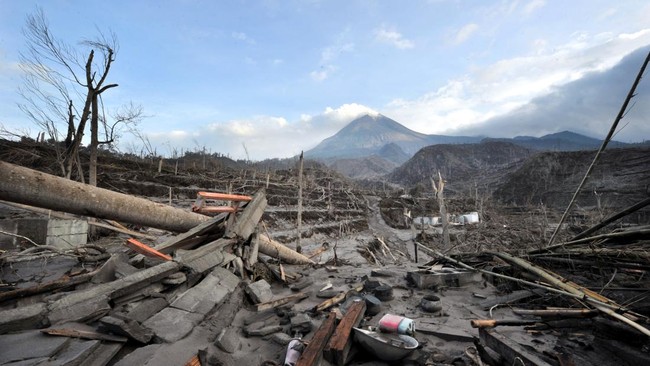
Four years later, the situation was different. On 26 October 2010, pyroclastic flows swept through Kinahrejo, where Mbah Maridjan lived on Merapi’s southern slopes. The guardian died alongside dozens of other victims. He was found dead in a prostrating position, ending his life in the area to which he had devoted himself.
Merapi’s eruption peaked in early November
Indonesia was stunned when Mbah Maridjan was found dead. But the volcano’s activity had not yet reached its peak. Merapi subsequently entered a much more explosive phase of eruption.
The eruption triggered pyroclastic flows down the southern slopes. Rapid magma movement and changes to the lava dome also helped make the volcano’s activity more dangerous.
The peak came on the night of 4–5 November 2010. An ash column rose about 17 kilometres into the atmosphere, while pyroclastic flows travelled around 15–16 kilometres along the Kali Gendol valley. This was far beyond the reach of the initial phase of the eruption, expanding the area at risk.
The National Disaster Mitigation Agency (BNPB), in its report ‘Indonesian Disaster Data 2010’, said the scale of the eruption led the government to extend the danger zone to a radius of 20 kilometres. Hundreds of thousands of residents had to leave their homes to avoid pyroclastic flows and volcanic material. The sequence of eruptions was recorded as one of Merapi’s most powerful in more than a century.
The BNPB recorded 341 deaths, 368 people treated in hospital and 61,154 evacuees. Material losses were estimated at Rp4.23 trillion, including damage to 3,307 buildings.
After the major 2010 eruption, Mount Merapi experienced another magmatic eruption on 11 August 2018, which continued until September 2019. Activity continued with a series of explosive eruptions in 2020, before the volcano entered an effusive phase in January 2021, marked by lava-dome growth, lava avalanches and pyroclastic flows.
Although an eruption on the scale of 2010 has not recurred, Merapi remains an active volcano that requires vigilance. Its activity continues to be monitored to anticipate threats to communities living on its slopes.