
Java, Sumatra and Kalimantan Were Once Connected: Ancient Human Migration Routes Revealed
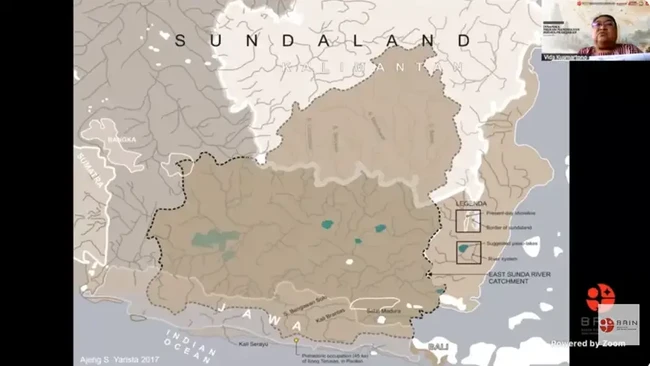
The National Research and Innovation Agency (BRIN) has revealed that ancient river networks in the Sunda Shelf were likely the primary migration routes for early modern humans moving through Southeast Asia during prehistoric times.
“Geomorphological and paleogeographical research shows that the Sunda Shelf during the Pleistocene had major river systems now submerged due to rising sea levels,” explained Vida Pervaya Rusianti Kusmartono, a researcher at BRIN’s Centre for Prehistoric and Historical Archaeology Research (PR APS), during a webinar for the Kebhinekaan Forum Series #36 on ‘Dynamics of Prehistoric Human and Cultural Migration’.
She noted that these ancient river networks likely served as ecological corridors facilitating the spread of prehistoric humans into inland areas and Wallacea.
“Prehistoric human mobility likely did not solely follow coastal routes but also utilised ancient river systems as migration pathways,” she stated in her study titled ‘Kalimantan: Human Migration in the Eastern Sunda Shelf during the Late Pleistocene to Early Holocene’.
Vida explained that modern human migration from Africa to Southeast Asia did not occur in a single wave but through prolonged stages and diverse routes. She mentioned the coastal migration theory, which posits that humans moved along coastlines offering abundant food sources and easier mobility compared to inland regions.
“During glacial periods, sea levels dropped, forming extensive landmasses connecting Southeast Asian regions. This enabled human, flora, and fauna movement across the Sunda Shelf,” she added.
She added that the eastern Sunda Shelf held strategic importance as a corridor to Wallacea and Sahul (Australia-Papua). Archaeological sites in Kalimantan indicate the presence of modern humans around 45,000 to 30,000 years ago, evidenced by stone tools, faunal remains, and cave dwelling findings.
However, Vida acknowledged that early human migration research in Southeast Asia faces significant challenges, particularly due to the tropical climate which hinders fossil preservation.
“High soil acidity accelerates bone and collagen degradation, complicating absolute dating processes,” she explained.
As a solution, BRIN continues to advance research through geophysical surveys, sediment analysis, and modern dating methods to obtain more accurate data on prehistoric human migration in the Sunda Shelf region.
In his remarks, Herry Yogaswara, Head of BRIN’s Archaeology, Language, and Literature Research Organisation (OR Arbastra), stated that this topic is crucial for understanding the early dynamics of human civilisation in the Nusantara region.
As a concrete commitment, he affirmed BRIN’s focus on human evolution and dispersal studies in Southeast Asia, including the establishment of the Centre for Human Evolution, Adaptation, and Dispersal in Southeast Asia (CHEADSEA), which has received formal recognition from UNESCO.
“Through academic forums and research institutions like this, we hope to generate new insights and strengthen collaboration in prehistoric human migration research,” Herry said.