
Java Shaken by Five Earthquakes Today, Expert Issues Reminder
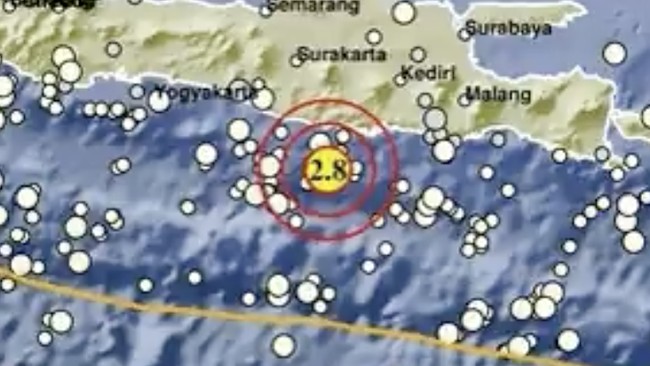
The Meteorology, Climatology and Geophysics Agency (BMKG) reported that at least five earthquakes shook the island of Java on Monday (20/7/2026).
The first, a magnitude 2.8 tremor, struck 66 kilometres southeast of Pacitan, East Java, at 09:26:32 WIB, with a depth of 20 kilometres. This was followed by a magnitude 3.7 earthquake at 10:18:56 WIB, located 72 kilometres southwest of Bayah, Banten, at a depth of 16 kilometres.
A third tremor, measuring magnitude 2.9, occurred at 12:40:01 WIB, 39 kilometres southwest of Sumur, Banten, at a depth of 27 kilometres. A magnitude 2.8 earthquake then struck 116 kilometres southwest of Jembrana, Bali, at 13:03:34 WIB at a depth of 24 kilometres. The fifth and final earthquake recorded by BMKG was a magnitude 2.9 tremor centred 74 kilometres southeast of Pangandaran Regency, West Java, at a depth of 58 kilometres, occurring at 14:34:39 WIB.
Daryono, an earthquake expert and member of the Indonesian Association of Disaster Experts (IABI), explained that minor and micro-earthquakes are not merely fleeting vibrations to be dismissed.
‘From a seismological perspective, low-amplitude tremors store vital structural information regarding the dynamics of the Earth’s crust beneath our feet,’ he told CNBC Indonesia. ‘Each release of micro-energy provides a precise picture of the existence and activity level of fault zones.’
Daryono explained that faults or subduction zones that frequently release small earthquakes indicate the zone is experiencing shear weakening and is in an active deformation phase. The mapping pattern of epicentres and hypocentres from these small earthquake clusters helps seismologists accurately map fault geometry, determine the direction of shift, and detect ongoing tectonic stress accumulation along fault lines.
Furthermore, he added, a series of small earthquakes can act as foreshocks before a mainshock. The gradual release of seismic waves on a small scale indicates microfracturing in rocks at depth, which are becoming increasingly brittle under tectonic pressure.
‘Although small earthquakes are often considered a form of gradual energy release, the accumulation of large-scale tectonic energy in locked zones still has the potential to trigger severe shaking in the future,’ Daryono stated. He stressed that understanding and monitoring small earthquakes is a fundamental key in seismic engineering and seismic hazard mapping. ‘Information on the wave spectrum and frequency levels from small vibrations helps engineers measure local site effects and wave amplification, which is crucial for design.’