
Java Island Gas Pipeline Connected, But Supply Falls Short
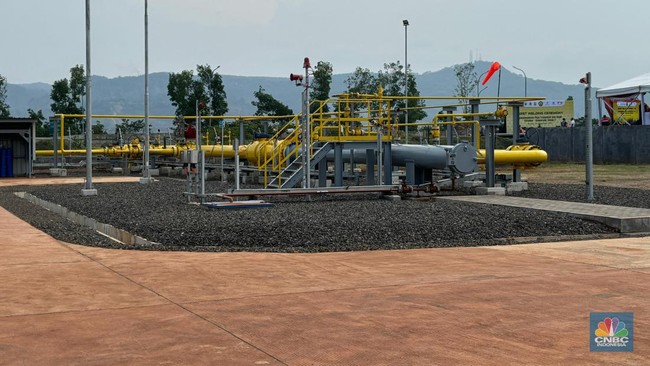
The Ministry of Energy and Mineral Resources (ESDM) has completed the construction of the Cirebon-Semarang (Cisem) natural gas transmission pipeline Phases I and II. This means the gas transmission pipeline across Java, from East Java via the Gresik-Semarang (Gresem) gas transmission pipeline to West Java, is now connected.
Unfortunately, the completion of this natural gas infrastructure has not been matched by sufficient gas supply to meet demand on Java.
Director General of Oil and Gas at the Ministry of Energy and Mineral Resources Laode Sulaeman acknowledged that the gas supply that can be channelled through the Cisem gas transmission pipeline is not yet optimal.
He explained that Java is currently experiencing a gas deficit. According to records from the Directorate General of Oil and Gas, there is a gas deficit in Central Java and East Java due to reduced gas supply from several fields in the Madura Strait working area.
Therefore, his office is seeking additional gas supply, including from Lengo, managed by Kris Energy, Bukit Panjang, managed by PCK2L, and others.
“We are all still working to ensure that gas utilisation in East Java can be optimally channelled for the Cisem I and Cisem II pipelines. This certainly requires discussions and optimisation, so that it does not conflict with the increasing gas demand in the eastern part of Java,” he explained during a hearing with Commission XII of the Indonesian House of Representatives in Jakarta, as quoted on Thursday (27/8/2026).
According to records from the Directorate General of Oil and Gas as of July 2026, the gas deficit in Central Java and East Java averaged around 100-125 MMSCFD.
In January 2026, gas supply was recorded at “only” 563.01 MMSCFD, lower than the demand of 674.19 MMSCFD. As a result, there was a gas deficit of around 111.18 MMSCFD.
The largest gas supply deficit was recorded in February 2026, with a shortfall reaching 276.79 MMSCFD, when available supply was only 473.64 MMSCFD to meet demand of 750.43 MMSCFD.
In July 2026, the gas deficit reached 104.16 MMSCFD, as out of a demand of 753.89 MMSCFD, available gas supply was “only” 649.73 MMSCFD.
The gas supply shortage is also projected to continue until the end of 2026. In December 2026, gas supply is estimated to be “only” 634.02 MMSCFD, lower than the demand of 760.63 MMSCFD. As a result, the gas deficit in December 2026 is estimated to reach 126.61 MMSCFD.
“If there is a gap or shortfall, we have also received adequate information, particularly from SKK Migas, on how to cover the gas shortage in that pipeline section. However, this is still in the form of potential for future utilisation,” he added.
“The Directorate General of Oil and Gas together with SKK Migas will make the necessary arrangements, but the shortfall can be covered by the additional potential from the areas shown in this slide,” he continued.
To address the gap, the government has prepared a strategy through seeking additional supply from new sources such as Lengo, managed by Kris Energy, Bukit Panjang, managed by PCK2L, the ENC field managed by PT Energi Mineral Langgeng, TIS Blora Phase 2, Pertamina EP Asset 4, the Paus Biru field managed by Medco Sampang, West Sidayu by SIPL, the MBF and MDK fields by Husky-CNOOC Madura Ltd (HCML), and others.
In the long-term plan for the 2027 to 2035 period, the potential for additional natural gas supply in East Java and Central Java is projected to increase gradually. The highest increase in natural gas production is projected to occur in 2030 to 2031.
The government has mapped a number of potential fields ready for development in East Java and Central Java. The main contributors that will form the backbone of the additional supply are the Lengo-Kris Energy field, projected to contribute 84.49 MMSCFD starting in 2030, and the Bukit Panjang-PCK2L field, which will provide a stable contribution of up to 50 MMSCFD in the 2032-2033 period.
Meanwhile, national natural gas utilisation in the first half of 2026 was recorded at 5,327.72 BBTUD, with domestic use accounting for 74.55%.
Overall, average natural gas production from January to July 2026 stood at 6,544 MMSCFD, with the industrial and electricity sectors being the largest domestic consumers of this clean energy.
In addition to the Cisem pipeline, the government is currently building the Dumai-Sei Mangkei (Dusem) gas transmission pipeline. This 541 km gas transmission pipeline project is targeted for completion in 2028.
Once completed, Indonesia will soon have a natural gas transmission pipeline network connected from Aceh to East Java.
Laode said that construction of the Dusem transmission pipeline has currently reached around 30%.
“And once this pipeline is connected, the major transmission pipeline from Aceh to East Java for natural gas will be available, and gas delivery patterns can be carried out at every point where these pipelines are located,” he said.
Based on data from the Ministry of Energy and Mineral Resources, the Dusem gas transmission pipeline project requires an investment of around Rp 2 trillion. The project is divided into two segments, namely:
Segment 1 (SKG Belawan - St. Labuhan Batu), where physical construction of the pipeline has now reached 39.34%.
Segment 2 (St. Labuhan Batu - Duri), where physical construction has reached 36.39%.
Source: jawawa.id (https://jawawa.id/newsitem/java-island-gas-pipeline-connected-but-supply-falls-short-1787831481)
Originally published by CNBC Indonesia (https://www.cnbcindonesia.com/news/20260827154603-4-762805/pipa-sepulau-jawa-sudah-tersambung-tapi-pasokan-gasnya-kurang), translated from Indonesian